
Ray Tomlinson was sitting in a beige office at Bolt Beranek and Newman in Cambridge, Massachusetts, in front of two refrigerator-sized mainframes pushed close enough together that he could swivel between their teletypes. The two machines were already connected to ARPANET, the Pentagon-funded research network that would eventually become the internet. He was not working on email. He was, in the words of his employer’s spokeswoman years later, just fooling around with a file-transfer program and a local messaging tool, wondering what would happen if he stitched them together.
He typed a string of characters into one machine. He addressed it to himself on the other. He pressed send. The message travelled through ARPANET, a journey of perhaps fifteen feet, and arrived on the second machine. The content, Tomlinson later said, was entirely forgettable, most likely a run across the top row of his keyboard: QWERTYUIOP.
And to glue the username to the destination machine, he reached for the only character on the keyboard that could not possibly appear inside a person’s name.
The @ sign.
The room where it happened
Bolt Beranek and Newman, known to everyone in computing as BBN, was a consulting firm with Defense Department contracts and a culture closer to a graduate physics lab than a corporation. Tomlinson had joined in the late 1960s after completing his education. By late 1971, BBN had been working with ARPANET, and Tomlinson had been writing low-level systems software, including parts of the network’s own plumbing.
The two machines in his office ran an operating system that supported multiple users. Each had its own users. Each already had a small local mail program that let people on the same machine drop notes into each other’s mailboxes, the way office workers in the same building might leave memos in pigeonholes down the corridor. What did not exist was a way to leave a memo in someone’s pigeonhole on a different machine in a different city.
Tomlinson had been working on a utility for shoving files across ARPANET from one host to another. The question that nagged at him was small and practical: what if a file being shoved across the network were appended to a mailbox file instead of overwriting it? A message on one computer could land in a mailbox on another. The mechanism was almost embarrassingly simple. The implications were not.
Why the @ sign, and nothing else
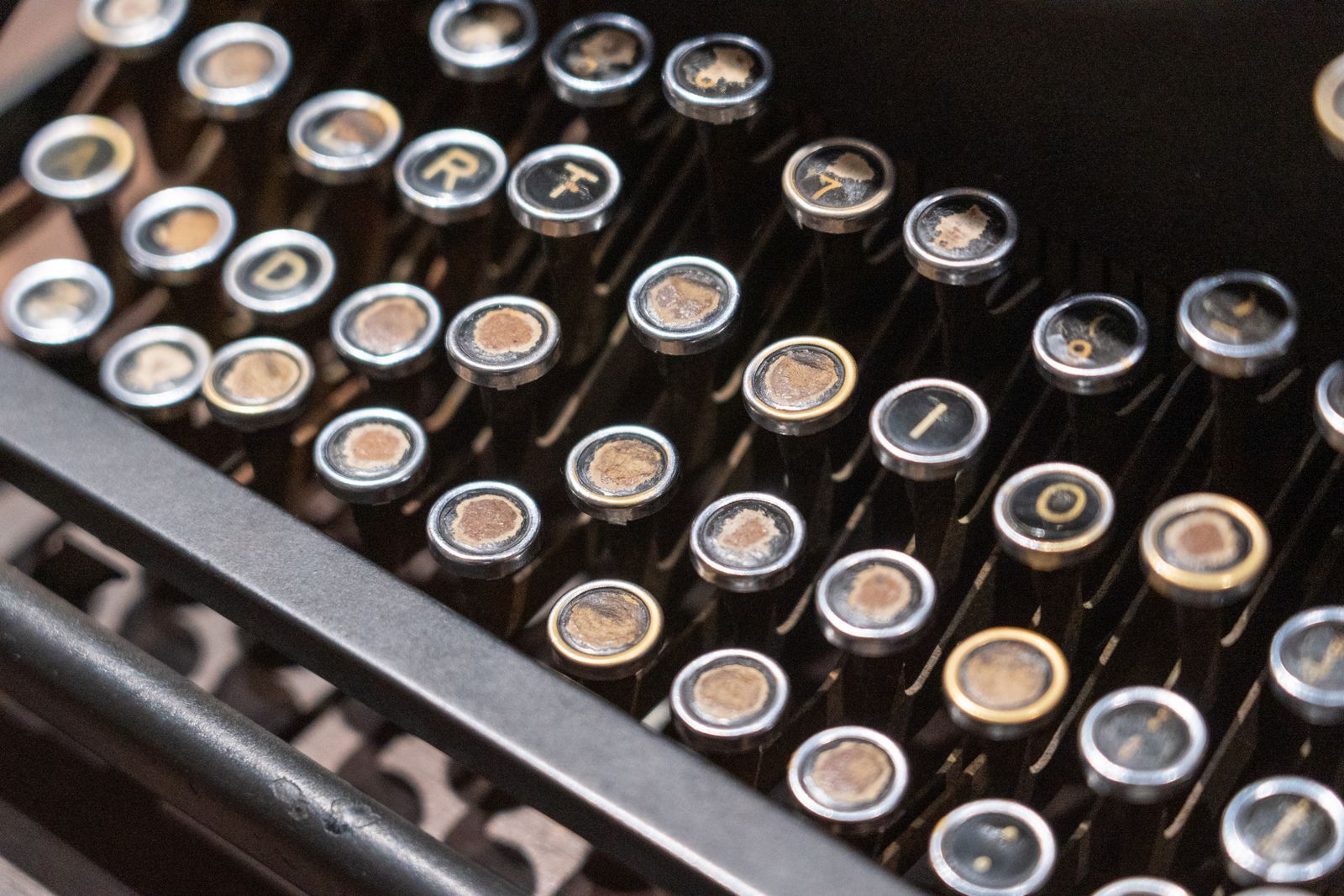
To make the addressing work, Tomlinson needed a separator. Something that could sit between a username and a host name without ever being mistaken for part of either. He stared at his keyboard, a clattering, all-uppercase electromechanical printer-keyboard that had been the standard ARPANET terminal, and ran through the punctuation marks.
Most of them were already in use. Periods appeared in filenames. Commas and semicolons separated items in lists. Slashes had meaning in paths. Hyphens and underscores routinely appeared inside names. He needed something that nobody would ever, under any circumstances, put inside a username. The character had to be unambiguous.
The @ sign was, as his employer’s spokeswoman put it years later, a symbol that probably would have gone away if not for email. By 1971 it was mostly an accounting relic. The @ symbol was commonly used by grocers on invoices to mean ‘at a rate of’. Six apples at 10 cents each. It was sitting up there on the keyboard precisely because commercial typewriters had carried it since the late nineteenth century for bookkeeping. Nobody named a file with it. Nobody put it in a login. It was punctuation in search of a job.
It also read, beautifully, as the English word “at”. tomlinson at bbn-tenexb. The grammar of the address explained itself the moment you saw it.
An old symbol with a long, strange past
The shape Tomlinson grabbed off his keyboard had been drifting through manuscripts for centuries. Early instances of a character drawn in the looping @ form appear in medieval manuscripts, where scribes used it for various purposes. Renaissance merchants in Venice and Florence adopted it as shorthand in commerce. From there it filtered into Spanish and Portuguese trade ledgers as the “arroba”, a measure of weight, and from there onto the typewriter keyboards of nineteenth-century American accountants.
By the time it reached Tomlinson’s keyboard, it had been doing quiet bookkeeping for centuries. It was about to be conscripted into the most widely transmitted piece of punctuation in human history.
What the first message actually was
Tomlinson sent several test messages between the two machines that autumn. He never wrote any of them down. When pressed in later interviews, he said only that they were forgettable strings of characters typed to confirm the program was working. Most likely QWERTYUIOP or something similarly meaningless. He never claimed otherwise.
Once he was satisfied the thing worked, he sent a message to his BBN colleagues. It announced, using his own new invention, that network mail now existed and explained how to address a message to someone on another machine. It was the first piece of email anyone other than Tomlinson had ever received. There is no surviving copy of that note either.
Tomlinson, when asked about the invention decades later, gave one of the more famous one-line explanations in computing history. He had built it, he said, mostly because it seemed like a neat idea.
From neat idea to global standard
For the first decade, network email stayed inside the research community. ARPANET in 1971 had a limited number of host computers attached to it, scattered across universities, defence labs and a few private contractors like BBN. Sending a message was a privilege of the few hundred people with login accounts on those machines.
The character itself spread faster than the technology. Programmers writing other mail tools copied Tomlinson’s syntax because it was the obvious thing to do. By the mid-1970s, the form user@host was the de facto convention across ARPANET. When the Simple Mail Transfer Protocol, SMTP, was formalised in the early 1980s and rolled out across ARPANET, the @ sign was baked into the standard. Every email address sent since has used the syntax an engineer improvised in an office in Cambridge.
The mechanics of email changed many times. The address grammar did not.
The character that came back from the dead
Before 1971, the @ sign was so marginal that several European keyboard layouts left it off entirely. Italian typewriters routinely shipped without one. After 1971, every keyboard manufacturer on earth had to put it back. The symbol gained widespread recognition, with its cultural significance celebrated in various ways.
The character’s name in other languages says something about how foreign it once looked. In Italian it became chiocciola, the snail. In German, Klammeraffe, the spider monkey clinging to a branch. In Hebrew, strudel, the pastry. In Czech and Slovak, zavináč, the rolled pickled herring. In Greek, papaki, the little duck. Every culture that suddenly needed a name for the thing reached for the nearest animal or food it resembled.
None of those metaphors existed before Tomlinson made the symbol unavoidable.
The engineer who was not addicted to his own invention
Tomlinson kept working at BBN for the rest of his career. He was still employed there as a principal scientist when he died in March 2016 at the age of 74. He had been inducted into the Internet Hall of Fame, given lifetime achievement awards by the Association for Computing Machinery and the IEEE, and named one of the most influential engineers of the twentieth century. He lived quietly in Lincoln, Massachusetts, and raised miniature sheep.
Colleagues described him as patient and modest, the kind of engineer who would sit with a junior programmer for an hour to walk through a bug. His employer’s spokeswoman said he was surprisingly not addicted to email.
He never patented the idea. He never tried to commercialise it. The technical paper he wrote about file transfer protocols, the one that contained the mail-appending trick, lists network mail almost as an afterthought. The whole thing, in his telling, was a side project that worked.
What survives in the address bar
The ARPANET of 1971 had fewer host computers than a modern coffee shop has Wi-Fi clients. The mainframes weighed close to a ton, cost several hundred thousand dollars, and had less memory than a present-day microwave. The keyboard on which Tomlinson typed his test messages printed in capital letters only, at ten characters per second, on a continuous roll of yellow paper. The first email travelled a distance shorter than the length of a city bus.
Pull up any email address typed today, at a hospital in Lagos, a trading desk in Singapore, a school in São Paulo, a Mars rover team in Pasadena, and the punctuation mark in the middle is the same character Tomlinson plucked off his keyboard because no human being would ever name themselves with it. Every login on every web service in the world that uses an email address as an identifier is built on the same forgotten accounting symbol. Billions of times a day, fingers reach for the same key.
Most punctuation marks earn their keep by clarifying a sentence. The @ sign earns its keep by clarifying a person. It is the only character on a standard keyboard whose modern job has nothing to do with writing and everything to do with pointing: this name, that machine. A small piece of bookkeeping shorthand, drafted out of retirement, still doing the work of telling the network where to find you.