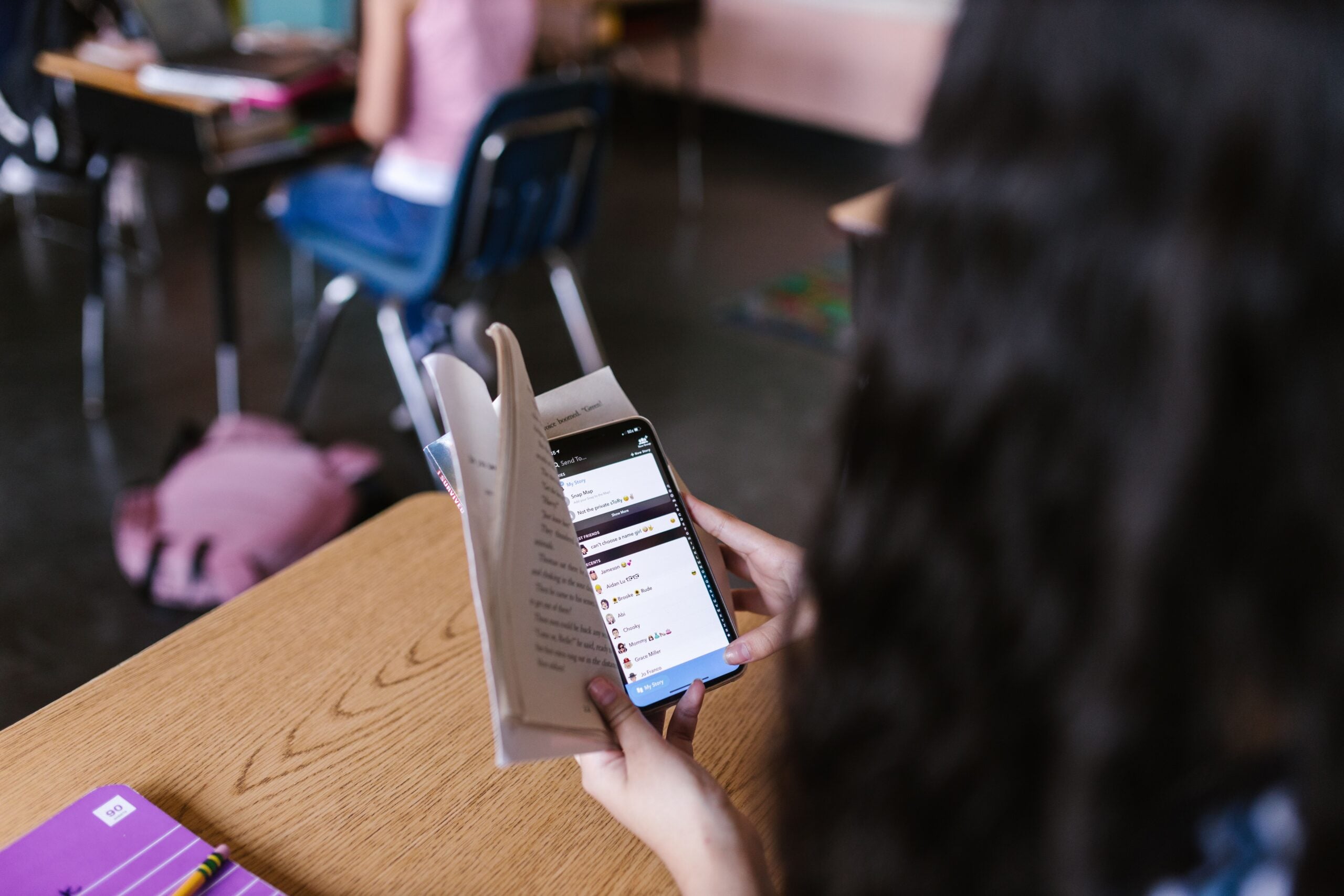
At the beginning of a lecture, students in one group were required to place their phones in a wooden box. Students in another group kept theirs under the ordinary rules of the classroom. Nothing about the intervention was technically elaborate. Its purpose was to remove one small decision that could otherwise return every few minutes.
Across 10 higher education institutions in Odisha, India, that change was followed by a modest improvement in grades. The randomised trial covered 16,955 undergraduate and postgraduate students during the spring 2024 semester, making it considerably larger than the phone experiments usually discussed in arguments about classroom attention.
The average result was not dramatic. After accounting for prior achievement, the researchers estimated an improvement of 0.086 standard deviations. The distribution was more revealing: students with lower prior GPAs gained 0.161 standard deviations, roughly 1.9 times the average estimate.
Those numbers support a careful conclusion. Collecting phones helped academic performance in this setting, especially for students who had previously performed less well. They do not show that one phone policy will suit every institution, course or student.
The experiment changed access, not ownership
The working paper was written by Alp Sungu of Wharton, Pradeep Kumar Choudhury of Jawaharlal Nehru University and Andreas Bjerre-Nielsen of the University of Copenhagen. The authors ran the experiment from February to May 2024, with dates varying slightly between institutions.
Randomisation did not occur student by student. Within each institution, department-and-semester cohorts were assigned to either the phone-collection treatment or business-as-usual control. A student therefore encountered broadly the same rule across courses throughout the semester, while another cohort might continue to have access to phones.
At the beginning of each treatment lecture, students had to deposit their devices in designated wooden boxes. The project used roughly 1,000 boxes made from recycled material. Similar boxes could be present in shared classrooms used by both groups; the important difference was whether teachers enforced collection.
Students with documented emergency or caregiving needs could request prior approval to retain a device. Teachers were not formally prohibited from using phones. Technology was already excluded from examinations in both groups, so the experiment changed access during teaching rather than the conditions under which final assessments were taken.
This design tested more than whether one person can resist checking a screen. A classroom is a social environment. When a whole cohort follows the same rule, the intervention may change what classmates see, what a teacher needs to police and what behaviour feels normal in the room.
What 0.086 standard deviations actually means
In the main analysis, which controlled for students’ earlier academic performance, assignment to phone collection increased GPA by 0.086 standard deviations. The reported 95 per cent confidence interval ran from 0.015 to 0.157 standard deviations. A course-level analysis produced an estimate of 0.061.
This is not an 8.6 per cent rise, nor an increase of 8.6 grade points. A standard deviation expresses the effect relative to the spread of grades in the data. It lets researchers compare outcomes across institutions with different grading systems, but it is less intuitive than the mark on a transcript.
A Wharton account rounded the average effect to 0.07 standard deviations, using a version standardised against the control group. Either way, “modest” is the sensible description. It is large enough to detect across the sample, but not large enough to transform the typical student’s academic record.
The precise estimate also changed with the model. Across alternative specifications reported in the paper, the estimated effect ranged from 0.034 to 0.112 standard deviations. The most demanding student fixed-effects specification, using the longest available pre-experiment history, produced the smallest estimate and did not meet a conventional significance threshold.
That variation does not make the headline result meaningless. It does make false precision unhelpful. The evidence points towards a small positive effect in this trial, while leaving a reasonable interval around exactly how large it was.
The average hides who benefited most
Students who entered the experiment with lower prior GPAs recorded an estimated gain of 0.161 standard deviations. Dividing that by the main estimate of 0.086 gives about 1.87, which is the basis for saying their gain was roughly twice the average student’s.
The higher-performing subgroup did not show a comparable gain. First-year students had another relatively large estimate, 0.142 standard deviations. Non-STEM students recorded an estimated 0.097-standard-deviation improvement, while the estimate for STEM students was smaller and not statistically clear.
Subgroup results are usually less precise than the main result because each estimate uses fewer observations. They should not be turned into a diagnostic rule that predicts which particular person needs a phone box. Still, the pattern is consistent with a plausible asymmetry in the cost of distraction.
A student who already has effective study routines, strong preparation or ample academic margin may lose little when a device remains available. Someone still adjusting to college or struggling with the material may have more to gain when the temptation, and the effort required to resist it, is removed from the desk.
That matters for interpreting a modest average. An intervention can look minor when everyone is pooled together while being more consequential for the group with the least room to absorb another lost fragment of attention.
The room changed along with the student
The researchers supplemented grades and official attendance records with two survey waves and 7,797 unannounced classroom spot checks. Each observation lasted less than a minute and was conducted through a doorway or window to limit disruption.
Observers recorded less student phone use in treatment classrooms, as expected. They also saw fewer unrelated conversations and other disruptive behaviours. Teachers were observed using their own phones less often and spending more time occupied with educational materials, despite not being subject to the collection rule.
That teacher result is important because it shows how a rule aimed at students can alter the shared room. It is possible that enforcing collection drew teachers more firmly into the lecture, or that a less phone-focused group changed how teachers behaved. The experiment establishes the combined classroom effect, not a clean separation between those pathways.
One observation moved in the opposite direction. External observers coded more apparent student distraction in treatment classrooms. The authors suggest that some students may have shifted to daydreaming or other distractions once their phones were unavailable. Students themselves did not report becoming more distracted.
The spot checks also have a limitation. Research assistants were formally blinded to assignment, but could often infer it from whether phones were visible and collection appeared to be enforced. Their judgements were brief external impressions, not continuous or perfectly objective measures of attention.
Students did not simply become happier
Exposure to the collection rule made students more supportive of it. They reported seeing more benefits in restricted classroom access and became less likely to prefer completely unrestricted use. Experience, in other words, softened some resistance to the policy.
That acceptance did not mean every response was positive. Self-reported fear of missing out rose mildly among students in the treatment group. The paper found no significant aggregate change in overall wellbeing, academic motivation, digital use or online harassment.
Attendance did not measurably improve either. Students apparently did not earn higher grades because the boxes persuaded them to attend more classes. Nor did the intervention produce a clear reduction in total screen time or the likelihood of bringing a phone to campus.
The pattern is therefore narrower than a story in which removing phones makes students broadly happier, more motivated and digitally restrained. Academic performance moved a little. Several visible classroom behaviours changed. Many other measured outcomes did not.
A previous Silicon Canals article examined a different randomised experiment in which people kept phones available during a cafe meal. There, even limited use was associated with lower reported enjoyment. The settings and outcomes differ, but both experiments show why access can matter even when a phone occupies only a small part of the observed time.
The mechanism remains open
Physical collection could help in several ways. It removes notifications from reach, makes an impulsive check more difficult and relieves students of repeatedly deciding whether to look. It may also create a visible group norm, reducing the social cue produced when someone nearby picks up a screen.
In that sense, the box can function as a commitment device. A person makes one decision at the door and no longer needs to win the same small contest throughout the lecture. That interpretation is plausible, but the trial was not designed to determine exactly how much of the grade effect came from temptation, peer behaviour, teacher behaviour or another mechanism.
It also tested a specific, enforced procedure. Asking students to silence phones while keeping them in pockets is not the same intervention. Neither is a voluntary phone-free section. The inconvenience, visibility and consistency of collection may all be part of the treatment.
The research team originally aimed to enrol 18 institutions, but only 10 completed the experiment. Logistical constraints also prevented the planned baseline survey and phone-tracking application from being introduced before treatment. That reduced the authors’ ability to examine changes in individual device use and some planned differences between students.
The resulting 63-page paper reports a preregistered, institutionally reviewed experiment, but it remains a publicly posted working paper rather than a peer-reviewed journal article. Its methods and results can be inspected now; its claims may still be revised through review.
What this trial can and cannot establish
Within these institutions, random assignment gives the study a stronger basis for causal inference than a survey comparing frequent and infrequent phone users. The result is not merely that students who avoid phones tend to have better grades. Cohorts assigned to collection performed a little better than comparable cohorts left under existing practice.
Generalisability is a separate question. These were college lectures in Odisha over one semester. A secondary school, a digitally integrated engineering course, a hybrid class or an institution with different expectations around phone use could produce another result.
Implementation would matter too. The experiment provided boxes, established exemptions and relied on teachers to enforce the assigned rule. A nominal ban that is inconsistently applied is not equivalent to the intervention the researchers studied.
There are also costs that a GPA estimate does not settle. Students may have legitimate reasons to remain reachable. Instructors may use phones for course activities. Collection creates responsibility for devices and can produce friction at the beginning and end of class. The trial does not convert those choices into one universal policy answer.
Its clearest contribution is more limited, and more useful. Removing immediate phone access can cause a small academic improvement, and the benefit may be concentrated among students who began with weaker results. The average tells us that the box mattered. The uneven gains tell us why a simple average is not enough.