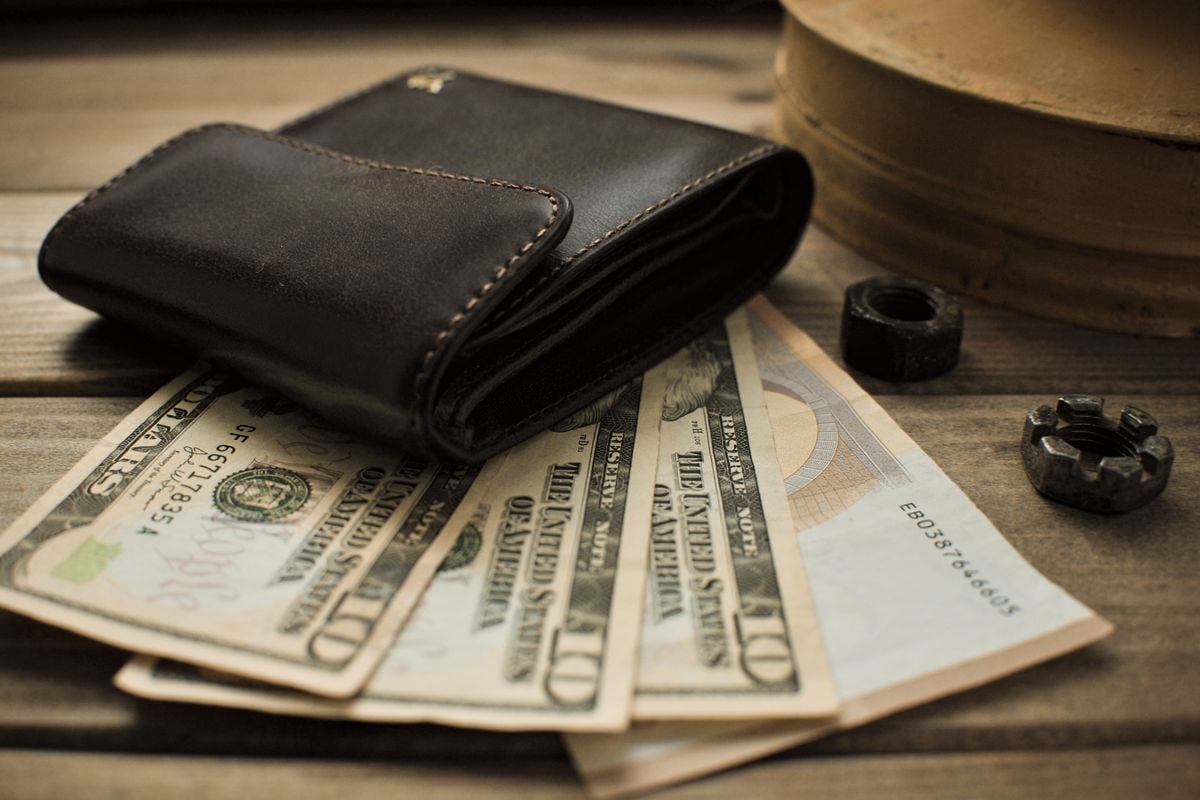
Putting cash in a supposedly lost wallet made its recipient more likely to contact the owner in a large international field experiment. Across 355 cities in 40 countries, researchers handed in 17,303 wallets and found that the reporting rate rose from 40% without money to 51% with a modest amount inside.
The result, published in Science in 2019 as Civic Honesty Around the Globe, challenges the expectation that a larger opportunity for personal gain necessarily makes dishonest behaviour more likely. It also needs a precise description: the main outcome was an email to the supposed owner, not a direct observation of every wallet being physically returned.
A controlled handover rather than a dropped wallet
Alain Cohn, Michel André Maréchal, David Tannenbaum and Christian Lukas Zünd designed an experiment around a familiar situation, but controlled how recipients encountered it. Research assistants approached employees at institutions such as banks, hotels, cultural venues, post offices and public offices, handed over a supposedly found wallet and left.
The wallets were transparent cases. The main comparison randomly varied whether they held no money or the local purchasing-power equivalent of US$13.45. Contact details allowed the team to observe whether the recipient emailed the owner within 100 days.
The cash changed the response.
That is a stronger design for comparing the two conditions than asking people whether they consider themselves honest. The researchers changed a feature of the situation and measured what happened next. But the handover also defines the setting: these were employees receiving lost property at work, not a representative sample of everyone who might spot a wallet on a pavement.
Eleven percentage points is a meaningful difference
The University of Michigan’s account of the study reports the overall rise from 40% to 51%. That is an increase of 11 percentage points. Expressed relative to the 40% baseline, it is about a 27.5% increase in the likelihood of reporting.
Those two descriptions refer to the same difference, but they should not be mixed up. Saying that reporting rose by 11% would understate the relative change; saying that it rose by 27.5 percentage points would exaggerate the absolute change.
For a simple illustration, imagine 100 comparable handovers in each condition. The reported averages correspond to about 40 emails when the wallet contained no money and 51 when it contained cash. That does not mean the same 11 people would always change their minds, only that the rate differed between the groups.
There was still substantial non-reporting in both conditions. The experiment does not support the comforting conclusion that nearly everyone will contact an owner, even when there is money inside. Its finding is comparative: adding cash increased the measured response.
More money could also mean more moral discomfort
The University of Zurich’s explanation focuses on self-image. The authors suggest that keeping a wallet can carry a psychological cost because a person may see the act as theft. Increasing the cash could increase both the financial temptation and the discomfort of thinking of oneself as a thief.
Additional survey respondents judged that failing to return a wallet felt more like stealing when it contained more money. The researchers also varied whether wallets contained a key, an object useful to the owner but generally not to the recipient. Wallets with a key were more likely to be reported than otherwise comparable wallets without one, supporting a role for concern about the owner.
These findings help explain the pattern, but they do not provide a recording of each recipient’s thoughts. The observed behaviour and the proposed psychological mechanism are different kinds of evidence. Someone may contact an owner for several overlapping reasons, including concern, habit, workplace expectations or their own sense of responsibility.
The cash was not necessarily the only thing being weighed.
The larger-cash test had a narrower reach
A further experiment increased the amount to the local equivalent of US$94.15 in the United States, the United Kingdom and Poland. The Michigan release describes still higher reporting with the larger amount. That extension matters because it tests whether the main result depended entirely on the temptation being very small.
It does not establish what would happen at every possible amount. The behaviour associated with a wallet holding roughly a hundred dollars cannot simply be projected onto a suitcase of money, an accounting fraud or a commercial negotiation. The form of the opportunity, the setting and the consequences change.
The same caution applies to geography. A broad international sample is valuable, but a three-country extension remains a three-country extension. It should not be presented as if every amount had been tested in all 40 countries.
What an email can and cannot tell us
The most useful reading keeps the action close to the evidence. Sending an email creates a route for returning someone’s property. It is an observable step that can be compared across experimental conditions. It does not, by itself, describe every subsequent interaction or establish a permanent character trait.
Likewise, the absence of an email should not automatically become a claim that a particular employee pocketed the money. An institution might handle lost property in another way, or a message might never be sent. Those possibilities limit how individual cases can be labelled, even when the comparison between experimental groups remains informative.
For anyone interested in human behaviour at work, the study supplies a reason to question an overly simple prediction about incentives. A material benefit can change how an action is understood as well as what it pays. The recipient was not only looking at cash. There was also an owner’s name and a way to contact them.