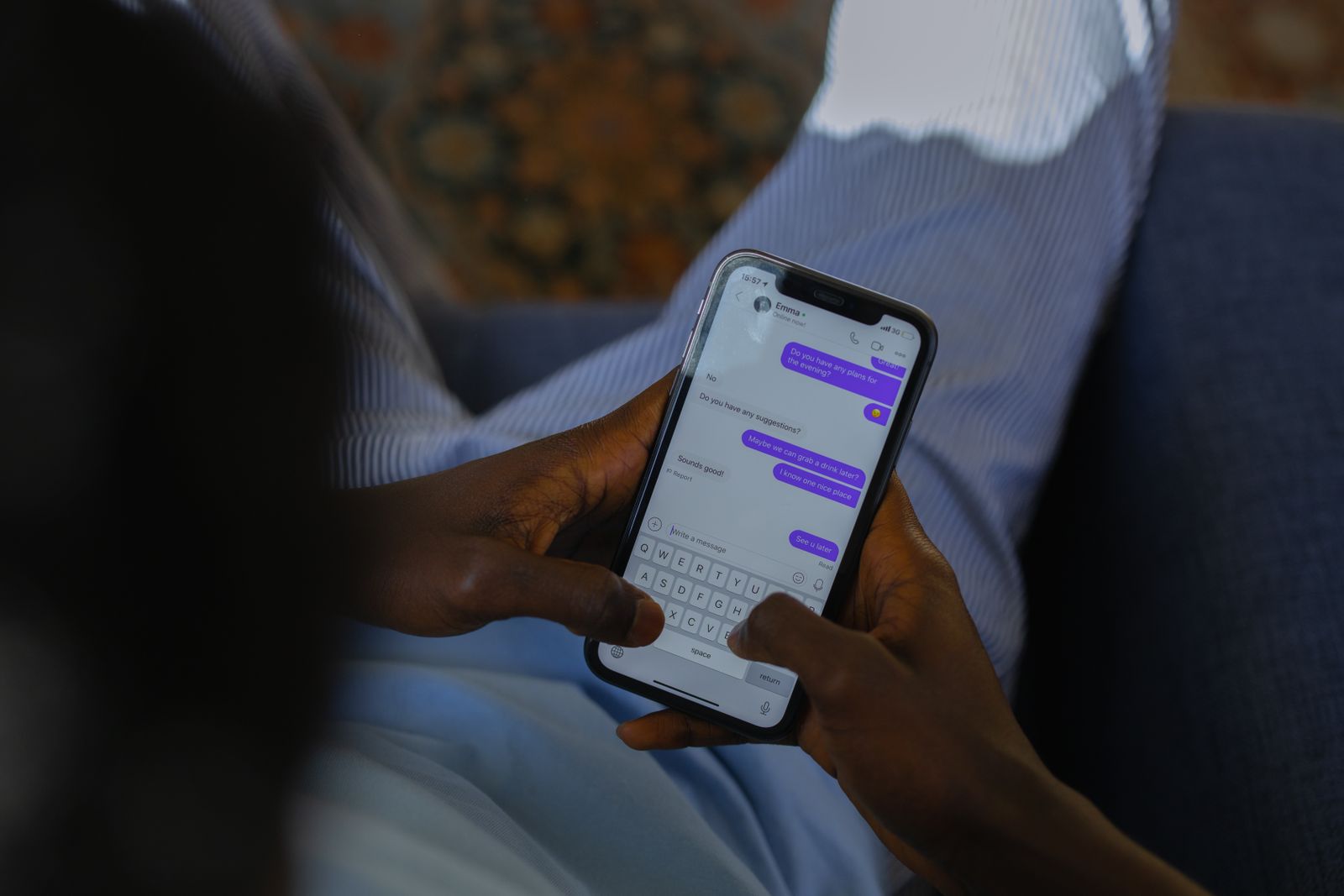
The phone rings out. Voicemail. Three seconds later the screen lights up: “what’s up?”
The easy interpretation is that they are dodging you, that a person who will not pick up is keeping you at arm’s length. Sometimes that is exactly what is happening. But the preference for a text over a call is not always avoidance. For a lot of people it protects something a live call takes away, which is the gap between being asked a question and having to answer it.
A call is real time. It wants a reply now, in your actual voice, with no chance to take the sentence back. A text lets you read, think, draft, delete, and send a version you have actually considered. For some people that gap is not evasion. It is where the good version of what they wanted to say gets written.
What a text gives that a call does not
This maps onto something researchers have described for years. The communication scholar Joseph Walther has written about how written, computer-mediated messages are editable and often asynchronous, meaning you do not have to respond in the moment. You can compose, revise, and choose what to put forward, what Walther calls selective self-presentation.
That is not a flaw in texting. It is the main thing it offers. A message you can edit before sending is a message you have had time to think about, and for plenty of people the difference between a blurted answer and a considered one is the difference between saying what they meant and saying what merely came out first. So the reframe in the idea is fair. A person reaching for text instead of voice may not be retreating from the other person at all. They may be reaching for the part of the exchange where thinking is still allowed. That gap tends to matter most to a particular kind of person: the one who would rather be accurate than quick, who replays a clumsy sentence for an hour afterwards, who does their best thinking with a backspace key within reach. For them a call is not frightening so much as lossy. It forces a first draft into the world and treats it as the final one.
This is a reading, not a verdict
It is worth being honest that this is a generous interpretation, not a measured fact about everyone who screens a call.
People text instead of calling for all sorts of reasons. Convenience. Habit. The call would take twenty minutes and the text takes twenty seconds. And yes, sometimes plain avoidance, dressed up after the fact as a need for space. The “I just think better in writing” explanation is true for some people and a comfortable cover for others, and the same person can use it both ways on different days.
Naming the considered-thinking motive is useful because it is real and often missed. It is not a licence to assume it is always the reason.
What a call gives that a text does not
There is a cost to defaulting to text, and the research on it is worth taking seriously.
In a set of studies published in 2021, the psychologists Amit Kumar and Nicholas Epley had people reconnect with old friends, and chat with strangers, using either voice or text. Voice conversations produced a stronger sense of connection than text did. The interesting part was the forecast: people expected a phone call to be more awkward than a text, and it generally was not. They consistently overestimated the discomfort and underestimated how good it would feel to actually hear the other person. In the field study, people asked to reconnect with an old friend leaned towards email, expecting a call to be more uncomfortable. Those who called instead came away feeling more connected, and no more awkward than the people who typed.
That finding lands harder than the comfortable version of the texting story allows. If the call you are avoiding would, on average, feel better and bond you more than the text you send instead, then “I need space to think” is often a misforecast wearing the costume of a preference. The control texting offers is real, but it is not free. What it costs is the warmth that only the unedited voice seems able to carry, and once you have routed a relationship through the keyboard for long enough, that warmth does not always come back.
The same trade-off shows up at work
If this sounds familiar from the office, that is because it is the same choice scaled up. Asynchronous tools, the message threads and shared documents, give people time to compose a careful answer, which is part of why they suit detailed or sensitive work. Synchronous ones, the call and the meeting, move faster and build more of the rapport that holds a team together.
Teams that go fully asynchronous often gain clarity and lose warmth. Teams that run on back-to-back calls tend to feel close and waste a lot of time. Neither setting is the mature one. They are buying different things, and the better-run groups seem to know which they are buying and when. The mistake is treating one mode as inherently more professional. A culture that sneers at phone calls gives up something measurable, and a culture that calls for everything gives up whole afternoons.
What it comes down to
So here is where I would land. The person who texts instead of calling is making a trade, often without noticing it: immediacy and warmth on one side, control and time to think on the other. The trade is not symmetrical.
Texting buys you a better-drafted sentence. It does not buy you the thing the Kumar and Epley work keeps pointing at, which is the small, unrepeatable warmth of a voice arriving in real time. That warmth is not a bonus feature. It is most of what people mean when they say they felt close to someone. Choose the keyboard often enough and you are not just choosing a medium. You are quietly agreeing to do without the part of connection that does not survive editing.