

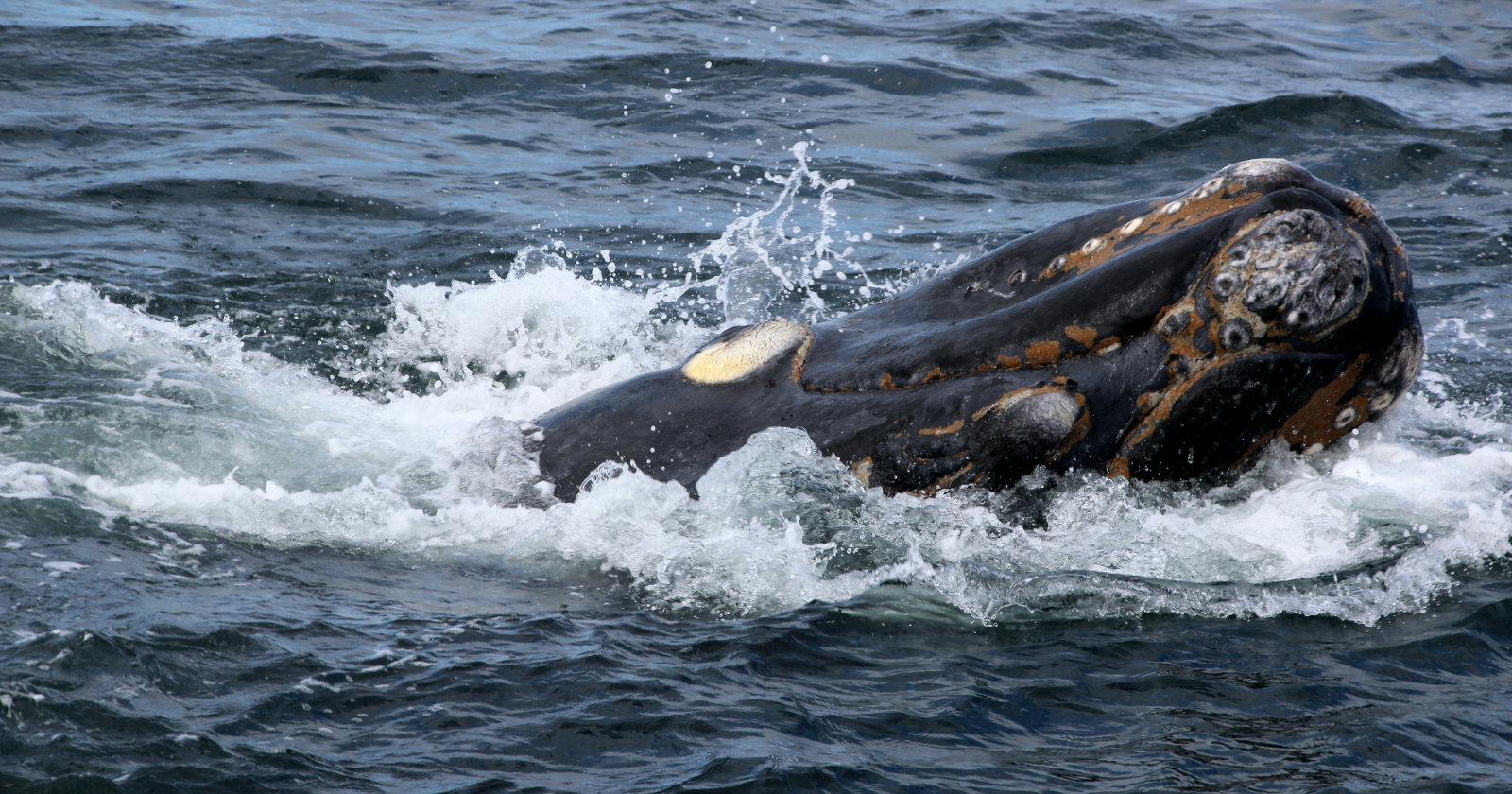
A bowhead whale alive today might have been calving in the Bering Strait the same decade Charles Darwin published On the Origin of Songs. Some of them are pushing past 200 years. And inside their bodies, biologists keep finding something stranger than long life itself — partial tumors. Clumps of abnormal cells that started to grow, then stopped, then sat there, frozen in a kind of biological standoff, while the whale went on swimming through the Arctic for another century.
That observation, gathered from tissue shared by Iñupiaq subsistence hunters in Utqiaġvik (Barrow), Alaska, is the starting point for research published in November 2025 by Vera Gorbunova’s lab at the University of Rochester. The team had gone looking for the genetic trick that lets the second-largest mammal on Earth dodge cancer for two centuries. They expected to find a stockpile of tumor-suppressor genes, the way elephants have one. That is not what they found.
The paradox that shouldn’t let bowheads exist
Start with the math. A bowhead whale weighs about 100 tons, roughly the mass of a fully loaded Boeing 737, and is built out of something on the order of a quadrillion cells. Each cell division is another chance for a mutation. Each year of life is another chance for those mutations to stack up into a tumor. By any reasonable accounting, a 200-year-old, 100-ton animal should be a cancer factory.
This is Peto’s paradox, a framework describing why cancer rates don’t track body size across species the way you’d expect. Mice and humans get cancer at broadly similar rates, even though humans have about 1,000 times more cells and live 30 times longer. Whales, by this logic, should be tumor-ridden floating tragedies.
They aren’t. According to NPR reporting, Gorbunova noted that malignant tumors have not been reported in bowhead whales, despite occasional necropsies showing tumor-like growths that stalled out. That absence, combined with occasional necropsies showing tumor-like growths that simply stalled out, is what sent her team digging into bowhead tissue in the first place.
How you date a 200-year-old whale
The 200-year figure isn’t folklore, although Iñupiaq whalers had been telling biologists for generations that the animals lived two human lifetimes. Scientists confirmed it two ways. The first was chemical. By measuring the racemization of aspartic acid in the lenses of bowhead eyes, a slow, clock-like change in protein structure that ticks at a known rate, researchers calculated ages well past 150 and in some cases above 200.
The second was archaeological, and almost absurd. Whalers occasionally recovered bowheads carrying stone or ivory harpoon tips of a design that hadn’t been used since the late 1800s. The whales were swimming around with 19th-century weapons embedded in their blubber. One specimen taken in 2007 was estimated to have been struck, and survived, sometime around 1880.
For context: a bowhead alive in 2026 that hatched out of the womb in 1820 was a calf when Beethoven was still composing. It was middle-aged during the construction of the Eiffel Tower. It lived through the entire 20th century as an adult.
Elephants kill the cells. Bowheads fix them.
The standard cancer-resistance story in long-lived giants used to belong to elephants. African and Asian elephants carry 20 copies of TP53, the gene that codes for the p53 protein, sometimes called the guardian of the genome. Humans have one copy. When an elephant cell starts behaving badly, p53 floods the system and the cell, in Gorbunova’s phrasing, commits suicide. Kill the suspect, save the herd.
Gorbunova assumed bowheads would have an even bigger arsenal of TP53. According to NPR, Gorbunova was surprised to find that bowhead whales did not have the expected larger arsenal of TP53 genes. Gorbunova explained to NPR that the whales had taken a different evolutionary route than expected, demonstrating how nature can challenge researchers’ hypotheses.
The whales had taken a different evolutionary route. Instead of executing damaged cells, they prevent the damage from compounding in the first place. Their cells are spectacularly good at fixing double-strand breaks in DNA, the most dangerous kind, where both rails of the molecular ladder snap. Human cells are competent at this kind of repair. Bowhead cells are two to three times better, fusing the broken ends back together without losing chunks of code along the way.
A protein that wakes up in the cold
The molecular workhorse, the Rochester team found, is a protein called CIRBP, cold-inducible RNA-binding protein. The gene that produces it is activated by low temperature, which is convenient if you spend your life in water that hovers near freezing. Bowheads produce CIRBP in quantities far above what’s seen in other mammals.
When the researchers engineered human cells in a dish to overproduce CIRBP, those cells got better at repairing DNA breaks. When they did the same in fruit flies, the flies lived longer and shrugged off DNA-damaging agents that would normally kill them. Gorbunova suggested that the research indicates there is room for improvement in human cellular repair mechanisms.
Which is where the stalled tumors come in. If a bowhead cell does start down the path toward cancer, the repair machinery appears to keep patching the genome faster than mutations can accumulate. The tumor doesn’t get the genetic instability it needs to keep dividing aggressively. It runs out of momentum. It sits there, sometimes for decades, as the whale ages around it.
Investment over cleanup
Gorbunova frames the difference in almost economic terms. Elephants spend energy on surveillance and demolition. Bowheads spend it on maintenance. Gorbunova told WUNC that bowhead whales appear to focus on cellular repair and maintenance rather than the cell-elimination strategy used by elephants.
That choice makes more sense the longer you expect to live. Killing off damaged cells is fine when you only need your body to last 70 years. Stretch the warranty to 200, and the running tally of dead cells starts to matter. Tissues thin, organs lose function, the animal hollows out from the inside. Better, evolutionarily, to fix.
The slow metabolism, the cold water, the time
There’s almost certainly more than one mechanism at work. Bowheads have a famously sluggish metabolism, which produces fewer reactive oxygen species, the unstable molecules that nick and break DNA in the first place. The cold water of the Arctic slows everything down further. Long-lived animals consistently devote fewer genes to energy metabolism and more to maintenance pathways.
Vincent Lynch, an evolutionary biologist at the University at Buffalo who was not involved in the Rochester study, told NPR the CIRBP finding is one entry in a much longer ledger still being written. An independent researcher at the University at Buffalo told NPR that scientists have identified only a small number of the mechanisms responsible for bowhead whale cancer resistance. The researcher noted that many more mechanisms remain to be discovered in future research.

A pattern across the strangest animals on Earth
The bowhead joins a small club of vertebrates that seem to have rewired their cells to outlast normal mammalian life expectancy. Brandt’s bat, weighing less than a paperclip, lives more than 40 years. The naked mole rat lives past 30, almost never gets cancer, and uses interferon secretion to trigger cancerous cells to self-destruct. The Greenland shark can survive past 400.
Silicon Canals has covered other animals whose biology breaks the rules biologists thought they understood, including the Mariana snailfish, which lives nearly 8,000 metres down at pressures that would buckle a submarine, kept upright by partly unossified bones and a cellular shield of TMAO. The pattern that keeps emerging: extreme environments produce extreme cellular adaptations, and those adaptations tend to involve protecting molecules from falling apart.
For the bowhead, the environment is the Arctic itself. Dark, cold, and on a timescale most mammals never experience. CIRBP turns on because the water is freezing. The repair machinery runs constantly because the metabolism runs slowly. The animal lives so long that the strategy compounds.
What the Iñupiaq knew first
The science has a coda that’s easy to skip past. The tissue Gorbunova’s lab worked with came from whales harvested by Iñupiaq hunters in Utqiaġvik under subsistence quotas. The community, Gorbunova told NPR, agreed to share small samples with the researchers. The 200-year lifespan they were trying to confirm with mass spectrometry and embedded harpoon tips was something Alaskan whaling captains had been telling biologists for generations. Bowheads live two human lifetimes.
The Iñupiaq, meanwhile, are dealing with rising cancer rates. If CIRBP biology ever produces a clinical therapy, the people who made the research possible may end up among those who benefit from it.
What the data actually shows, and what it doesn’t
Strip the storytelling away and the November 2025 paper lands on a fairly narrow set of findings. Bowhead cells repair double-strand DNA breaks two to three times more efficiently than human cells. CIRBP is expressed at unusually high levels in bowhead tissue. Forcing human cells to overproduce CIRBP improves their repair performance in culture. Fruit flies engineered to do the same live longer and tolerate higher doses of DNA-damaging agents. That is the evidence base, and it is preliminary.
The open questions are larger than the answers. Researchers still don’t know how much of the bowhead’s cancer resistance is attributable to CIRBP specifically versus the slow metabolism, the cold body temperature, the reduced reactive oxygen species, or mechanisms not yet identified. They don’t know whether boosting CIRBP in a whole mammal, rather than a cell line or an insect, produces the same benefit without side effects. They don’t know why partial tumors stall in bowheads instead of progressing, only that the repair machinery seems to outpace the mutations driving them.
What the bowhead offers, for now, is a proof of concept. A 200-year-old, 100-ton animal carrying century-old harpoon tips and stalled-out tumors is evidence that mammalian cells can be tuned to last far longer than ours do. Translating that into something a clinician can prescribe is the work of the next several decades, and the ledger Lynch described is still mostly blank pages.
