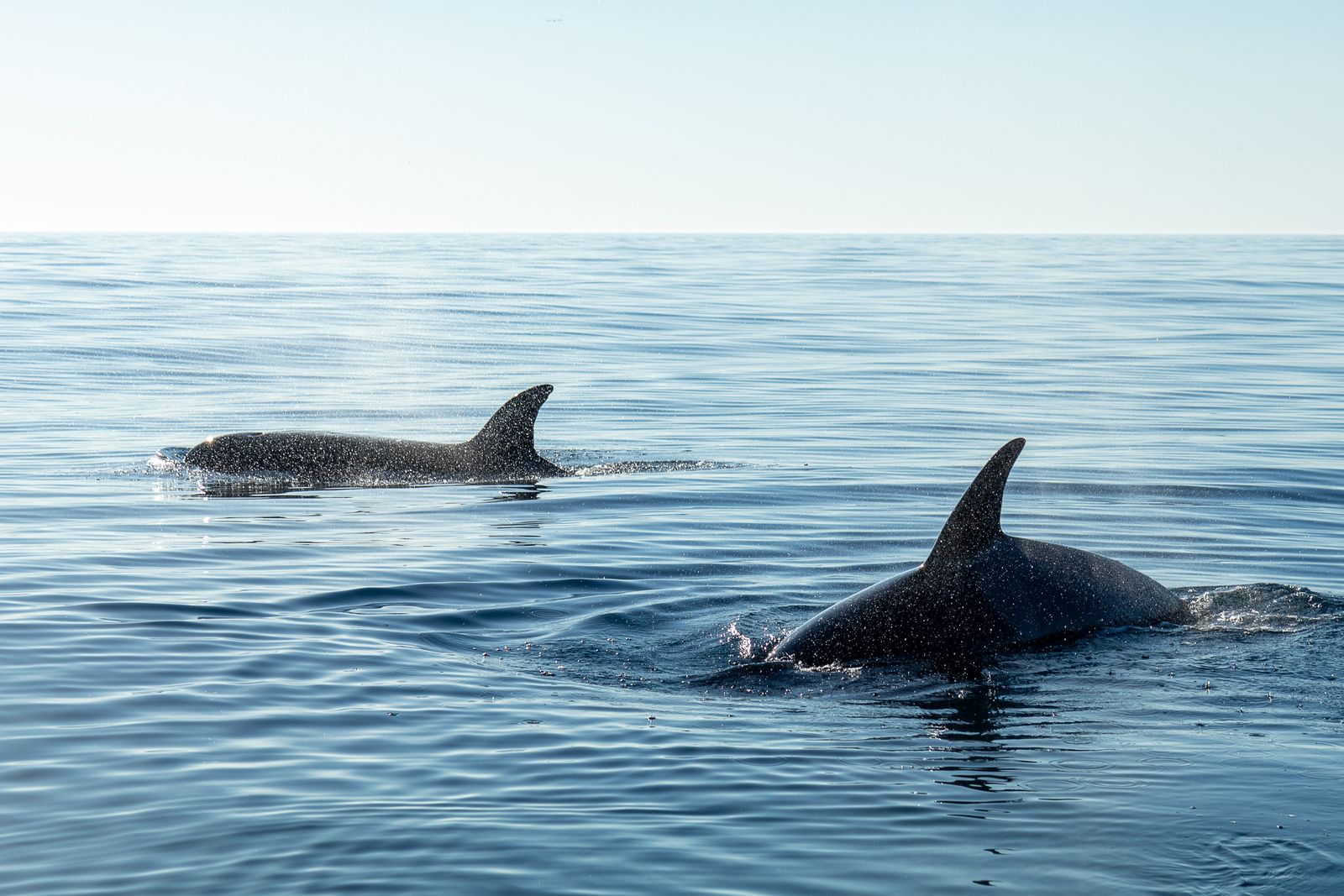
In 2008, a team led by biologist Patrick Miller at the University of St Andrews glued digital acoustic tags to the backs of sperm whales in the open ocean and waited for data on their hunting clicks. What came back instead was silence. For ten to fifteen minutes at a stretch, the tags recorded nothing at all: no clicks, no movement, no breathing. The whales had gone offline.
Video footage taken around the same time explained the silence. A pod of sperm whales sleeps by standing up. Not floating, not drifting, but pointed nose-first toward the sky, tails hanging into the dark, bodies arranged just below the surface of the open ocean. They hold the posture for ten to fifteen minutes at a stretch, completely silent, completely unresponsive, before sinking, breathing, and resuming.
Both halves of the brain were offline. The largest predator in the ocean was, for those minutes, completely defenceless.
The accidental discovery
That blindness to a massive moving object was the clue. Sperm whales are among the loudest animals on Earth, producing clicks that exceed 230 decibels and that they use to scan the ocean for prey at depths of two kilometres or more. A whale that does not register an oncoming ship is a whale that has stopped processing sound entirely.
The 2008 work used digital acoustic tags to confirm what the video suggested. As Miller later told Live Science, behavioural tags are often the only way to study sleep in animals that cannot be brought into a laboratory. Brain scans on a sperm whale at sea are not on the menu. The tag data showed the whales pitching upward, slowing to a halt, and going quiet for short bouts. The same tags had been deployed to log foraging dives and click rates, and the sleep signal was effectively a by-product of equipment built for other questions. The whales tilted nose-up, stopped clicking, and drifted in clusters. Researchers found that some pods failed to react when the research vessel itself approached, which is how the behaviour was first noticed in the wild. The tags recorded the descent back into clicking and movement once the bout ended. That accidental framing matters: nobody set out to study cetacean sleep with these instruments, and the data emerged as an absence rather than a presence.
Why vertical, and why so brief
The posture is physics. A sperm whale’s enormous head is packed with spermaceti, a waxy oil that fills the spermaceti organ and the junk, two structures that together can account for a quarter of the animal’s body length. The oil is buoyant. When a whale stops swimming and goes limp, the head wants to rise and the heavy fluked tail wants to sink. The body settles into the vertical the way a thermometer settles into temperature.
The brevity is biology. Sperm whales are conscious breathers, meaning every breath is a deliberate act rather than an autonomic reflex. A whale that fully loses consciousness for too long simply stops breathing and drowns. The tag data showed bouts of around ten to fifteen minutes. Long enough for a sleep cycle, short enough to surface, exhale a single explosive blast from the blowhole on the left side of the head, and sink again.
Bihemispheric sleep in the open ocean
What makes the sperm whale’s behaviour strange among cetaceans is that both halves of the brain go offline at once. Dolphins are the textbook case for the opposite strategy: unihemispheric sleep, where one hemisphere rests while the other keeps the animal swimming, watching, and breathing. In a pod, dolphins tend to keep the eye facing the rest of the group open, the better to avoid drifting away from their companions in the dark.
Sperm whales, in the rare windows when they sleep, give that up. They sleep the way humans do, with the whole brain in slow-wave shutdown, accepting the predator risk as the cost of doing it properly. Pods will sometimes cluster, with adults arranged around calves, but no one is keeping watch. For those minutes, the largest toothed predator on Earth is functionally absent from the world.
The cost of being a deep-diving mammal
Sleep in marine mammals is a problem set with no clean solution. They cannot lie down. They cannot stop breathing. They cannot float on the surface for long without losing body heat to the water or attracting predators. Each lineage has improvised its own answer.
Northern elephant seals dive deep before letting their brains enter REM sleep, then flip upside down and spiral slowly toward the seafloor while paralysed. They sleep remarkably little at sea, roughly two hours per day. Sperm whales sleep even less, perhaps an hour and a half across a twenty-four-hour cycle, and they do it in tight, vertical, vulnerable windows. The metabolic accounting for this is still being worked out. The answer may lie in the extraordinary oxygen efficiency of deep-diving species, but the question of why a 50-tonne predator needs so little sleep has not been settled.
What the sleeping whales tell us about the awake ones
Sperm whales spend most of their lives in motion. They are pursuit hunters of giant squid, descending to depths where light has been gone for kilometres, hunting by sonar in a place where the only ambient sound is the click of their own clan. They live in matrilineal pods that pass down distinct vocal dialects, sequences of clicks called codas, which recent work suggests may carry the kind of combinatorial structure once thought unique to human language.
A team supported by the Cetacean Translation Initiative recently identified vowel-like patterns in sperm whale codas, hinting that the animals modulate not just rhythm and tempo but the timbre of their clicks in ways that scale with the kind of phonetic complexity found in spoken languages. The sleeping pod, then, is also the silent pod. It is the only sustained interval in a sperm whale’s day when the constant ratcheting click-track of pod communication falls completely quiet.
The risk of being unresponsive
The danger of bihemispheric sleep in the open ocean is real. Killer whales hunt across most of the sperm whale’s range, and while adult sperm whales are large enough to be difficult targets, calves and even adults are not immune. National Geographic recently documented a pod of orcas off Madeira hunting and killing a pygmy sperm whale, a smaller cousin of the great sperm whale, in what may have been the first recorded mammal predation by orcas in those waters. The smaller whale released a cloud of red-brown intestinal fluid as a defensive screen, a squid-like ink response unique to its family, but the orcas tracked it through the cloud anyway. According to National Geographic’s coverage of the incident, marine biologist Camila Alejandra Dávila Pardo noted the orcas’ exceptional tracking abilities as they pursued the whale through its defensive cloud.
Great sperm whales facing an orca pod will form a defensive arrangement with adults arranged tails-outward in a ring around the calves, fluking at any approaching predator. None of that is possible if the pod is asleep. The vertical posture is, in evolutionary terms, a bet that ten quiet minutes is short enough to get away with.
Ship strikes and quiet bodies
The 2008 discovery has had a practical afterlife. Stationary, unresponsive whales near the surface are exactly the kind of target a fast-moving cargo ship cannot detect or avoid. Strikes on sleeping pods may contribute to stranding rates documented along busy shipping corridors. Long-term stranding data analysed across decades has helped researchers map where vessel traffic and cetacean habitat overlap most dangerously, and the vertical-sleep behaviour has become part of the case for slower transit speeds in known whale-dense waters.
The deep ocean is full of organisms that have improvised odd solutions to the problem of being a body in water that doesn’t behave like air. We’ve written before about the Mariana snailfish, which keeps its proteins from collapsing under crushing pressure with a chemical called TMAO. The sperm whale’s vertical sleep is the same kind of improvisation, just nearer the surface: a workaround for the fact that a mammal that breathes air and weighs as much as a city bus cannot simply close its eyes and let go.
What the numbers leave open
The current best estimate puts sperm whale sleep at roughly 90 minutes per 24 hours, distributed across bouts of 10 to 15 minutes, in pods of typically six or seven animals arrayed vertically near the surface. Those figures come from a small number of tagged individuals in the North Atlantic and off northern Chile. The sample is thin.
Several questions remain open. Whether the 90-minute total is representative across populations, whether calves sleep on the same schedule as adults, whether REM sleep is occurring at all in these bouts, and whether the synchronisation within a pod is coordinated or coincidental: none of this has been resolved with the available tag data. Brain activity has never been directly recorded in a free-swimming sperm whale, and likely will not be soon. Until it is, the vertical pod remains a behaviour described from the outside. The sleep itself, the part that happens inside the skull, is still a gap in the dataset.