A single Great Basin bristlecone pine growing in the White Mountains of eastern California has been alive for 4,855 years. It germinated when the Great Pyramid of Giza was still a construction project, when writing was a novelty confined to a few river valleys, and when the wheel was newer technology than the automobile is to us. It is still adding rings. Its needles still photosynthesize. Its cones still produce viable seed. The tree, nicknamed Methuselah, grows in dolomite soil so alkaline and nutrient-starved that almost nothing else can hold ground beside it.
The species is Pinus longaeva, and according to a University of California, Davis genome-sequencing project published in G3: Genes|Genomes|Genetics, it is the oldest individual, non-clonal organism on Earth. Some specimens in the White Mountains have passed 5,000 years. Their exact locations are kept secret by the USDA Forest Service.
A tree older than most civilisations
To sit with the number for a moment: 4,855 years. That is longer than the interval between the invention of bronze metallurgy and the launch of the James Webb Space Telescope. When Methuselah’s first ring formed, mammoths still walked the Wrangel Island tundra. The Minoans had not yet built Knossos. The Sumerian city of Ur was a going concern.
The tree has watched the Bronze Age begin and end. It was middle-aged when Homer’s oral tradition was compiled into the Iliad. It was already an ancient thing when Julius Caesar was assassinated. It has added roughly one millimetre of wood to its trunk per year for the entirety of recorded human history.
Why the harshest ground grows the oldest trees
The counterintuitive part of the bristlecone story is that these trees do not live long despite the brutality of their environment. They live long because of it. The White Mountains sit between 9,500 and 11,800 feet, where the wind scours the ridges to bare rock, the growing season lasts perhaps six weeks, and the dolomite substrate offers almost no nitrogen or phosphorus. Nothing grows fast here. Not the trees, not the sparse grass, not the fungi.
Slow growth means dense, resinous wood. Dense wood resists rot, insects, and fire. Cold, dry air keeps microbial decay to almost nothing. A dead bristlecone branch can sit intact on the ground for another 5,000 years after the tree finally dies, which is why dendrochronologists have been able to build tree-ring chronologies stretching back more than 9,000 years using deadwood from the same slopes.
The soil that would kill an ordinary conifer is what keeps Methuselah alive. Fast-growing competitors cannot establish. Bark beetles struggle at that altitude. The dense, resin-soaked heartwood repels fungal invasion. Everything about the tree’s biology is tuned to a rate of living so slow it looks, from a human timescale, like standing still.
The genome that took decades to read
In 2026, a team coordinated by UC Davis plant sciences professor emeritus David Neale, with sequencing done at Johns Hopkins University, published the first full Pinus longaeva genome. It is 24 billion base pairs — eight times the size of the human genome — and yet contains only 21,364 protein-coding genes, slightly more than a human carries.
The rest is repetitive sequence, what Steven Salzberg, the Johns Hopkins biomedical engineer who co-authored the paper, described as containing millions of repetitive DNA sequences that the organism has carried through evolutionary history.
Two findings from the sequencing stand out. First, the genome contains an unusual density of disease-resistance genes. Second, its telomeres — the protective caps on the ends of chromosomes that shorten with each cell division in most organisms — are notably longer than in other conifers. In human biology, longer telomeres correlate with slower cellular ageing. Whether the same logic scales to a 5,000-year-old tree is exactly the kind of question the reference genome was built to eventually answer.
Does Methuselah actually age?
Here is the strangest finding of the UC Davis work. Bristlecone pines may not senesce in any meaningful biological sense. Neale told the university’s press office that unlike human cells — which, no matter how carefully we treat ourselves, eventually die and go unreplaced — bristlecone pine cells show no clear signs of aging or senescence. Their deaths are caused by outside forces: an axe, a storm, a lightning strike, a landslide. Not by old age alone.
Neale is cautious about the implication. He has called the biological-immortality theory overstated, while acknowledging that studying such long-lived organisms naturally raises questions about biological limits. The theory being: that the tree is, in some functional sense, biologically immortal, and only ever dies by accident.
What longevity looks like at cellular scale
The human obsession with slowing biological ageing has produced a small industry of research. A 2026 randomised trial published in Nature Medicine, part of the COcoa Supplement Multivitamins Outcomes Study, found that a daily multivitamin slowed two of five epigenetic clocks by roughly 2.7 to 5.1 months over two years in adults averaging 70 years old. Howard Sesso of Mass General Brigham noted that the quality of additional years matters as much as their quantity.
Similar work has probed how nutrient supplementation may shift the trajectory of cellular ageing in already-older adults, and other studies have looked at compounds like theobromine, found in dark chocolate, as candidate markers of slower biological ageing. The gains are measured in months. The bristlecone measures its equivalents in millennia.
The broader field, sometimes called geroscience, has shifted from treating individual age-related diseases toward targeting the underlying biological drivers of ageing itself — cellular senescence, telomere attrition, mitochondrial decline. Neale described the bristlecone genetics as providing a comprehensive catalog of what enables extreme longevity.
The rings tell the climate story
Because bristlecones grow so slowly, and because their wood persists so long after death, dendrochronologists have used them to build a continuous ring-by-ring record of climate in the American West stretching back more than nine millennia. Each ring encodes that year’s temperature, precipitation, and atmospheric composition. When a wet year hits, the ring is wider. In a drought year, thinner. Volcanic eruptions leave frost damage. Solar cycles show up in the isotope ratios of the wood.
That archive is why bristlecones were used to correct radiocarbon dating in the 1960s. Willard Libby’s original carbon-14 method assumed atmospheric carbon had stayed constant. Tree-ring dating showed it had not. The correction rewrote the timeline of the Bronze Age.
How Methuselah was found, and why nobody will tell you where
Edmund Schulman, a dendrochronologist at the University of Arizona, identified Methuselah in the 1950s during a systematic core-sampling survey of the White Mountains groves. He cross-dated its rings against the growing bristlecone chronology and calculated a germination date around 2833 BCE. Schulman died shortly after his findings were published in National Geographic in 1958.
The tree’s exact coordinates have been withheld ever since. In 1964, a graduate student named Donald Currey cut down a bristlecone in nearby Nevada, later named Prometheus, and only realised after counting the rings that it had been older than Methuselah — roughly 4,900 years. The Forest Service response was to stop naming locations. Today, hikers on the Methuselah Trail in Inyo National Forest walk past the tree without knowing which one it is. That is intentional.
Long-lived neighbours in the same century
Extreme longevity is rare, but not unique to bristlecones. Silicon Canals has previously looked at how Greenland sharks can live more than 400 years, with individuals now swimming the North Atlantic that were already adults when Isaac Newton was working on the Principia. Ocean quahog clams from the North Atlantic have passed 500 years. The colonial aspen stand called Pando in Utah is estimated at 14,000 years old, though its individual stems are only decades.
Bristlecones remain the record-holder for a single, continuous, non-clonal individual. One organism. One trunk. One unbroken sequence of rings.
The soil is the point
Walk the Schulman Grove in late summer and the ground is powder-white with dolomite dust. There is almost no shade because there is almost no canopy. The trees are widely spaced — sometimes 30 or 40 feet apart — because the substrate cannot support them any denser. Between the pines, the ground is essentially bare: a few limber pines, some sagebrush lower down, small mats of buckwheat and phlox in the sheltered pockets.
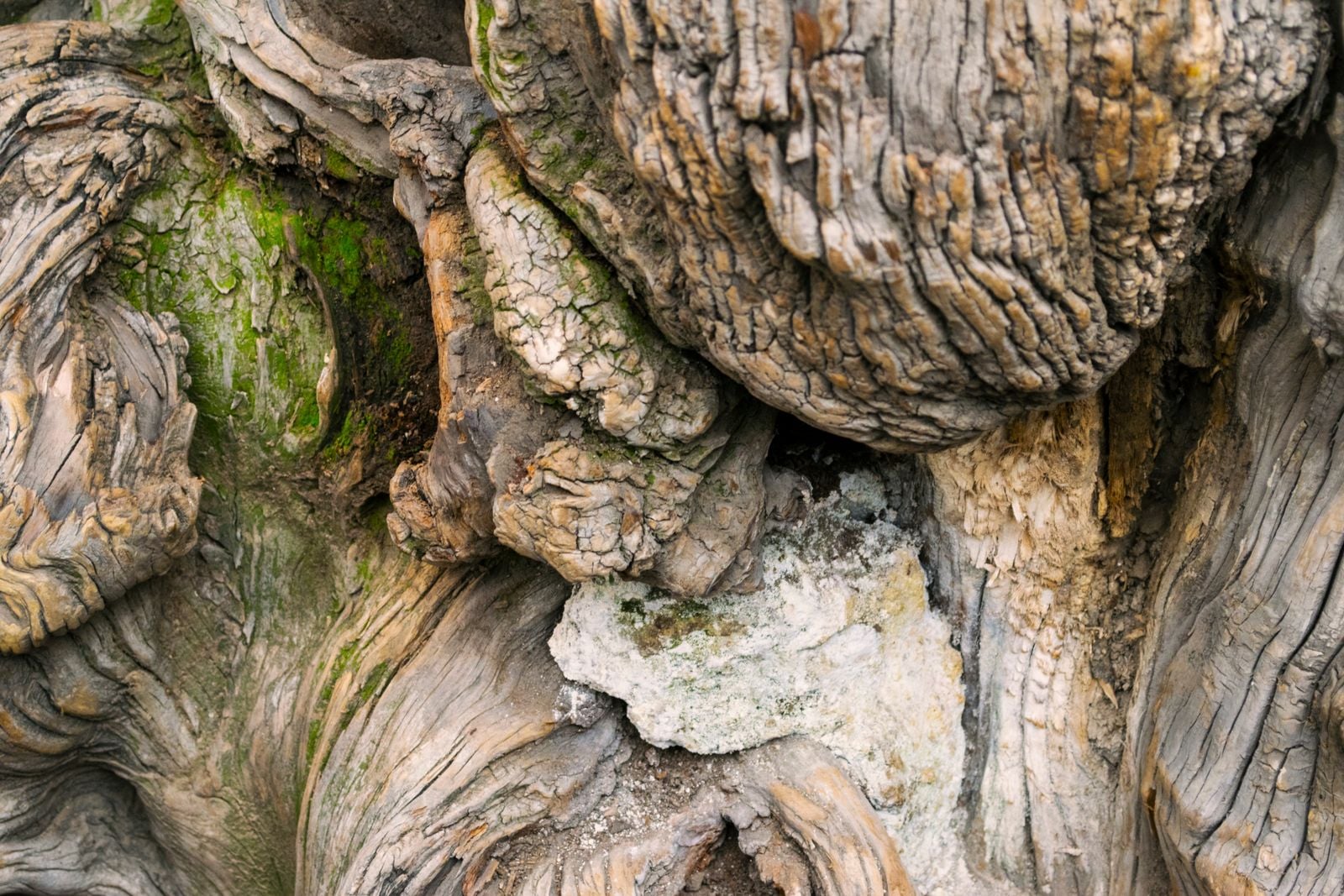
This is what soil so poor that almost nothing else survives beside it looks like in practice. It is a landscape that looks, on first glance, like something has gone wrong. The trees are half-dead. Great strips of bark have peeled off, exposing weathered heartwood polished by wind into shapes closer to sculpture than lumber. Often only a single narrow ribbon of living tissue connects the roots to a handful of green needles at the crown.
That partial-death is a survival strategy. When one section of the tree loses its cambium to lightning or fire or frost, the rest of the tree seals off that channel and keeps going. A bristlecone can operate on maybe five percent of its original vascular tissue and continue producing cones for centuries.
What the White Mountains tell us about the future
Constance Millar, the USDA Forest Service ecologist who co-authored the genome study, noted that the White Mountains bristlecone populations have persisted through nearly 11,000 years of climate extremes since the last ice age. The trees survived the Younger Dryas cold snap, the Holocene Climatic Optimum, the Medieval Warm Period, and the Little Ice Age — each of them a climate regime that would end most species.
But something has shifted recently. Bark beetles, previously excluded by cold, are reaching bristlecone elevations for the first time. Drought stress is measurable. Some individual trees have died since 2015 from causes that would have been impossible a century ago. The reference genome now exists partly so that land managers can, in Millar’s framing, identify genetic material that might help future bristlecones adapt.
Methuselah is not on the front line of that stress. It sits at the elevation and orientation where the species has thrived for eleven millennia. But the fact that the question is being asked — whether a 5,000-year-old organism might need help getting through the next century — is itself worth sitting with.
Standing under the tree
If you walk the Methuselah Trail in Inyo National Forest, at somewhere around 10,000 feet, you are moving through a grove where roughly a dozen trees have been alive longer than any human civilisation you can name. The air is thin. The wind is constant. The wood underfoot cracks like old bone.
One of those trees germinated when someone in Egypt was hauling limestone toward what would become the tomb of Khufu. It is still alive. It made a millimetre of new wood last summer. It will probably make another millimetre next summer. It will still be there, quietly, when everyone reading this sentence has been dead for a thousand years.