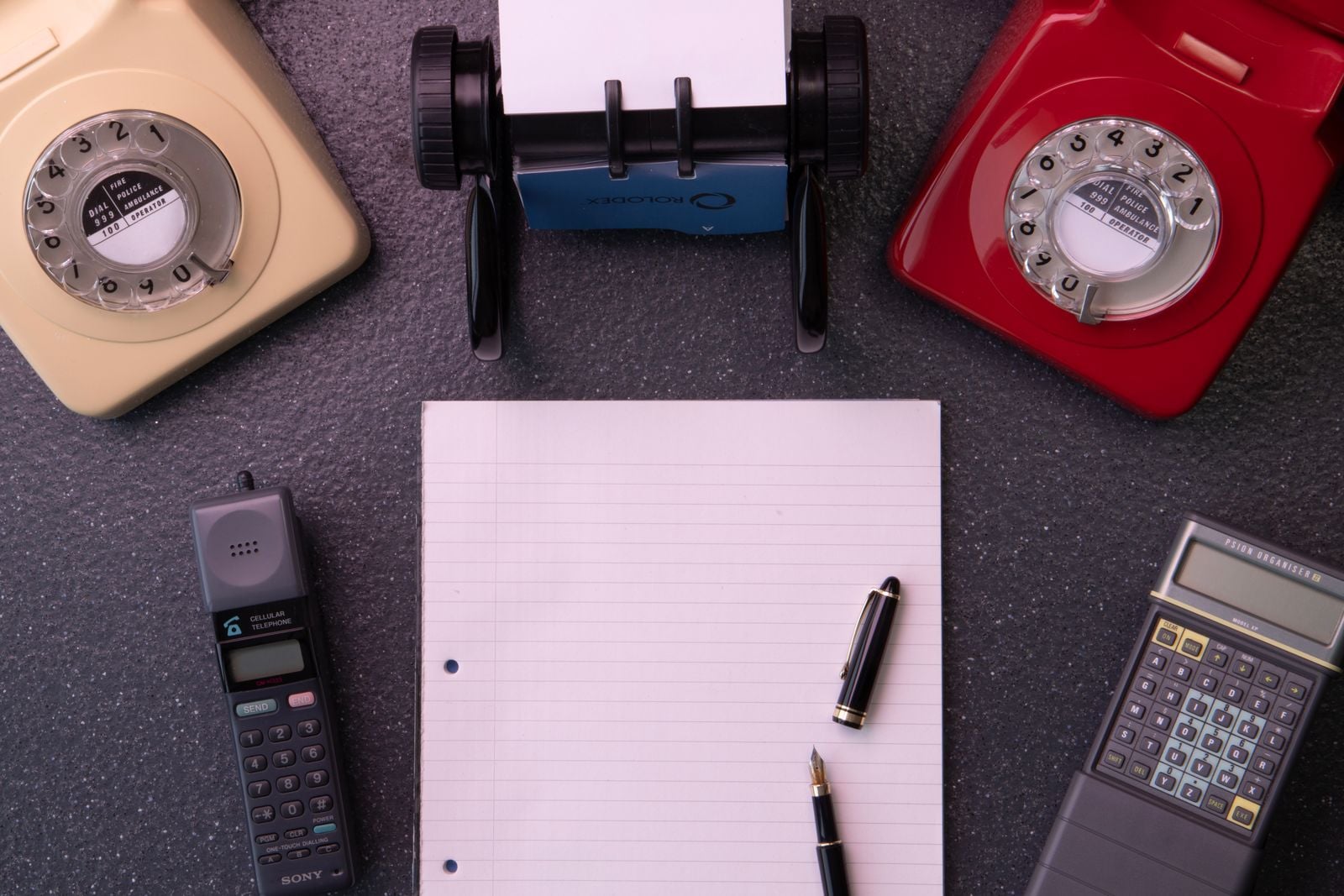
The people who can still recite a dozen phone numbers from memory aren’t cognitively superior. They were simply trained by an environment that demanded it, and that environment quietly disappeared in the years around the first iPhone.
Before 2007, remembering things was infrastructure. You memorised your best friend’s landline because otherwise you couldn’t call her. You held your route to the new job in your head because there was no turn-by-turn voice to hand it back to you at each junction. You knew your bank details, your passport number, the birthdays of six cousins, the opening hours of the corner shop.
None of this made anyone smarter. It made them practised.
What the older generation actually built
What that generation built was a specific, unglamorous kind of everyday recall: strings of digits, spatial maps of cities, sequences of directions, small logistical facts about the people around them. It was maintained the way any skill is maintained, through daily reps that nobody thought of as reps.
Then, over roughly a decade, almost every one of those reps went away. Contacts app. Google Maps. Autofill. Calendar reminders. The friend’s birthday surfaced by a notification rather than by memory. The route to the airport handed over to a voice on the dashboard.
This is what psychologists call cognitive offloading, and it has been discussed for a very long time. Plato complained that writing would ruin memory. Teachers once refused to let students bring calculators into exams. The Hackaday essay on cognitive surrender reaches back to an Einstein anecdote in which he refused to memorise the speed of sound because it was in a book. His point was that education should train the mind to think, not to store.
The interesting thing is that Einstein’s argument was correct. Offloading is not the same as decline. But offloading does mean the underlying skill goes quiet.
Why this looks like sharpness but isn’t
When someone in their sixties rattles off their sister-in-law’s mobile number without pausing, it feels like a demonstration of a better brain. It isn’t. It’s a demonstration of a habit that was practised thousands of times in an environment where the alternative was a paper address book and a lot of frustration.
Younger people are practising different things. Adults under 34 now make up the majority of global users of conversational AI tools, according to a June 2026 Digital Journal analysis. They are practised at querying, at prompting, at scanning synthesised responses for what looks trustworthy. Whether those skills are as valuable as memorising a phone number is a separate argument. But they are skills, built by daily reps in the environment those users happen to live in.
Each generation gets sharp at what the environment keeps asking of them.
The thing that never quite replaced it
Here is where the picture gets more uncomfortable. The everyday memory that the world stopped requiring wasn’t replaced by a new everyday memory of comparable weight. It was replaced by access.
Access is not the same as recall. When your route to a new place lives entirely inside an app, you can get there without ever building a mental map of the city. When your appointments live in the calendar, the shape of your week is something you consult rather than something you carry. This is what researchers describe when they talk about distributed cognition: the mental work moves out of your head and into the tools you use.
A Popular Science piece on offloading makes the reasonable point that this trade is not automatically bad. Freeing up mental space is often useful. Books did it. Notebooks did it. The question is what you do with the freed capacity.
The older generation freed capacity from, say, doing long division in their heads, and used some of it to memorise the phone numbers of everyone they cared about. The younger generation has freed capacity from phone numbers, addresses, and routes, and the question of what fills that space is genuinely open.
Where the risk sits
The risk isn’t that anyone is getting stupider. Every generation has been accused of that by the one before it, and every accusation has aged badly.
The risk is subtler. When you offload a task to a calculator, the calculator gives you a deterministic answer you can sanity-check. When you offload a task to a chatbot, you get a fluent, confident-sounding answer that may or may not be correct. The Hackaday essay draws on a study by Steven Shaw and Gideon Nave at the University of Pennsylvania, in which one group of test subjects had access to a chatbot that gave correct answers and another had access to one that gave wrong answers. The subjects used the chatbot heavily either way, and their results tracked the chatbot’s accuracy rather than their own.
This is what the essay calls cognitive surrender, as distinct from cognitive offloading. Offloading is handing off the task and keeping the judgement. Surrender is handing off both.
The everyday memory of the pre-2007 generation had a hidden feature that doesn’t get talked about. It kept a small internal check running in the background. If the route you memorised didn’t feel right, you noticed. If the phone number you dialled reached a stranger, you knew you’d misremembered. The feedback was fast and it was yours.
What the comparison actually tells us
None of this is a case for going back. Nobody wants to memorise a hundred phone numbers again, and the older generation would be the first to say so once they got used to the alternative. The comparison is useful only because it makes something visible.
Each era rewards a specific bundle of everyday cognitive habits. When the environment stops rewarding a bundle, the bundle fades, and it fades quickly. What replaces it is whatever the new environment happens to reward, which is not necessarily the thing you would have chosen if you were designing a curriculum for human minds.
The pre-2007 bundle happened to include: holding numbers, holding routes, holding small facts about people, and holding a rough internal check on whether the world matched your model of it.
The post-2007 bundle includes: searching well, scanning fast, holding attention against interruption, and, more recently, prompting well. Whether it also includes a rough internal check on whether the world matches your model of it is the part still being sorted out.
The quieter takeaway
Field Notes has written before about how people who grew up writing things down by hand seem to process experience differently. It’s a related pattern. A physical, effortful daily habit is doing a job that nobody named at the time. When the habit disappears, so does the job, and the replacement often does something adjacent rather than something equivalent.
The Field Notes beat has come back to this shape a few times. In an earlier piece on the habit of preparing for conversations that never happen, the same pattern showed up. A behaviour that looks like a personality trait turns out to be an adaptation to conditions that may no longer exist.
The generation that memorised phone numbers isn’t sharper. They were trained, thoroughly and without noticing, by a world that has now largely gone. What they had wasn’t a better mind. It was a set of reps.
The interesting question isn’t whether we should mourn those reps. It’s what the current reps are quietly building, and what small internal check we might want to keep running while we build them.