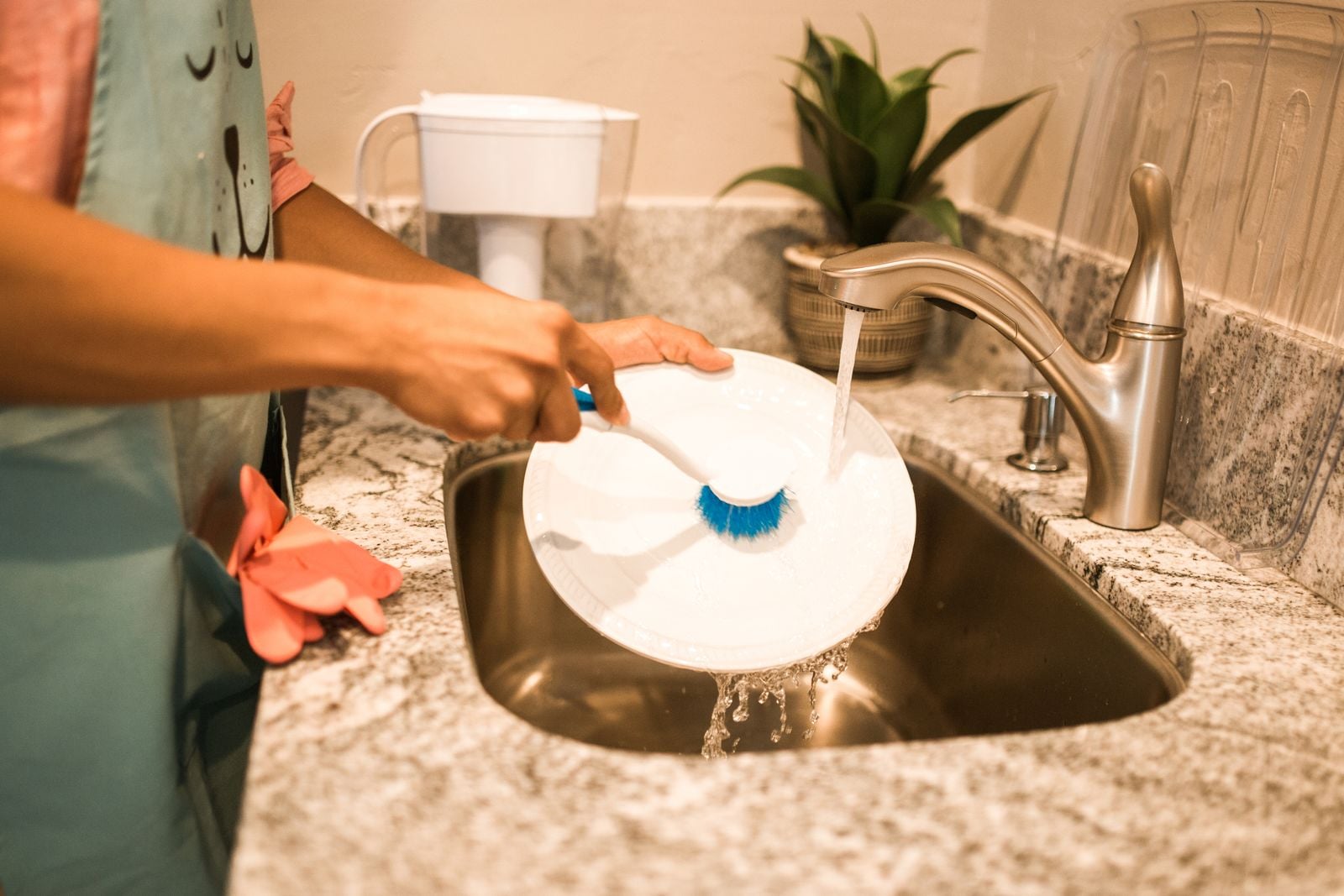
The person at the sink with their hands in warm water is not refusing modernity. They have simply noticed that some tasks reward being done slowly, and that the dishwasher, for all its efficiency, removes something from the evening that they would rather keep.
This is a small preference, easy to dismiss. It gets read as thrift, or nostalgia, or a mild eccentricity in a household that could afford otherwise. The people who do it rarely explain themselves, partly because the explanation sounds precious when spoken aloud.
But if you pay attention to what they actually get from the ten minutes at the sink, the picture is less quaint than it looks.
The task that doesn’t ask anything of you
Washing a plate by hand is one of the few remaining activities in an ordinary day that requires attention without requiring decisions. There is no notification. There is no optimisation. The water is the right temperature or it isn’t. The plate is clean or it isn’t.
Most of modern life runs on the opposite logic. Choices stack on choices, and even the small ones, which streaming service, which route home, which of six similar emails to answer first, use a form of low-grade cognitive effort that adds up over a day.
A sink of dishes closes that loop for a while. You are doing one thing, in one place, with a clear end state. This is not meditation in the formal sense. It is closer to ordinary attention brought to an ordinary activity, a principle that sits within a broader understanding of how repetitive, contained tasks can lower a person’s sense of being pulled in several directions at once.
The dishwasher removes the task. The person washing by hand is, quietly, keeping it.
What the sink actually does for the household
There is a more practical case, too, that gets ignored because it does not fit the tidy story about efficiency.
A 2015 study by Bill Hesselmar and colleagues at the University of Gothenburg, published in Pediatrics, the journal of the American Academy of Pediatrics, surveyed the families of 1,029 Swedish children aged seven and eight and found that hand dishwashing was associated with a reduced risk of allergic disease. Eczema in particular was less common in households where dishes were washed by hand than in dishwasher-using households. The effect grew when the family also ate fermented food or bought food directly from farms.
This is one study, not settled consensus. Speaking to reporters when the findings appeared, Hesselmar cautioned that his study was only observational and that more research was needed, including on the onset of asthma. It sits inside the broader, still-debated hygiene hypothesis, which suggests that early exposure to a small amount of microbial life may help train the immune system.
The finding is worth naming carefully. It does not mean hand-washing prevents allergies. It means that in this dataset, in these families, an association appeared. That is not nothing, and it is not a prescription.
What it does complicate is the assumption that the appliance is straightforwardly better.
The chore that ruins relationships, and the one that doesn’t
There is a counter-argument, and it is worth taking seriously. In a 2018 brief prepared for the Council on Contemporary Families, Daniel Carlson of the University of Utah reported that dishwashing was the task whose division mattered most to women in the couples studied. Those who did the lion’s share of it reported more relationship discord, lower relationship satisfaction and less sexual satisfaction than those who split it with a partner. Sharing the dishes was the single biggest source of satisfaction among all the household tasks measured, and not sharing them the single biggest source of discontent, which is why the research was covered at the time as the chore most likely to ruin a relationship.
This is the part of the story that gets missed when people romanticise hand-washing. The task is only restorative if you are choosing it. If you are stuck with it, night after night, while someone else scrolls on the sofa, it is not a small pocket of calm. It is resentment with a sponge.
So the argument is not that everyone should return to the sink. It is that the people who do it by preference, in a household where the labour is shared, may be onto something the efficiency argument misses.
Why the small task carries weight
Some small household tasks get psychologically heavier the longer they are left. The mug on the counter is trivial in the morning and faintly oppressive by evening. Dishes are the same principle at scale.
Loading a dishwasher defers the task in one sense and completes it in another. You have moved the plates, but the plates are still, in some low-priority mental drawer, unfinished until the machine has run and been emptied. Hand-washing collapses the whole cycle into a single event. The plate is dirty. The plate is clean. The plate is in the rack. There is nothing else to remember.
This is a small thing. But small things repeated nightly are not small.
The sensory case, without the marketing
There is also, plainly, the physical experience of it. Warm water on hands. The specific weight of a wet ceramic bowl. The sound the tap makes at a particular pressure.
The marketing industry has been paying attention to sensory experience for years. A Forbes piece on sensory marketing describes how retailers layer scent, sound and touch to create the feeling of comfort, familiarity and calm that they hope will translate into loyalty. Luxury hotels manufacture the sensory register that people at kitchen sinks arrive at for free.
The thing brands are trying to synthesise, in other words, is available in the ordinary act of washing a plate. Warm water is warm water whether you are paying for it in a spa or running it into a chipped bowl at ten at night.
The water argument, and why it isn’t the point
The other objection is environmental. Modern dishwashers, run full, generally use less water than hand-washing. Various consumer guides, including a summary from KATC, note that this depends heavily on how the hand-washing is done. Running the tap continuously wastes far more than filling a basin.
Practical guides such as this one on water-saving techniques point to scraping plates rather than pre-rinsing them under a running tap, filling a basin instead of letting the water run, and working in batches from the least dirty items to the dirtiest. The gap between a wasteful hand-wash and an efficient one is enormous.
So the water argument does not settle the question. It just means the hand-washer who cares about it has to be a slightly more considered hand-washer.
What the preference is actually about
The people who prefer washing dishes by hand are not usually arguing against dishwashers in principle. Most of them use one for the weekly load, the dinner party, the moment when the sink is full and the day has been long.
What they are protecting is a small window of activity that asks very little of them and gives back something specific: attention that settles, hands that are doing something with a clear point, a room that gets quieter as the pile shrinks.
You could describe this in the language of stress research, and it would not be wrong. You could also describe it in the language of a person who has noticed that they feel better after ten minutes at the sink than after ten minutes on their phone, and that is probably closer to how the preference actually forms.
It is not a rejection of the appliance. It is a preference for keeping one task in the day that stays the same size as itself.
The people who do this rarely explain themselves. When asked, they tend to shrug and say they just like it. That is usually the honest answer, and it is also, on inspection, a considered one.
The sink is still there. It works the same way it always did.