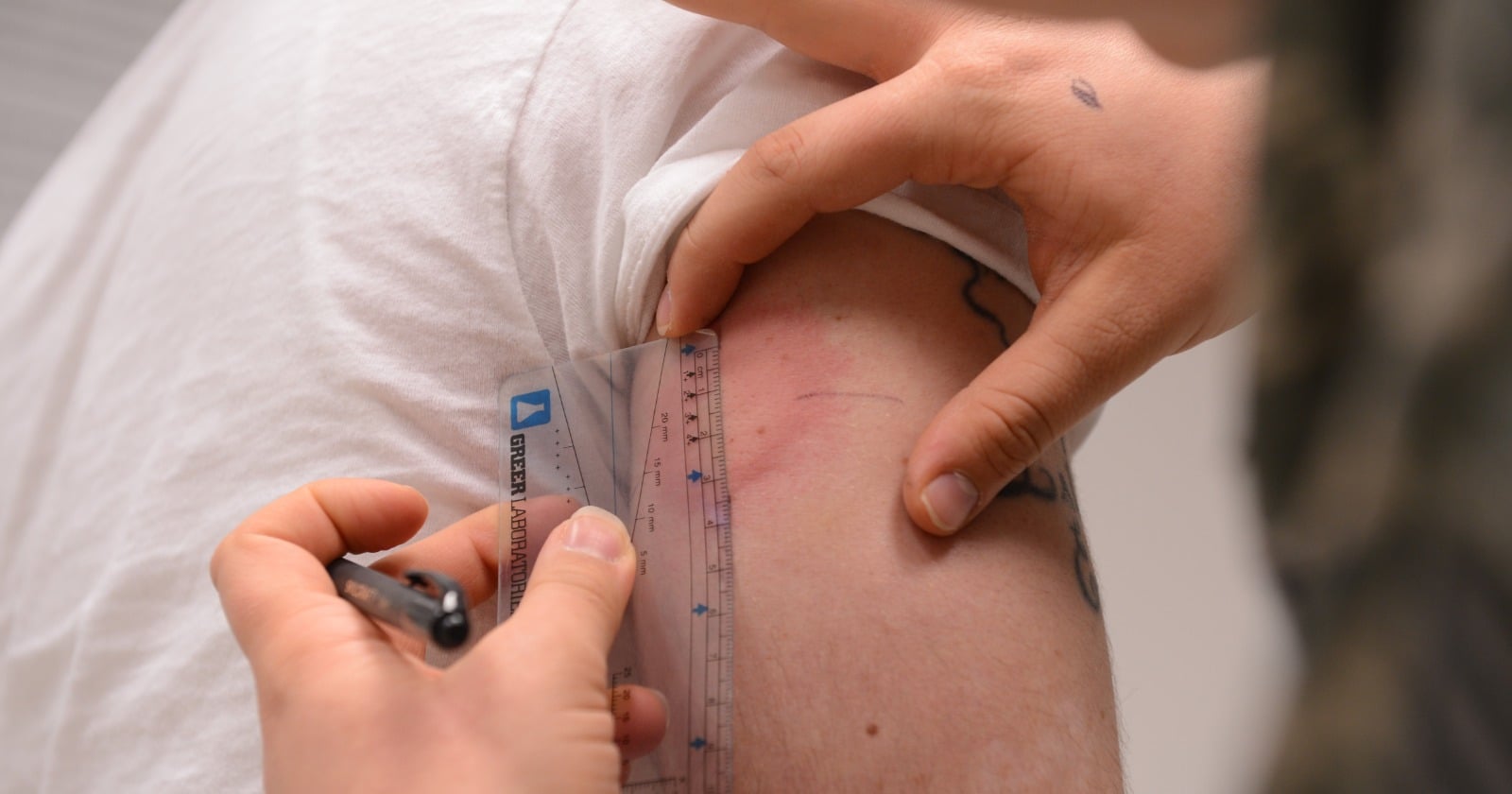
A drop of histamine sits on the middle third of a left forearm for thirty seconds. Then a trained experimenter, who does not know which condition this session is, wipes the residue away with a tissue. A lancet has already broken the skin underneath. Over the next twenty minutes a welt rises, a ring of redness spreads around it, and someone measures both with a ruler six times.
Everyone in the study went through that at least twice, three to five days apart, at the same hour of day. What changed between sessions was the instruction about where to put their attention. When participants were asked to keep it on the arm, the welt at its twenty-minute peak averaged 3.5 mm; when they were asked to watch video clips, 5.0 mm. Around nine in ten reacted more strongly under distraction.
The result was published in Nature Human Behaviour on 17 August. Nofar Mizrachi and Liron Rozenkrantz of Bar-Ilan University ran it with Menachem Rottem of the allergy and clinical immunology division at Emek Medical Center in Afula. Their claim is one sentence long. The attention manipulation used no drug, no training and no deception, and it changed a local inflammatory response while that response was happening.
Two sessions, three to five days apart
Inflammation was induced with a standardized histamine skin prick test, the same procedure allergy clinics use. It produces a reaction within minutes and peaks at fifteen to twenty. Wheal is the raised bump; flare is the red halo. Both were measured at one, three, five, ten, fifteen and twenty minutes while heart rate, skin conductance, skin temperature and pulse were recorded continuously.
In the first experiment, 37 participants kept their gaze on a screen in both conditions. In one, the screen showed a fixation cross and the instruction was to attend to the sensations in the pricked hand, returning there whenever attention wandered. In the other, the screen showed neutral video clips and the instruction was to attend to those. The flare followed the wheal: 10.6 mm under inward attention against 14.0 mm under distraction. The gap at the twenty-minute peak was large by the usual conventions, with a Cohen’s d of 1.30. Post hoc tests put the first significant difference at the three-minute measurement, where it was about half that size, and it widened from there.
Participants were told the experiment involved an allergy test, but not what was being manipulated, and the histamine and lidocaine were never named to them. At the end, eight of the 57 correctly guessed the link between attention and the skin reaction, and their results did not differ from everyone else’s.
Both conditions saw the same thirty-seven shapes
Watching videos and staring at a fixation cross are not the same task, and the authors ran a second experiment to deal with that. Twenty new participants saw identical visual input in both conditions: the same run of 37 abstract shapes, forty seconds each, in the same order. In one, each shape change was a cue to return attention to the arm. In the other, participants judged whether the shape could exist in real life. On a post-task effort rating the two conditions did not differ significantly.
Reactions came out about 1.6 times smaller under inward attention, and again 90 per cent of participants reacted more strongly under distraction. An objective check confirmed the instructions had worked: people told to watch the shapes remembered them better.
One result cuts against the intuitive reading of all this. In that second experiment, participants rated the itching and burning as stronger while attending to the arm. The reaction shrank as the feeling of it grew.
A smaller welt is not automatically a better one
Smaller wheal and flare measurements are conventionally read as more regulated immune activity, and that convention is what the paper’s framing rests on. The authors also write that reduced magnitude “may not universally reflect beneficial regulation,” because inflammation is a protective process whose useful size depends on context. Faster resolution may help in a sterile or excessive reaction. In an infection, the authors write, excessive blunting could compromise the body’s defences.
The scope is limited in other ways. This is histamine in the skin of healthy volunteers over twenty minutes, in a laboratory room under controlled light and temperature, with participants recruited between February 2024 and July 2025. Of the 57 analysed, 40 were women and the average age in each experiment was in the mid-twenties. No molecular or cellular mediator was measured, so the link between the attention and the skin is an inference from the pattern.
Two of the paper’s numbers need their status attached. The recovery analyses were not part of the pre-registration and the authors label them exploratory. That includes the comparison in which nearly 90 per cent of participants under inward attention had a stable or shrinking welt between the fifteen- and twenty-minute measurements, against 46 per cent under distraction, in the first experiment. In the second experiment the same recovery comparison ran in the same direction but did not reach significance, which the authors attribute to the smaller sample. Several secondary autonomic analyses that were pre-registered, including two standard heart-rate-variability measures, were not performed and are not reported. The one replication here is the authors’ own, in a cohort they recruited; the paper reports no independent replication.
Nothing in these experiments shows that attention shortens an illness, changes the course of an allergy, or substitutes for anything. Everyone in them was a healthy volunteer, screened to exclude asthma, past anaphylaxis, current infections, skin disease and antihistamine use, among other things. The authors raise the possibility that habitually distracting from symptoms contributes to conditions like chronic pain persisting, then say directly that this remains to be tested. This article is a report on one paper, written by journalists. It carries no clinical standing. Decisions about a symptom, or about whether to keep taking an antihistamine or a painkiller, belong with a doctor.
Three sympathetic measures flat, one vagal index up
Skin conductance, heart rate, skin temperature and self-rated anxiety were all indistinguishable across conditions, every comparison well short of significance. Pulse was recorded throughout and respiration in the second experiment; neither is reported.
Heart rate variability was the exception, running higher during inward attention. The difference is modest, and heart rate variability is an indirect index of vagal activity, which the paper says. The pattern still points one way. Three sympathetic measures and a self-rated anxiety score held flat while the single parasympathetic index moved, and it kept moving when the skin was numbed. On this evidence a vagal route is the better reading and generalised stress is a poor one.
Vagal traffic is an established anti-inflammatory route. The parasympathetic system does not directly innervate the skin, so any contribution here runs through the multi-step reflex the paper describes. Cortisol and other hormonal routes were not measured at all.
Numbing the skin weakened the effect without removing it
To test whether the sensations themselves were doing the work, 17 returning participants had 0.3 g of 5 per cent lidocaine cream applied over a marked three-by-three-centimetre patch before the prick, while holding attention on the arm. Topical anaesthetic is known to shrink the flare but not the wheal, so only the wheal was analysed.
Numbing mattered. The wheal came back about a millimetre larger under lidocaine than with sensation intact in the same people. But it did not account for everything: at 4.0 mm the numbed condition still undercut the 4.9 mm those same 17 produced under distraction. On the recovery measure it did not separate from distraction at all, which is a null on seventeen people rather than a match, while fewer participants settled under lidocaine than with sensation intact. The authors read that as sensory signalling contributing specifically to the resolution phase when attention is directed inward. These recovery comparisons were not pre-registered either, and fall under the same exploratory label. Lidocaine does not block every fibre type, and they note that residual sensory input cannot be fully excluded.
Distraction is already clinical technique
Looking away on purpose is deliberate practice as well as habit, including virtual reality during painful procedures, and the paper suggests such strategies may in some contexts carry a physiological cost. That is the claim with something at stake, and these experiments cannot settle it. Their design manipulated attention from the moment of the prick, so it does not fully dissociate an effect on how the reaction starts from an effect on how it ends. How far any of it generalises to infection, chronic inflammatory disease or autoimmune conditions is, in the authors’ words, unclear.
Earlier work did get an inflammatory response to move on command. Kox and colleagues had trained participants voluntarily activate the sympathetic nervous system during experimental endotoxaemia, which is the opposite autonomic branch from the one implicated here, and the one this study’s flat sympathetic readings make an unlikely explanation for its own effect. The forearm result, meanwhile, went online this month, and the technique it questions is in use in clinics today, on people with a real reason to look away.