

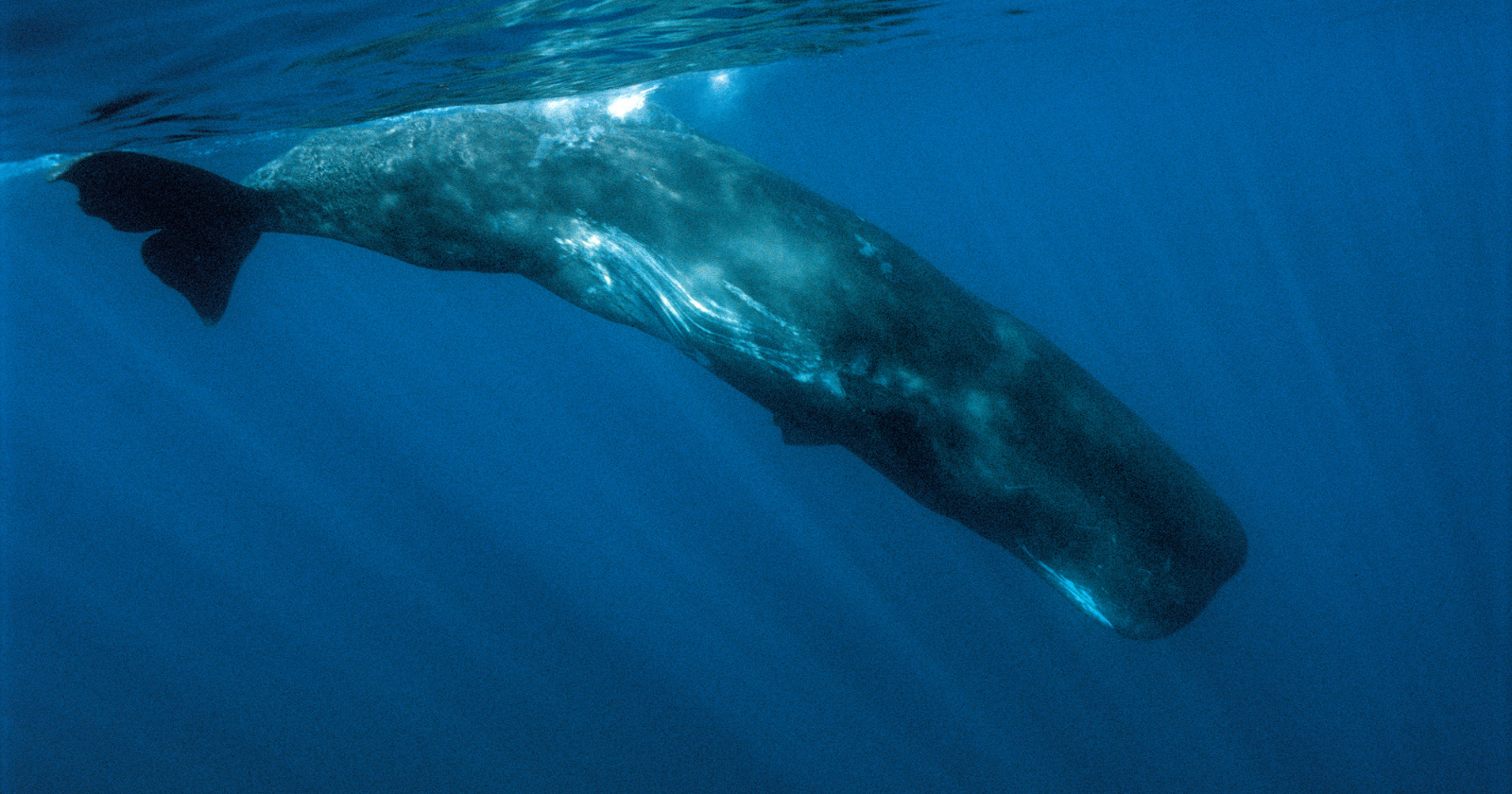
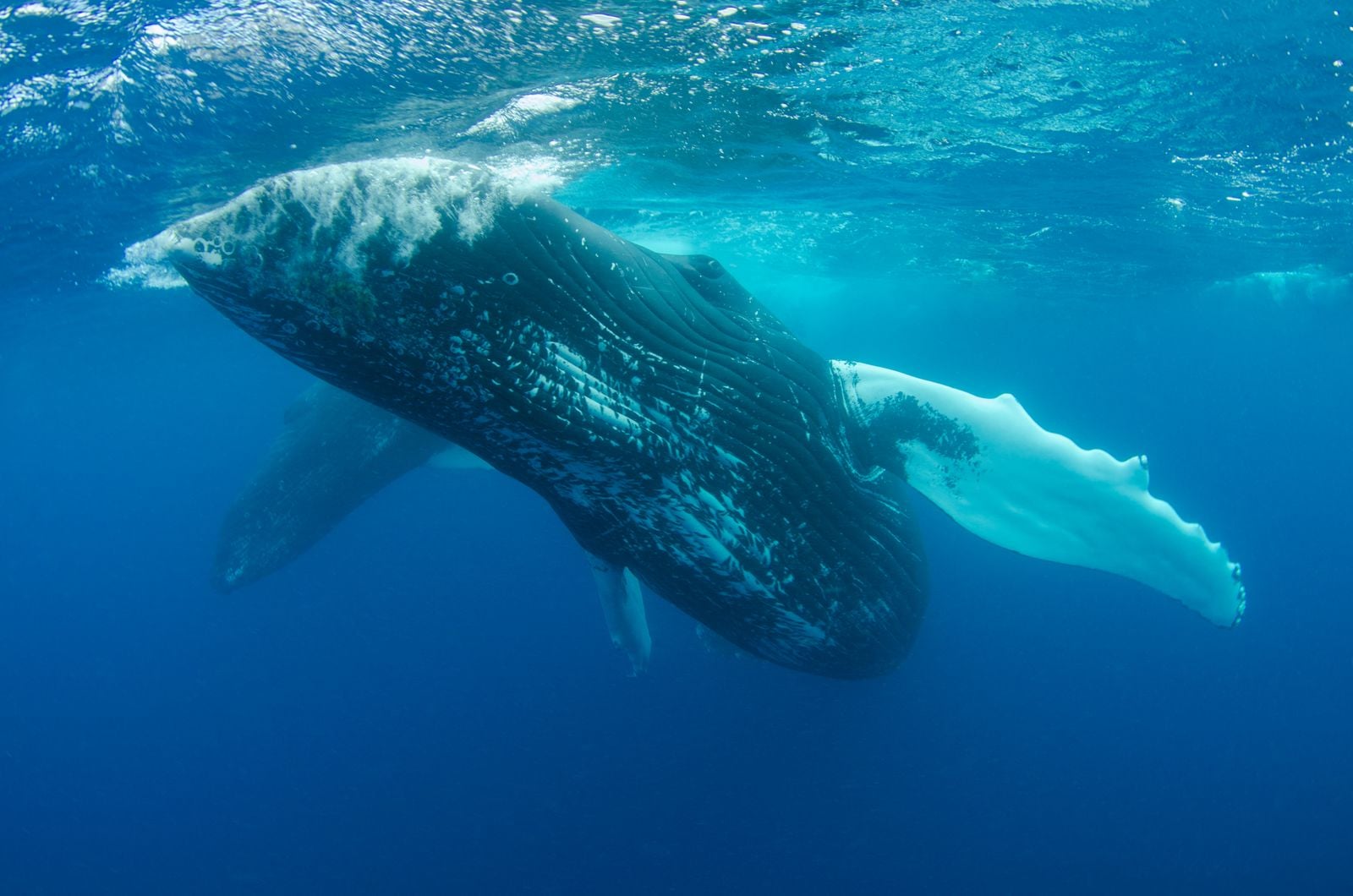
The tag data came back flat. For fourteen minutes and forty seconds, the instruments suction-cupped to the back of a wild sperm whale recorded almost nothing. No depth change, no roll, no pitch, no clicks. Then the animal exhaled, the sensors lit up, and the pod around it began to move again.
That stretch of silence was the first instrumented record of something whalers and yachtsmen had described for centuries but no one had quite confirmed. Sperm whales sleep standing up. Five or six adults hang vertically in the open ocean, noses pointed at the surface, tails drifting downward into the dark, completely silent and completely still. They stay that way for roughly fifteen minutes, sometimes a little longer, rarely much more, and then they wake, breathe, and move on. No other mammal sleeps so briefly, and no other mammal sleeps in that posture.
The tags recorded what no human eye had ever quite confirmed: the largest-toothed predator on Earth takes its rest in short, vertical naps, drifting like a cluster of waterlogged logs near the surface.
A posture no one expected
Sperm whales are massive. An adult male can reach lengths exceeding 15 metres and weigh dozens of tonnes, with a head that accounts for roughly a third of the body. That head is filled with spermaceti, a waxy organ that helps with buoyancy control and echolocation. When the animal stops swimming and stops actively managing its buoyancy, the dense tail sinks and the oil-rich head floats. The result is a whale standing on end in the water column, motionless, eyes closed.
The pods rest together. Researchers have observed groups of five or six animals lined up within a few body-lengths of one another, all facing the same way, drifting in formation. From the surface they look like a stand of pale tree trunks suspended just below the waves.
It is one of the strangest postures in the animal kingdom.
Tagging studies have revealed that sperm whales spend only a small fraction of their time in this drift-sleep state, amounting to less than two hours of sleep per day. That is among the least of any mammal yet measured. Many bats sleep close to twenty hours. Humans typically sleep eight. Giraffes manage only a few hours. The sperm whale sleeps even less.
Fifteen minutes, and then back to work
Each individual sleep bout lasts only a short time, typically around twelve to fifteen minutes. The whales then surface, blow, and either resume the drift or dive back down to hunt. This brief sleep cycle is unusual for another reason: the whales appear to sleep with both hemispheres of the brain at once.
That is the strange part. Most marine mammals, including dolphins, belugas, and eared seals, sleep unihemispherically. One half of the brain rests while the other half keeps the animal swimming, surfacing, and watching for predators. Sperm whales seem to throw that strategy out. During those brief windows they go fully offline, both hemispheres quiet, the entire body inert. If you motor a boat through a sleeping pod they sometimes do not react until contact is made. These deeply sleeping animals can be so unresponsive that a 50-tonne whale can be bumped by a hull before waking.
Why so little, and why standing up
The short answer is that sperm whales cannot afford much sleep. They are obligate breathers. Every breath is a conscious act, and they hunt squid at considerable depths, holding their breath for extended periods at a time. A pod’s daily schedule is built around long foraging dives separated by short surface intervals. There is simply no large window for rest.
The vertical posture probably emerged from a combination of anatomy and physics. The spermaceti organ shifts the whale’s centre of buoyancy forward of its centre of mass, so when the animal goes limp it naturally tips head-up. Comparative studies of cetacean evolution and paleobiology trace these adaptations back through tens of millions of years of refinement, as terrestrial ancestors moved into the sea during the early Eocene and reshaped their skulls, sinuses, and breathing reflexes to handle aquatic life.
The depth-handling itself is a remarkable feat. A recent paper looked at why ancient marine crocodiles, the thalattosuchians, never managed deep diving the way cetaceans did. The team from the University of Southampton found that the thalattosuchians’ large snout sinuses would have compressed dangerously under pressure, ruling out deep dives. Whales, by contrast, lost those bone-enclosed sinuses and developed external air sacs that could equalise. That is the same anatomical revolution that lets a sperm whale dive a kilometre and then nap vertically at the surface.
The pod as a single sleeping body
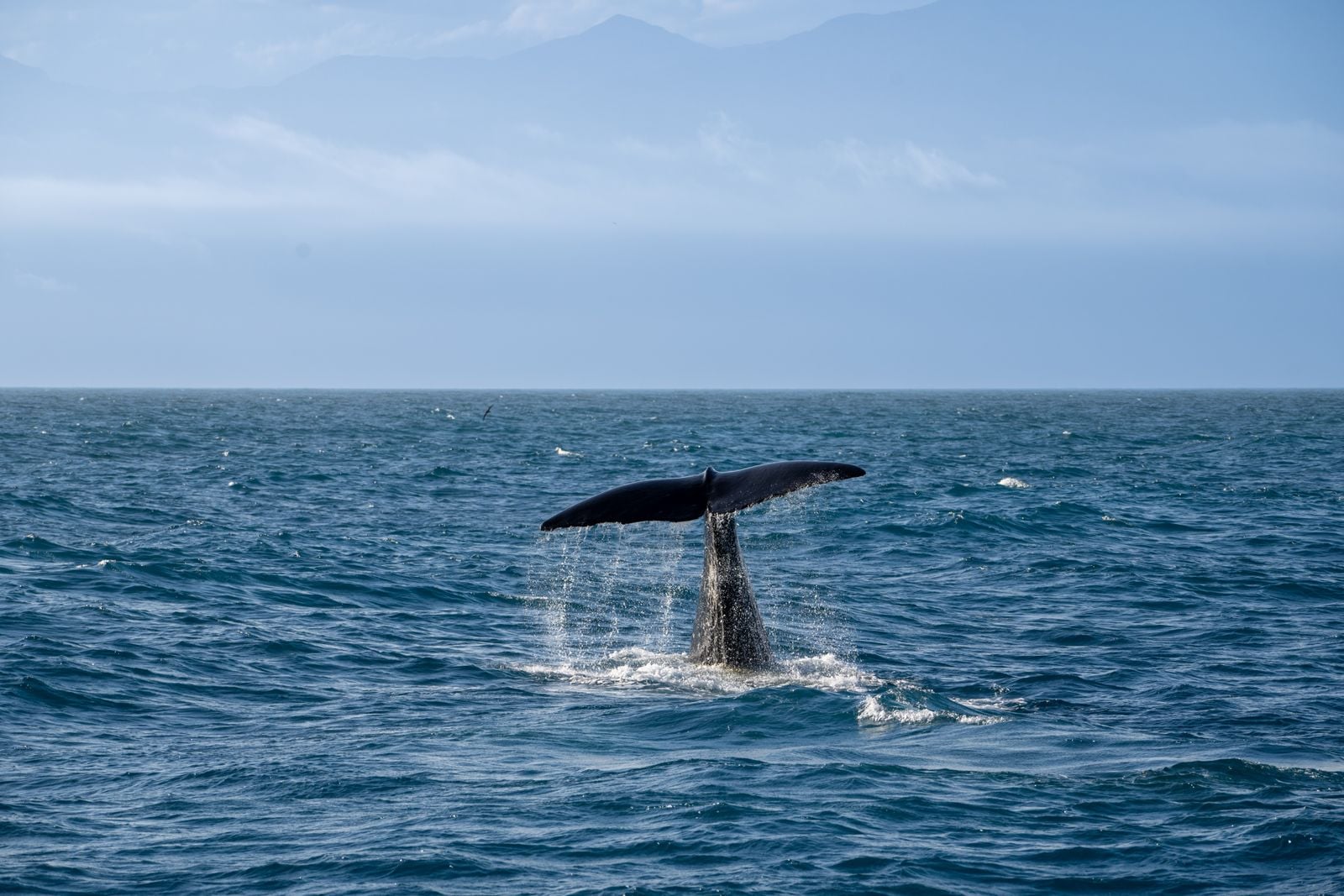
A sleeping pod is not random. The whales align themselves so closely that some researchers describe the formation as a single resting unit. Calves are typically positioned in the middle. The adults around them face the same compass direction, the whole arrangement drifting slowly with current and wind.
That coordination matters because sperm whale society is built on cooperation. Project CETI recently announced two studies documenting a rare sperm whale birth and the cooperative care behaviour around it. Adults from across the social unit converged on the newborn, attending to it, and protecting it in ways that suggest the behaviour is ancient and culturally transmitted. The same social glue that makes a birth a group event almost certainly makes sleep a group event too. A lone sperm whale rarely drifts. A pod does.
How the behaviour was finally caught on tape
Before systematic tagging work, the drifting posture was known mostly from whaler accounts and the occasional surprised yachtsman. The breakthrough came from miniaturised digital acoustic recording tags (D-tags) suction-cupped to the animals’ backs. The tags logged depth, pitch, roll, heading, and sound. When a tagged whale fell silent and stopped moving, the instruments revealed exactly what was happening: the body was drifting upward at a steep angle, the flukes hanging down, the click train of echolocation gone quiet. Drone footage has since extended the picture. The same kind of overhead camera work that produced the first video evidence of sperm whales headbutting, recorded near the Azores and Balearic archipelagos, has also captured drift-sleeping pods from above. The Smithsonian noted that these methods are opening up sperm whale behaviour in ways the old whaling-ship observers could never have managed. The animals are filmed without being disturbed. The patterns emerge from hours of overhead video.
The shortest cycle of any mammal
The comparative framework for mammalian sleep is well established. Slow-wave and REM sleep alternate in cycles that vary enormously across species. Sperm whales, on current evidence, cycle in roughly twelve to fifteen minutes from start to surface, and a full night’s worth of sleep adds up to less than two hours.
Whether that fifteen-minute window contains anything like REM sleep is still unsettled. Recordings of brain activity in a free-swimming sperm whale are nearly impossible to obtain. Researchers have inferred sleep stage from behaviour and posture rather than from electroencephalography. The broader question of how sleep states are structured and modulated across vertebrates, including non-mammalian models like the lizard Pogona vitticeps, which exhibits hundreds of sleep cycles per night, has been a productive front in recent comparative sleep research. The lizard work suggests sleep architecture is far more variable across species than once thought, which makes the sperm whale’s compressed cycle a little less alien and a little more like one extreme on a long evolutionary continuum.
What the silence sounds like
A waking sperm whale is one of the loudest animals on Earth. Its echolocation clicks can exceed 230 decibels at the source, louder than a rifle shot at the muzzle. Pods talk to each other in patterned bursts called codas, and individual whales produce slow trains of foraging clicks that can be heard on hydrophones from kilometres away.
A sleeping pod produces none of this. Acoustic tags have recorded a complete fall-off of sound during the drift periods. No clicks, no codas, no movement noise from the flukes. For fifteen minutes the loudest animal in the ocean is the quietest object in its corner of the sea.
The contrast with other long-lived cetaceans is striking. Bowhead whales, which can live more than two hundred years in the Arctic, sleep in patterns that have barely been characterised at all, largely because the sea ice and the cold make them so hard to follow. Sperm whales, by contrast, surfaced in warm tropical and temperate waters where tagging is possible, and so they became the first deep-diving cetacean whose sleep was caught on instrumentation.
Fifteen minutes in the open ocean
The pod hangs there. The water is dark blue going to black beneath them, sunlight falling in shafts through the upper few metres. The calves are tucked between the adults. The flukes drift gently with the swell. A dorsal-side suction cup tag records nothing for fourteen minutes and forty seconds: flat lines on depth, pitch, roll, sound.
Then one of the whales lifts its head, exhales a tall mist into the air, and the cluster reanimates. The clicks start again. The pod tilts forward, beats once with the flukes, and slides back down toward the squid.
But what was happening inside those fifteen minutes? If both hemispheres really do go quiet, is the sperm whale unconscious in the way a sleeping human is unconscious, or is it something else, something compressed and stranger? Why did evolution settle on two hours a day when nearly every other mammal needs more? And what is the cost of sleeping that little, paid in tissue or memory or attention, that we have not yet learned how to measure? The tags can tell us when the whale is still. They cannot yet tell us what, if anything, it is dreaming.
