

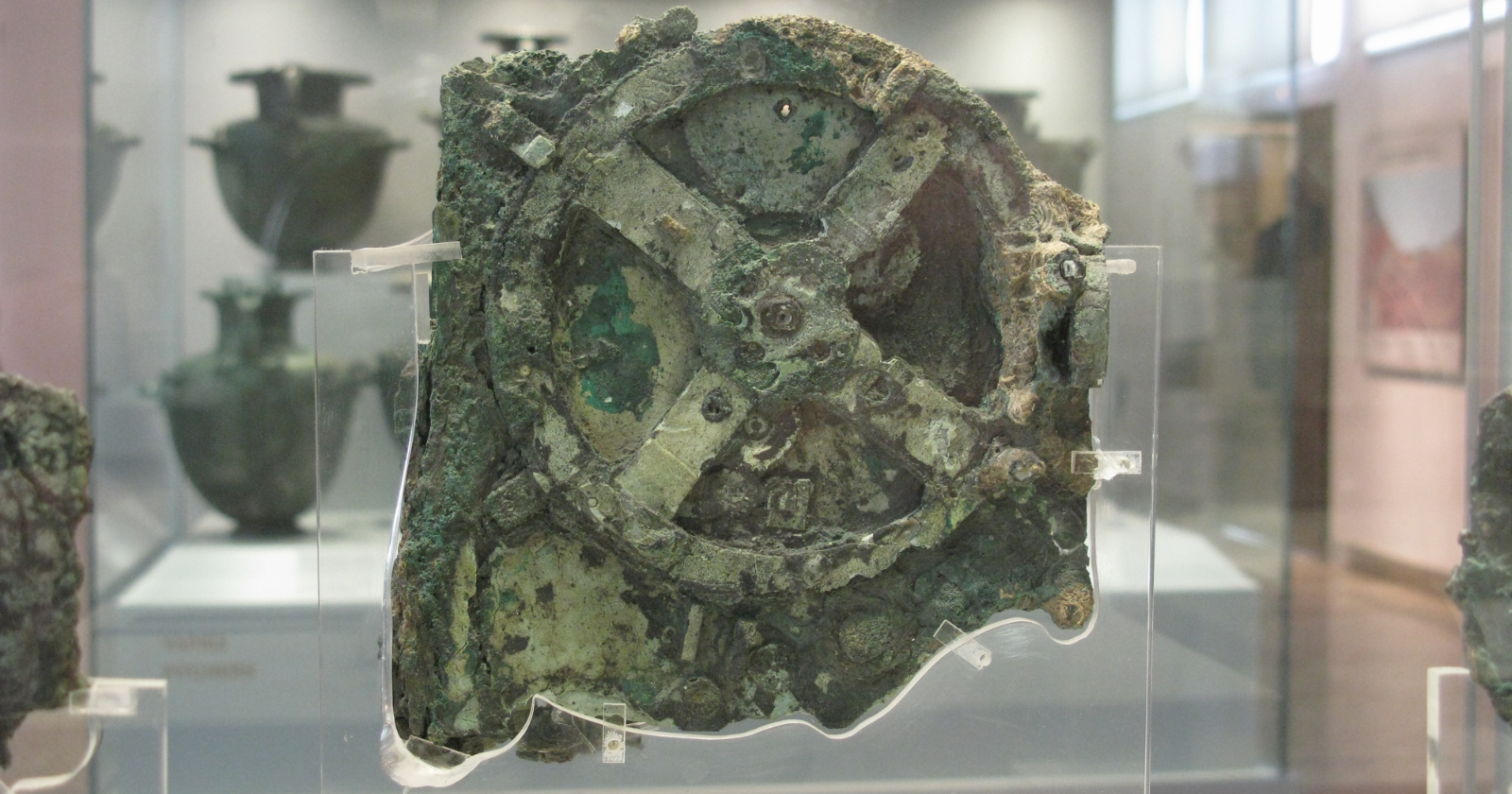
The fragments of the Antikythera mechanism were recovered during the 1900–1901 investigation of a shipwreck off the Greek island of Antikythera. Gear teeth attracted scholarly attention in 1902, rather than remaining unrecognised for another half-century.
Early research, followed by better imaging
The National Archaeological Museum’s history identifies a first research period from 1902 to 1934 involving archaeologists, naval officers and philologists. The mechanism was difficult to interpret, but it was not simply ignored in a drawer until the 1950s.
Derek de Solla Price’s later work, and radiographic investigations with Christos Karakalos, advanced understanding of the internal gearing. Subsequent imaging and inscription research revealed much more of its astronomical functions.
What the gears actually did
Price published his findings in 1974 in a paper called Gears from the Greeks. He described the device as a calendrical computing machine. The next 50 years of imaging, by teams using techniques that did not exist in Price’s time, filled in what he could only guess at.
In 2005, an international group led by Tony Freeth and Mike Edmunds, with engineers from the imaging firm X-Tek Systems, wheeled an eight-tonne microfocus computed tomography scanner into the Athens museum. The machine, built specifically for the job, fired X-rays through the fragments at resolutions fine enough to read inscriptions hidden inside the bronze corrosion. The results, published in Nature, mapped the gear train and decoded thousands of Greek characters that had been invisible for two millennia.
The mechanism was a hand-cranked analogue computer. Turn the knob on the side, and a network of bronze gears advanced pointers across a series of dials on the front and back faces. The front dial showed the position of the Sun and Moon against the zodiac and the Egyptian calendar. The Moon pointer used an ingenious pin-and-slot mechanism that varied the Moon’s apparent speed across the sky, representing the Moon’s varying apparent motion using ancient astronomical models.
One little silver ball rotated in a cutout to show the lunar phase. Black on one side, silver on the other.
The eclipse predictor on the back
Turn the device over and the back held two large spiral dials. The upper spiral was a 19-year Metonic cycle, the period the Babylonians had identified as the time it takes for the phases of the Moon to recur on the same days of the solar year. The lower spiral was a 223-month Saros cycle, the interval after which solar and lunar eclipses repeat in a near-identical pattern.
Glyphs around the Saros dial marked which months would carry an eclipse and roughly what time of day it would happen. The machine could tell a user in 80 BC that, say, 47 months from now, a lunar eclipse would occur in the evening. A bronze box, no bigger than a mantel clock, holding centuries of Babylonian observation translated into gears.

And then, the Olympics
The 2008 follow-up paper from the Antikythera Mechanism Research Project, again in Nature, added a finding nobody had expected. A small subsidiary dial on the back was inscribed with the names of athletic festivals: Olympia, Nemea, Isthmia, Pythia, and two more. Naa at Dodona and a sixth that may have been Halieia on Rhodes.
This was the Games dial. It rotated once every four years, tracking the schedule of the Panhellenic athletic cycle. The same machine that warned of eclipses also told the user when to expect the next Olympic Games. The inscription naming Olympia is still visible in the CT scans, the Greek letters cut into bronze that had been salt-water-soaked for two thousand years.
The presence of festivals like Naa, held in northwestern Greece, has led some researchers to argue the device was built for a customer in that region, possibly Epirus or Corinth, rather than the more famous astronomical centres of Alexandria or Rhodes.
Who built it
Nobody knows for certain. The leading candidates are the school of Hipparchus on Rhodes or someone working in the tradition of Archimedes, who according to Cicero built a similar planetary device that was carried to Rome after the sack of Syracuse in 212 BC. Cicero’s description of Archimedes’ machine, in De Re Publica, is one of the only ancient written hints that devices like this existed at all.
The shipwreck dates suggest the mechanism was being transported from somewhere in the eastern Mediterranean toward Rome, possibly as plunder or as a commissioned gift, when the ship went down on the rocks off Antikythera around 60 BC. The cargo was consistent with a Roman vessel hauling luxury goods west.
What is certain is that nothing of comparable mechanical complexity is known to have existed for the next thousand years. Geared astronomical clocks of similar sophistication do not reappear in the European record until the astronomical clocks of medieval Islamic engineers and, later, the cathedral clocks of fourteenth-century Europe. A gap of more than a millennium.
Why the lump sat unread for so long
Part of the answer is that the assumptions of early twentieth-century classicists did not allow for the possibility. Greek and Roman antiquity was supposed to be a world of philosophy, sculpture, and rhetoric, not precision engineering. When Stais pointed at gear teeth and said “clock,” his colleagues told him he was looking at intrusion from a later wreck.
The pattern is familiar in the history of science. Public perception of what an era was capable of often runs decades behind what the evidence on the ground actually supports. Frameworks shape what experts allow themselves to see. A bronze gear in 1902 was an anachronism. A bronze gear in 1974, after Price’s X-rays, was a discovery.
The Antikythera mechanism also sits inside a much older cultural pattern. Modern science writing, even at its most technical, keeps reaching back to Greek myth. To Prometheus, to Talos the mechanical guardian of Crete, to the oracle at Delphi, as an essay in The Conversation recently observed. The image of an ancient Greek bronze that could predict the future of the heavens fits that mythic shape almost too neatly, which may be part of why it took so long to be taken seriously, and why, once accepted, it became so famous so fast.
What the imaging revealed inside the bronze
The microfocus CT scans of 2005 and the polynomial texture mapping done by Hewlett-Packard’s research lab around the same time pulled roughly 2,000 Greek characters out of the corrosion. The mechanism turned out to carry its own instruction manual, engraved on bronze plates that wrapped the casing. Sections described what the dials showed and how to read them. A user manual written for a Hellenistic customer in the first century BC.
The text mentions the planets. Mercury, Venus, Mars, Jupiter, Saturn. The five known to antiquity. Some researchers, including Freeth’s group in a 2021 paper from UCL, argue that the front of the mechanism originally carried an entire planetary display, with concentric rings showing each planet’s position against the zodiac, driven by additional gear trains that have not survived. The reconstruction proposed by the UCL team uses 63 gears to produce the planetary motions described in the inscriptions.
If they are right, the front face was a complete cosmos in miniature — Sun, Moon, five planets, and the fixed stars — all advancing in synchrony from a single turn of a handle on the side.
The trace it left
The Antikythera mechanism is now in the National Archaeological Museum in Athens, displayed in 82 surviving fragments behind glass. Replicas exist in the Museum of Ancient Greek Technology in Athens, at the Smithsonian, and in private collections built by clockmakers who have tried to reproduce the gearing from scratch. A Lego version, built by Apple engineer Andrew Carol in 2010, demonstrated the principle using plastic bricks.
The history of computing tends to be told as a story of telegraphs, vacuum tubes, and silicon. Silicon Canals has traced how Samuel Morse’s first telegraph message in 1844 and how Ray Tomlinson sent the first email in 1971. The Antikythera mechanism sits at the back of that lineage, two thousand years before any of it, a hand-cranked bronze machine that ran a model of the sky and told an athlete from Corinth when to start training for the next Olympics. Its reconstruction developed over successive generations of research, starting soon after its recovery.
In Athens now, the 82 fragments lie behind glass in a darkened room of the National Archaeological Museum. The bronze has gone the colour of seafloor, green and grey, pitted where the salt water worked at it for two millennia. The largest piece is no bigger than a hand. Visitors lean in close to see the gear teeth, still meshed, still cut at their original angles. The handle is gone. The casing is gone. What is left is the geometry, holding its shape on a museum shelf, quiet under the glass.
Correction, 3 October 2026: The earlier headline and opening incorrectly said the mechanism remained unrecognised or ignored for decades. Its gears attracted attention in 1902 and a first research phase continued through 1934. The reference to Hipparchus describing an elliptical orbit has also been corrected.
