Cursor’s revenue story has the shape of a number that almost resists belief.
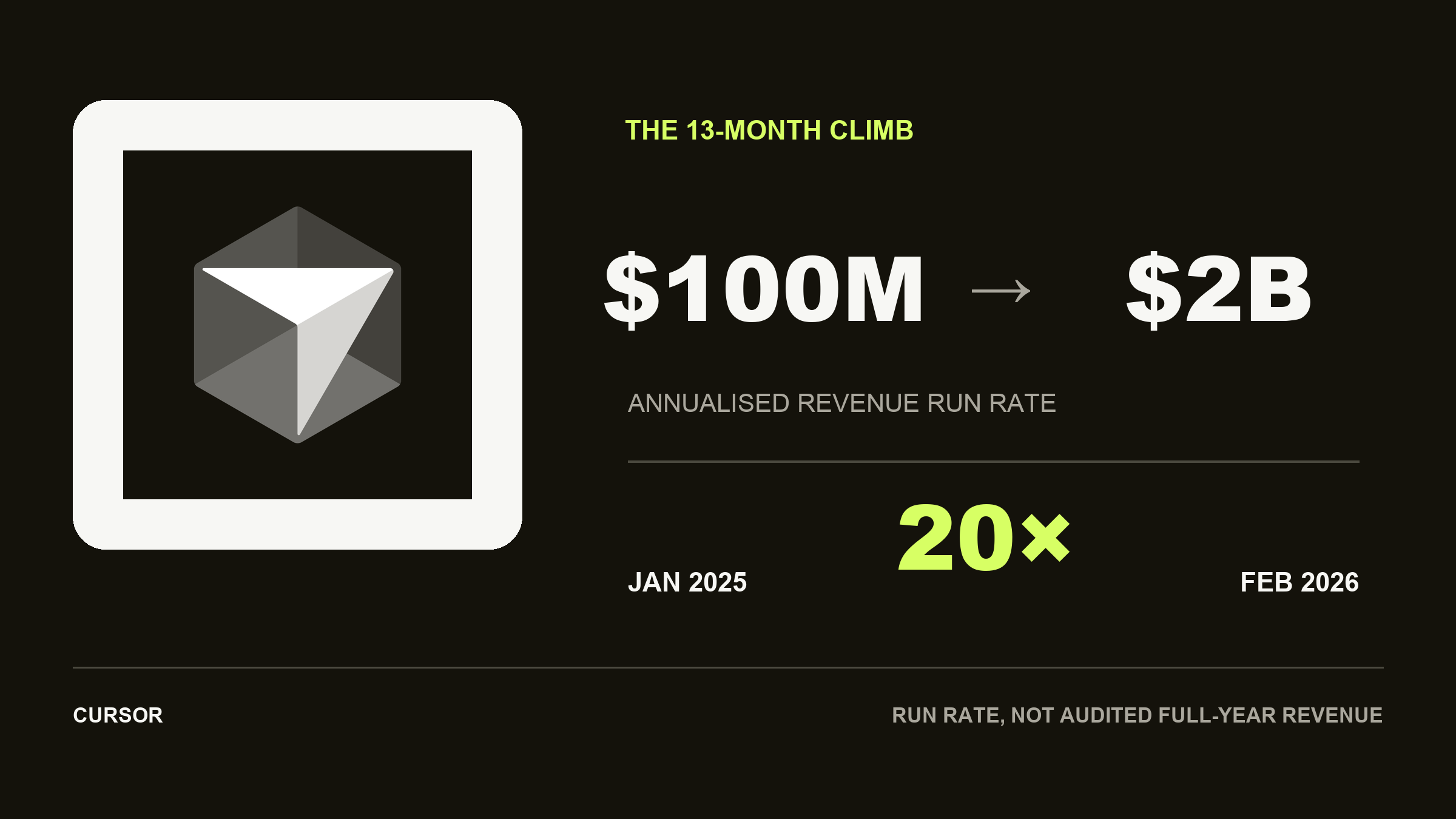
In January 2025, the AI coding editor was reported to have crossed $100 million in annual recurring revenue. Thirteen months later, Bloomberg reported that its annualised revenue run rate had passed $2 billion. The arithmetic is simple: a twentyfold increase.
The accounting is less simple. Neither number means Cursor collected that amount during the preceding 12 months, and the $2 billion disclosure did not come with audited accounts. It was a private-company run-rate estimate attributed to a person familiar with the business.
That does not make the expansion ordinary. Even with those caveats, moving from a nine-figure revenue pace to a $2 billion pace in 13 months is exceptionally fast for software. It outran the early reported growth of Slack and Zoom by a wide margin.
It is also no longer the latest number. A later report put Cursor at a $4 billion annualised run rate by June 2026. The $2 billion mark is best understood as one point on a remarkable curve, not a current snapshot or a completed fiscal-year result.
The 13-month climb
Sacra reported in February 2025 that Cursor had reached $100 million ARR during January. Its estimate placed the company at roughly $1 million ARR only 12 months earlier, although that earlier number was also an estimate rather than a public filing.
By June 2025, reports put Cursor at $500 million. The company then supplied the next firm marker itself. When Cursor announced a $2.3 billion Series D on 13 November 2025, it said it had passed $1 billion in annualised revenue.
On 2 March 2026, TechCrunch relayed Bloomberg’s report that the figure had doubled again to more than $2 billion during the previous three months. Cursor did not immediately respond to TechCrunch’s request for comment.
Put together, the milestones describe a curve that steepened as it grew: $100 million in January 2025, about $500 million in June, more than $1 billion in November, and more than $2 billion by February 2026.
A twentyfold gain over 13 months is equivalent to roughly 26 per cent compounded growth every month. That is a mathematical description, not a forecast. No serious reading should assume a business can keep compounding at that rate indefinitely.
What “annualised revenue” actually means
Run rate turns a recent period into a hypothetical full year. If a company is producing revenue at a pace of roughly $167 million a month, multiplying that pace by 12 gives about $2 billion.
The measure is useful when a company is growing too quickly for its most recent completed year to describe its present scale. It is also flattering to a business whose newest month is much larger than the months before it.
Run rate is not the same as revenue recognised under accounting rules over a completed 12-month period. It does not show how seasonal the business is, whether customers will renew, whether usage will fall, or how much of the current pace came from temporary incentives.
Cursor and reporting about it have also used “annualised revenue” and ARR somewhat interchangeably. For a subscription business, ARR usually refers to recurring contract value. An annualised revenue run rate can be broader, especially when usage charges vary. Without the underlying accounts, the precise composition is not public.
The cleanest formulation is therefore the least dramatic one: by February 2026, Cursor was reportedly generating revenue at a pace that would equal more than $2 billion if sustained for a year.
Slack and Zoom took longer, but the comparison has limits
Slack and Zoom make intuitive benchmarks because both converted a simple workplace tool into a large software business through product-led adoption. Their public filings, however, report completed fiscal-year revenue rather than private run-rate snapshots.
Slack’s 2019 S-1 listed revenue of $105.2 million, $220.5 million and $400.6 million for the fiscal years ended January 2017, 2018 and 2019. In two years, it moved from roughly the same starting scale as Cursor to about four times that scale.
Cursor’s reported run rate went from $100 million to five times that amount in roughly five months, then to twenty times it in 13 months. On the face of the reported figures, the acceleration was much faster.
Zoom’s annual report for the year ended January 2021 shows a different curve. Revenue rose from $151.5 million to $330.5 million and then $622.7 million across the three fiscal years before the pandemic-driven year in which it reached $2.65 billion.
Zoom therefore crossed from the low hundreds of millions to more than $2 billion in annual revenue over about three fiscal years, helped at the end by an extraordinary global event. Cursor’s reported run rate traversed a comparable range in about 13 months.
That supports the narrow claim that Cursor expanded faster. It does not make the figures identical. Slack and Zoom were filing recognised revenue under public-company rules. Cursor was reporting or being reported through annualised private-company estimates. The comparison is about velocity, not accounting equivalence.
Why a coding tool could grow this quickly
Cursor sits inside a task that software developers repeat throughout the day. A useful coding assistant is not opened once a week. It can become part of writing, navigating, debugging and reviewing code, which creates many opportunities to demonstrate value.
The product also had an efficient route into companies. Individual developers could adopt it with little organisational ceremony. Once enough people used it, Cursor could sell administration, security and team access to the employer.
That bottom-up route began to meet a top-down budget. According to the Bloomberg reporting summarised by TechCrunch, large corporate buyers accounted for about 60 per cent of Cursor’s revenue by the time it reached the $2 billion run rate.
Enterprise revenue can change the curve quickly because one agreement may cover hundreds or thousands of users. Corporate customers may also be less likely than an individual developer to switch tools over a modest price difference once access, security reviews and workflows are established.
Timing mattered too. Cursor arrived as businesses were willing to allocate new money to generative AI, and as strong general-purpose models became available through APIs. The company could build a product layer around those models without bearing the full cost of training every underlying model itself.
None of those conditions guarantees endurance. They help explain why revenue could accumulate unusually quickly during a period of concentrated demand.
The revenue figure leaves out the expensive part
Traditional software can serve one additional customer at very low marginal cost. AI coding products are different because each prompt, generated completion and agentic task consumes model inference.
Cursor may buy that inference from model providers, run some models itself, or combine approaches. The public run-rate figures do not disclose the mix. They also do not reveal gross margin, the amount of heavy usage being subsidised, or how model costs change as customers ask the software to do more.
That makes revenue quality important. A dollar of subscription revenue with a high and stable gross margin is not economically identical to a dollar that requires substantial, variable spending on someone else’s model.
The disclosed figures also reveal little about retention, customer concentration or discounts. A large enterprise share can make revenue more durable, but it can also leave a company dependent on a smaller number of big renewals.
There is competitive pressure from Anthropic’s Claude Code, OpenAI’s Codex, GitHub Copilot and other coding products. Developers can change preferences quickly, while enterprises move more slowly. Cursor’s shift towards corporate accounts may be both a growth strategy and a defence against volatility in the individual market.
These are not arguments that the revenue is weak. They are the questions a run-rate headline cannot answer.
The $2 billion milestone was already out of date
By the time the $2 billion figure had settled into industry comparisons, Cursor was reportedly moving again. Forbes reported on 8 June 2026 that annualised revenue had reached $4 billion, up from $3 billion in late April and $2 billion in February.
That later report was also a run-rate claim, not an audited full-year result. It should be read with the same care. It does, however, make clear that the 13-month journey from $100 million to $2 billion was not the end of the acceleration.
The funding followed a similar pattern. Cursor’s November 2025 round valued the company at $29.3 billion. Later fundraising discussions attached still higher numbers to it. A valuation records what investors agreed to pay for a stake under particular terms. It is not a verdict on eventual profit or durable market share.
Revenue growth and capital availability can reinforce each other. Faster sales support a higher valuation; more capital pays for model usage, enterprise sales, product development and infrastructure; those investments can support more sales. The loop works until growth, margins or investor appetite changes.
What the 13 months really show
Cursor’s climb belongs among the fastest software revenue expansions reported because the milestones are unusually compressed. Even after allowing for run-rate accounting, private disclosure and an AI spending boom, few software companies have moved from $100 million to a multibillion-dollar pace in barely more than a year.
The comparison with Slack and Zoom is useful precisely because those companies once looked fast. Their filings show how long it normally took a celebrated workplace product to turn early adoption into hundreds of millions of dollars in annual sales.
Cursor compressed that process by selling into a daily technical workflow, using individual developers as an entry point, expanding into large companies and arriving when buyers had new budgets for AI.
What the numbers do not yet show is just as important. They do not establish a full year of $2 billion sales, much less $4 billion. They do not reveal margins, renewal quality or the long-term cost of serving increasingly ambitious coding agents.
The honest version of the story is still remarkable. Cursor did not merely grow quickly. It reached a reported revenue pace in 13 months that earlier software leaders needed years, and in Zoom’s case a once-in-a-century demand shock, to approach. The remaining question is whether the economics underneath the curve can become as durable as the curve is steep.