

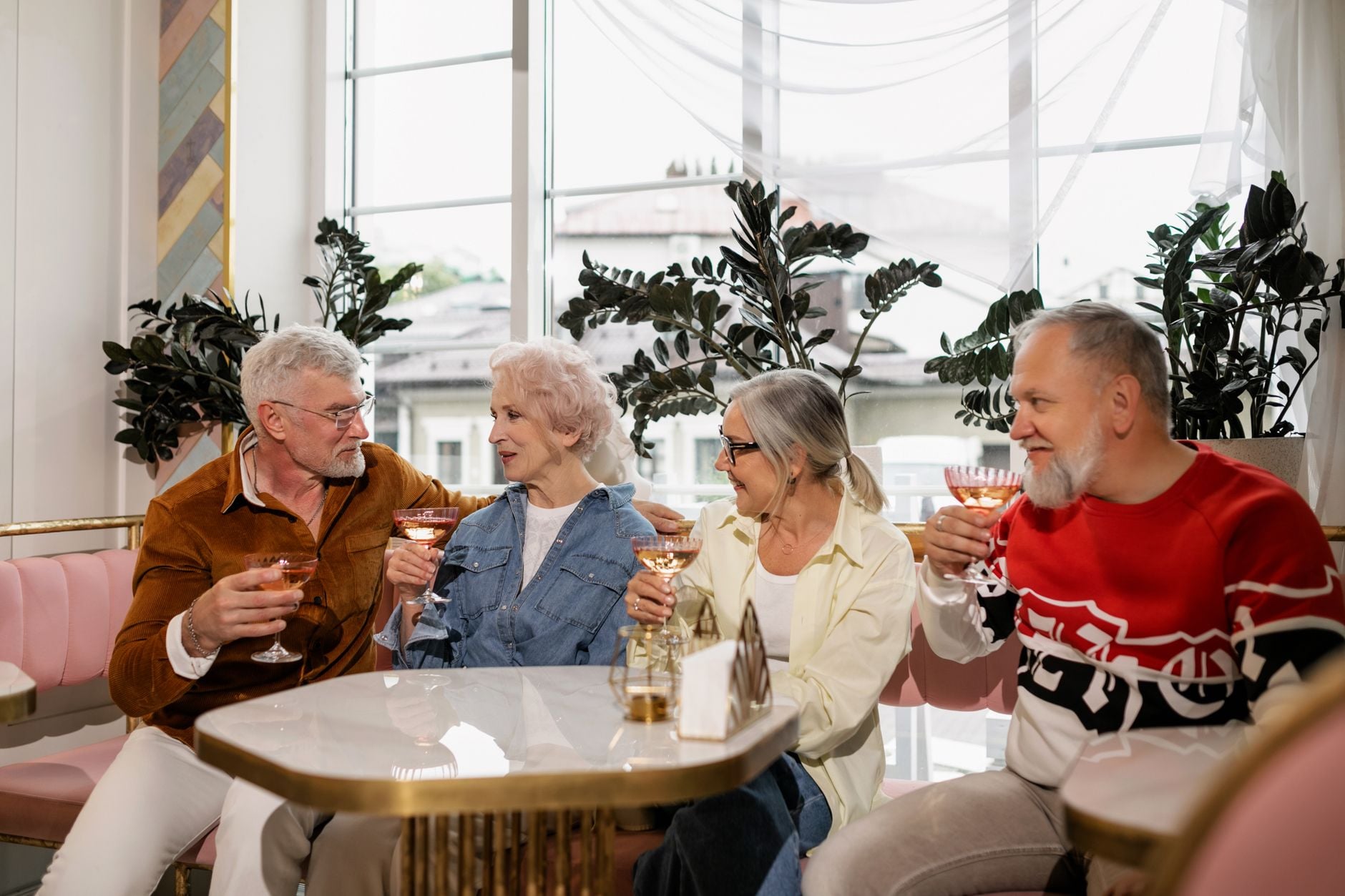
There is a particular kind of interruption that does not feel like an interruption at first.
You begin a sentence. Someone else enters before you have finished. Nobody turns back. The room accepts the new voice and carries on, leaving your unfinished thought behind as if it had never quite become part of the conversation.
This can happen to anyone, at any age, for reasons that have nothing to do with age. Some groups are impatient. Some speakers dominate. Some people are habitually overlooked because of gender, status, race, disability or temperament. No study cited here asked whether the first such moment makes a person feel old.
The research supports a narrower and more interesting claim. The age people feel is not determined only by their bodies or birth certificates. It responds to daily stress and to social information, including experiences people interpret as age discrimination.
A room that continues without you can therefore carry more than bad manners. In the right context, it can tell you something about the age the room has assigned to you.
Most adults carry an age that is not on their documents
Researchers call it subjective age: the answer to the question, “How old do you feel?” It is not a biological test and it does not replace chronological age. It is a self-assessment that condenses information about health, energy, social role, expectation and identity.
For many adults past midlife, that internal number runs younger than the calendar. Silicon Canals recently examined the long-running studies linking subjective age with health, memory and mortality. Those associations are important, but they can tempt us to imagine felt age as a stable personal trait: some people simply feel young and others do not.
Daily diary research suggests something more fluid. In a 2015 study in Psychology & Health, Dana Kotter-Grühn, Shevaun Neupert and Yannick Stephan asked 43 adults aged 60 to 96 to report their felt age, health, stressors and emotions for eight days. Participants felt older than usual on days when they reported more health problems, more stress or more negative emotion.
The sample was small, and the study did not establish which variable caused which. Its value is in showing that subjective age moved within the same person. It was not merely a fixed opinion recorded once.
The body provides cues, but so does the social world
A larger study gives the social part of the argument more weight. In 2015, Yannick Stephan, Angelina Sutin and Antonio Terracciano analysed 4,776 participants from the US Health and Retirement Study. Their average age was about 68.
The researchers considered both perceived age discrimination and physical measures including grip strength, lung function, waist circumference, blood pressure and telomere length. Their paper in PLOS ONE found that people reporting age discrimination felt about two percentage points older than those who did not. For a 68-year-old, the adjusted difference was roughly one year.
Some physical signals were associated with felt age too. Stronger grip and better peak respiratory flow were linked with feeling younger, while a larger waist circumference was linked with feeling older. Blood pressure and telomere length were not associated with subjective age in the analysis.
That pattern is useful because it resists a false choice. Feeling old is neither “all in the mind” nor a direct reading from the joints. The body supplies noticeable information about effort and capacity. Other people supply information about status, competence and belonging. Subjective age appears to take in both.
The authors were careful about causality. Their study was observational. Perceived discrimination may contribute to feeling older, but an older subjective age might also influence how ambiguous treatment is interpreted. The association was modest, and many other factors shape how old a person feels.
Being talked over can become an age cue
The room in the opening scene was not part of that study. It is an interpretation built from the kind of everyday treatment discrimination research does measure.
In the English Longitudinal Study of Ageing, researchers asked 7,805 adults aged 52 and older about experiences such as being treated with less respect or courtesy, receiving poorer service and encountering people who acted as though they were not clever. Respondents then indicated whether they attributed those experiences to age or to another characteristic.
The analysis published in Age and Ageing found that about a third reported at least one experience they attributed to age. Being treated with less courtesy or respect was the most commonly reported of the five situations. Eleven per cent said people had acted as if they were less clever because of their age.
A conversational interruption can fit inside either category, but it does not automatically belong there. The evidence of ageism comes from pattern and context: whose sentences survive, whose knowledge is requested, who receives eye contact, who is interrupted and then invited back, and who slowly stops being given the floor at all.
One instance may be noise. Repeated instances can become a message.
The message is not simply “you are older”
A birthday states a fact. Social treatment makes an assessment.
When a room repeatedly moves on while someone is speaking, the implied verdict may be that their contribution has lower priority, that their pace is inconvenient or that their knowledge belongs to a previous version of the world. The person is not just being told where they sit in the age order. They are being told what that position is worth.
This is close to the pattern explored in a previous Silicon Canals article about older adults describing themselves as socially invisible. The important feature was not open hostility. It was the withdrawal of attention.
Attention is easy to dismiss as a soft currency because it leaves no receipt. Yet conversation distributes standing in real time. A question says that someone’s answer is worth waiting for. An interruption that is repaired says the same thing: “Hold on, you were still speaking.” When nobody repairs it, the group quietly ratifies the disappearance.
That does not mean older adults are passive recipients of a room’s judgement. People differ in how they interpret and resist social cues. Many reject the age assigned to them. Some become more direct, choose better company or stop competing for attention in groups that have already decided not to listen.
Silence can be learned without being chosen
From the outside, a quieter older person may appear to have less to say. The order may run the other way.
If attempts to enter a conversation repeatedly fail, speaking becomes more costly. The person has to interrupt more forcefully, insist on returning to an abandoned point or risk the small humiliation of watching another sentence disappear. Withdrawal can be a sensible response to a room that has made participation laborious.
Silicon Canals has considered this dynamic more directly in an article about older men becoming quiet after people stop asking what they think. The present argument adds a subjective-age lens. A person may not merely speak less after being passed over. The treatment may become part of the information they use to locate themselves in the life course.
This is why a first moment can feel so sharp. It may be the first time a familiar breach of etiquette arrives with a new possible explanation. The interruption itself is ordinary. The thought that follows is not: perhaps this is how people speak around someone they consider old.
Once available, that explanation can colour later encounters. It can also be wrong. A careful account leaves room for both realities: ageism often operates through subtle treatment, and no individual can read another person’s motive with certainty from one conversation.
Listening does not require turning an older person into a ceremony
The obvious correction can become patronising if applied badly. Older adults do not need every gathering to pause solemnly whenever they begin a sentence. They do not need exaggerated deference, simplified language or a special side conversation conducted at half speed.
They need the ordinary repairs that keep any person inside a conversation. Notice the interruption. Return the floor. Ask the real question rather than the caretaking question. Address the person rather than the younger relative beside them. Allow disagreement, because treating someone as too fragile to contradict is another way of removing them from the room.
This is not a formula for making people “feel young.” Youth is not the prize that makes a life valuable. The point is to stop using diminished attention as a way of assigning diminished relevance.
A person can be 72, feel 58 and have no wish to pretend they are 38. They can also feel older on Tuesday than on Monday because Tuesday contained pain, fatigue, stress or a series of interactions in which other people behaved as if their turn had passed.
A room can add years without changing the calendar
Research on subjective age does not justify turning every interruption into a diagnosis of social exclusion. It does justify taking social context seriously when asking why someone suddenly feels older.
The mirror offers one kind of evidence. The joints offer another. The birthday is exact. None of them fully captures what happens when a person who still experiences themselves as current discovers that other people have begun treating them as background.
That discovery rarely arrives as an announcement. It arrives through timing, eye contact and the allocation of attention. It arrives when advice is requested from everyone else. It arrives when a decision is discussed around the person it concerns. It arrives when their sentence is replaced and nobody remembers to return it.
The calendar may have been saying the same thing for years. The room is the first place it becomes social.
