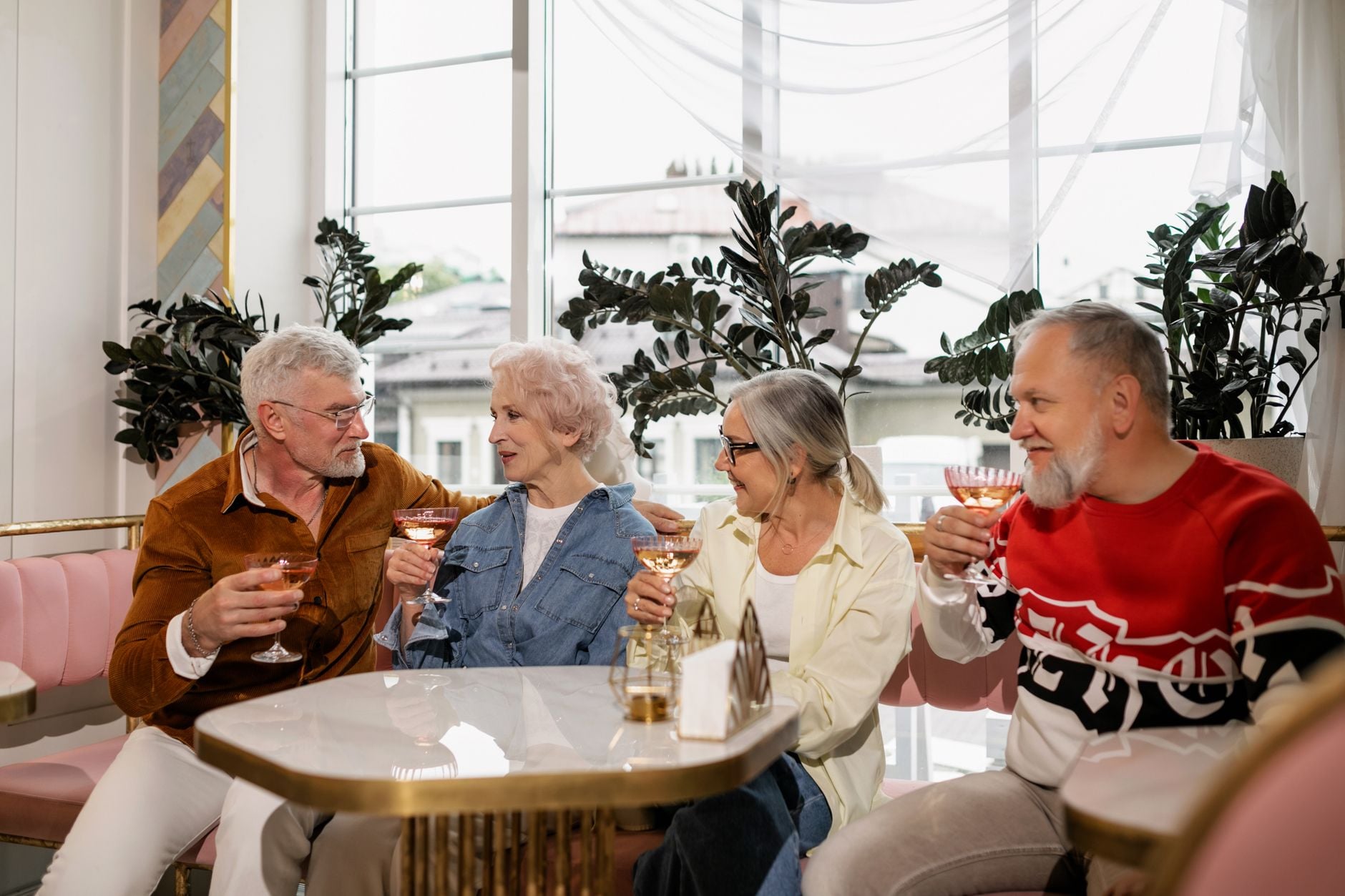
A friendship count makes a poor character reference.
When someone reaches later life with only a few close friends, other people can be surprisingly quick to turn the number into a personality story. They must be cold, difficult, too demanding or simply bad at keeping people. Yet a small circle is an outcome. It does not explain the life that produced it.
One possible history is that the person spent years doing most of the listening, remembering, initiating and repairing. Some relationships may eventually have felt less like friendship and more like an emotional job that nobody had agreed to share. The research gives that interpretation a real foothold, but not a licence to apply it to everyone. No study can inspect a person’s friendship count and reconstruct decades of relational history.
A small circle is not a character test
I wrote recently about a Pew survey in which 8 per cent of US adults reported having no close friends. What stayed with me was the distinction between a social network and a personality. Relocation, caregiving, divorce, retirement, bereavement, money and the disappearance of shared routines can dismantle adult friendships without revealing anything sinister about the people involved.
Research on older adults also resists the idea that social success can be read from the biggest number. Alexandra Thompson and colleagues surveyed 335 UK adults aged 65 and over. More close friends were associated with less loneliness and better scores on several measures of psychological wellbeing, but the estimated gains flattened after a relatively small number. The Ageing & Society study was exploratory, correlational and captured only one moment. It did not discover a universally ideal number of friends.
Someone with three trusted friends may feel securely connected. Someone else can know scores of people and still have nobody with whom they can be unguarded. Quantity matters, especially at the point where there is nobody close at all, but it never tells the full story.
“Carrying the emotional weight” has a measurable counterpart
The phrase is ordinary language, not a clinical category. I take it to mean being the person who always notices the change in tone, sends the first message, remembers what hurts, makes the plan, hears the complaint and repairs the disagreement. Each act can be generous. The weight comes from all of them settling permanently on one pair of shoulders.
A recent study offers the closest empirical parallel I have seen. Sociologists Lea Ellwardt and Theo van Tilburg used data from the Longitudinal Aging Study Amsterdam to examine 892 adults aged 61 to 100 and 4,273 members of their personal networks. In the peer-reviewed Social Networks paper, 15 per cent of the older respondents reported at least one relationship classified as difficult.
Those difficult ties were especially common when the older person received little emotional support while providing a great deal, and when the relationship was volatile. They also appeared disproportionately in relationships that were not entirely voluntary, including some ties with siblings, parents and neighbours. The authors’ point was partly structural: people sometimes remain connected because family obligations, proximity or care arrangements make withdrawal difficult.
This is one study, not settled consensus. Its data show an association at one survey wave. They do not establish that unequal support caused the relationship to become difficult, that the participant later ended it, or that difficult ties explain why anyone has few close friends. Still, the pattern matters. It turns “carrying the emotional weight” from a purely poetic phrase into something social research can partly observe.
Mutual support is not equal accounting every week
There is an important counterweight here. Giving more than you receive is not automatically depleting, and a relationship is not defective whenever its ledger looks uneven.
Wenran Xia and colleagues analysed three waves of the Survey of Health, Ageing and Retirement in Europe, covering 4,650 people aged 60 and older living outside institutions. Their measure concerned practical help exchanged with people outside the household over several years. In that longitudinal study of support balance, giving more support than one received was not associated with worse wellbeing than balanced exchange. The group receiving more than it gave reported lower wellbeing.
That result does not mean receiving help is bad. The authors note that poorer health or reduced independence can increase a person’s need to receive, making cause and effect difficult to separate. It does show why “one-sided” needs careful definition.
Giving can bring competence, meaning and the quiet knowledge that one still matters to another person. Close relationships also balance themselves across years rather than afternoons. A friend may carry much more during illness, bereavement, financial trouble or family upheaval, then be carried in another season. Mutuality is not identical input at all times. It is the expectation that both people are allowed to matter.
Support can nourish and tire us at the same time
A 2025 study in Research on Aging shows how dependent the experience can be on context. Yee To Ng and colleagues asked 180 older adults, whose average age was 74, to report their mood every three hours and their support exchanges each day for five or six days. Participants experienced a more positive mood on days when they provided practical help to friends. Men, however, reported lower positive mood on days when they provided emotional support; that pattern did not appear among women.
The daily-support study was small, brief and observational. It cannot tell us what years of emotional responsibility do, and its gender result should not be turned into a rule about men and women. Its value is narrower: support does not have one fixed emotional effect. Who gives it, what kind they give and what else exists inside the relationship can alter how the day feels.
Another daily study of older adults found that encounters with friends were associated with better mood, including encounters with less-close friends. The researchers pointed towards ordinary companionship and enjoyment, not only the exchange of help. That is easy to overlook when friendship is discussed as a support system. A friend is not merely someone who processes difficult feelings. Friendship also needs room for interest, silliness, attention and being together without a problem to solve.
Later life often changes what a worthwhile relationship looks like
Laura Carstensen’s socioemotional selectivity theory offers a broader explanation for why social circles often narrow with age. As people experience time as more limited, the theory proposes, emotionally meaningful goals become more important than collecting information, novelty or new contacts for an indefinite future.
In a 2021 review for The Gerontologist, Carstensen revisited longitudinal evidence showing that selective reductions in social contact can begin in early and middle adulthood. Peripheral ties became less frequent while emotional closeness in important relationships increased. In one follow-up of adults aged 70 to 104, most of the later network reduction reflected preference rather than death, and closeness to the most significant people grew.
None of that makes every small network chosen. Ageing can bring bereavement, reduced mobility, illness, retirement and fewer places where friendship happens without planning. Nor does selectivity mean older people stop wanting new friends. The evidence supports a more modest point: a smaller social world can sometimes be actively shaped around emotional value rather than passively emptied by rejection.
If that value increasingly matters, chronic imbalance may become harder to justify. Limited time changes the cost of spending another year in a relationship that depends on one person remaining endlessly available and largely unknown.
Walking away is one possible ending, not the only one
Some people do leave relationships once they recognise that nothing happens unless they make it happen. Others reduce contact, name the imbalance, renegotiate expectations or accept an uneven period because the wider friendship remains loving. Some never had a dramatic ending at all; the relationship simply stopped surviving once they ceased doing all the maintenance.
And many people reach later life with few close friends for entirely different reasons. They lost someone. They moved. Their workplace circle dispersed. They prefer a compact social life. They want more connection but lack the repeated time and proximity from which adult closeness grows. The same number can contain all of these biographies.
So I would not look at a small friendship circle and conclude that the person is cold, socially deficient or secretly wiser than everyone else. The research cannot support any of those verdicts. What it can support is a more generous uncertainty.
Some circles may indeed be small because their owner stopped confusing being constantly useful with being mutually known. That is not the only explanation, but it is one worth leaving room for before we turn a person’s social life into a judgement on their character.