

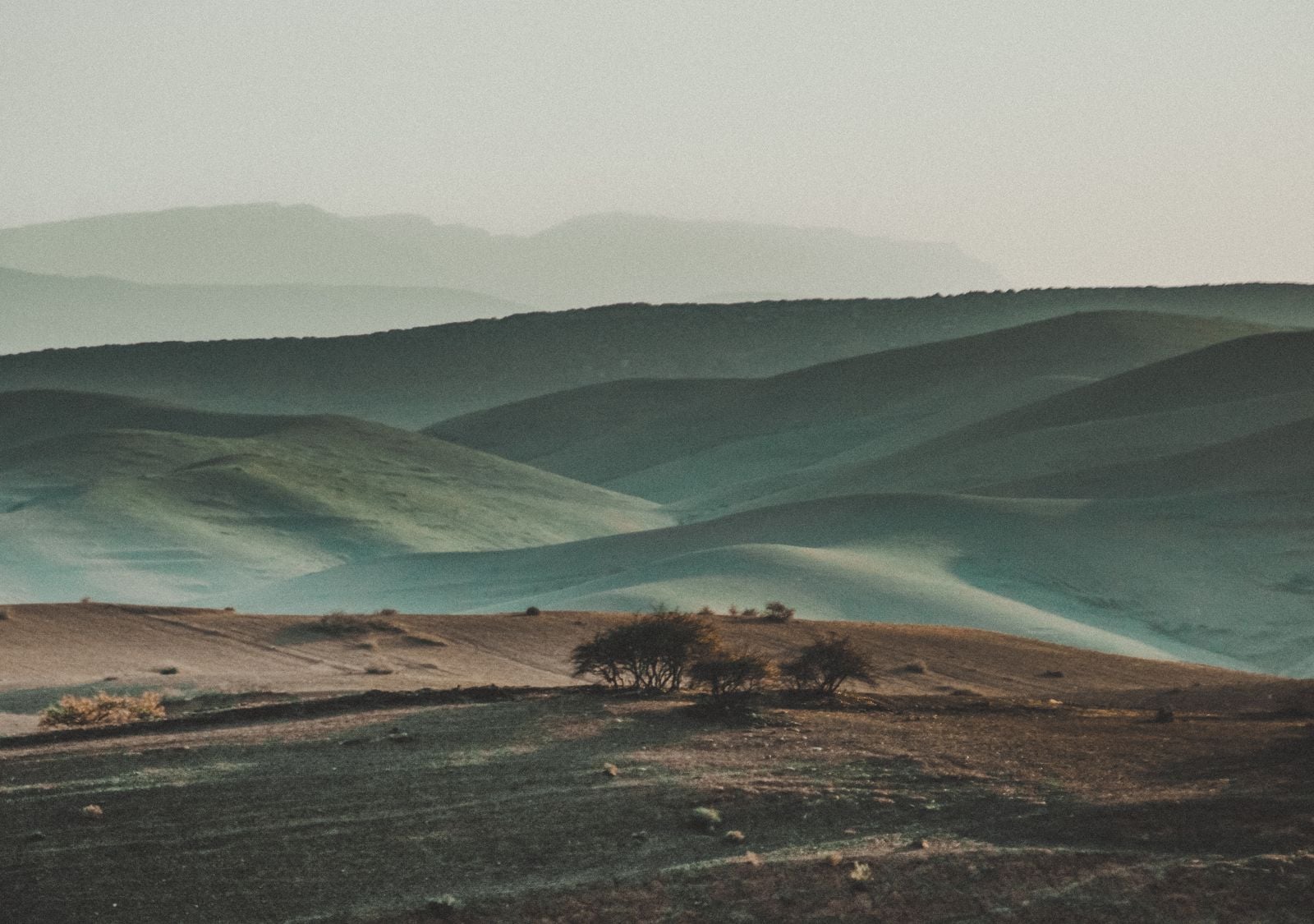
There are weather stations in the Atacama Desert that have sat on their tripods for decades without ever recording a single drop of rain. Not a trace. Not a mist reading. In the hyperarid core between the Andes and the Pacific — a strip of Chile roughly 1,000 kilometres long — the rain gauges function as monuments to absence. And yet, when you walk across the volcanic gravel at dawn, the stones are wet.
The moisture comes from the sea, not the sky. A dense marine fog called the camanchaca rolls in from the cold Humboldt Current, drapes itself across coastal cliffs, and clings to whatever surface it finds. It never falls as rain. It settles. And in the film of water it deposits on rock, lichens grow that exist nowhere else on Earth.
A desert older than the Amazon
The Atacama has been dry for a very long time. A study published in 2026 concluded that extreme aridity in the hyperarid core began approximately 45 million years ago, tens of millions of years earlier than previously assumed. That timeline predates the uplift of the modern Andes to their current height — the study argues the mountains and the cold Humboldt Current intensified and expanded a dryness that was already there, rather than creating it. It predates most of the mammalian lineages walking around today. When the first primates were evolving in Africa, this stretch of Chile was already a desert.
The reason is geography. The Andes to the east block moisture from the Amazon basin. The cold Humboldt Current to the west chills the air above the Pacific, suppressing evaporation and stabilising the atmosphere so that clouds cannot rise and release rain. What water the ocean does give up condenses low, close to the surface, in a marine layer that hugs the coast between roughly 400 and 1,200 metres of elevation.
That marine layer is the camanchaca. In Aymara, the word camanchaca roughly translates to a phrase meaning darkness that spreads. It arrives most reliably in the southern hemisphere winter, between May and October, creeping inland from the ocean at night and burning off by mid-morning when the sun climbs high enough to warm the coastal escarpment.
The stations that never recorded rain
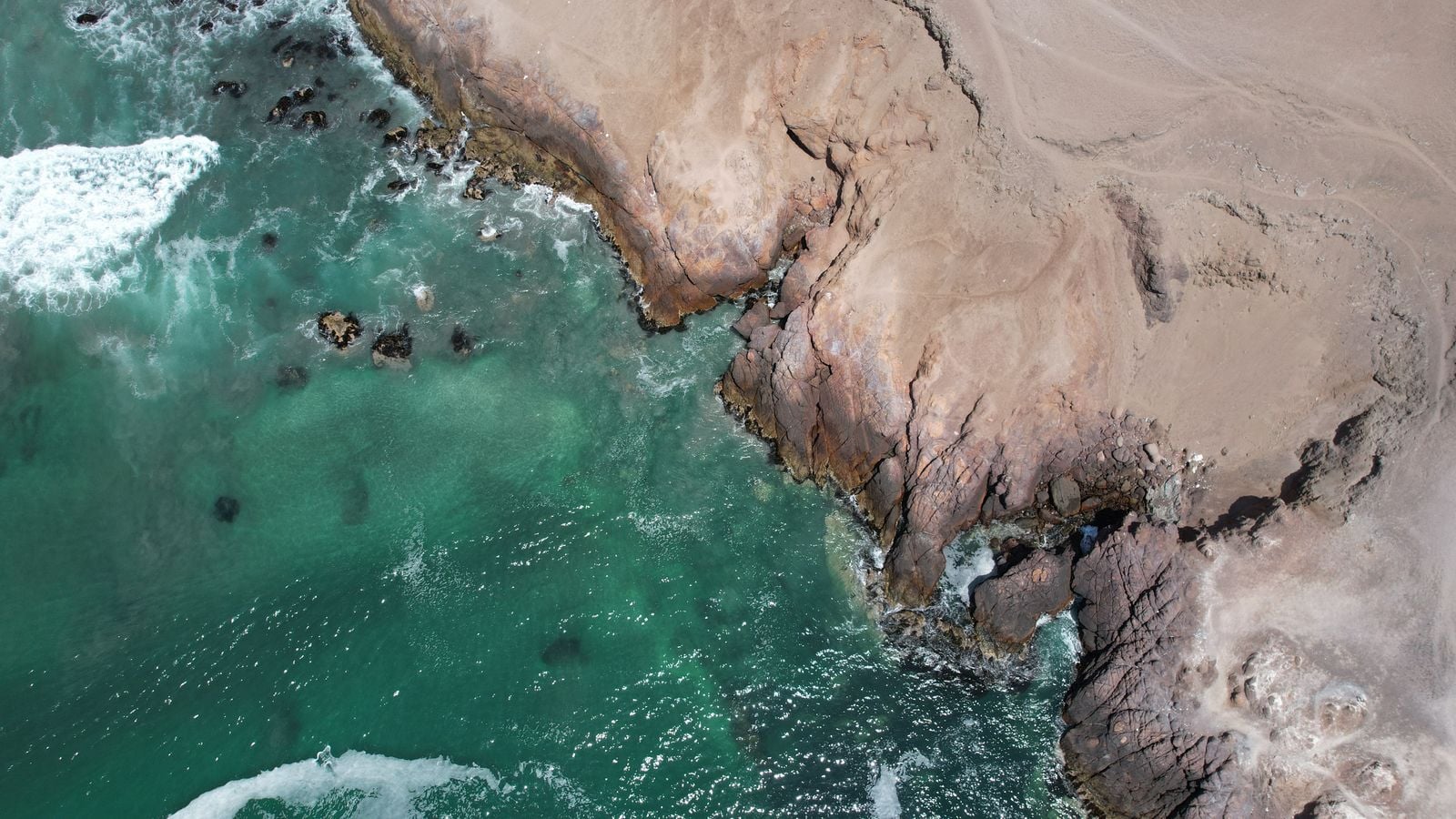
The town of Yungay, roughly 80 kilometres inland from the port of Antofagasta, sits on a plateau that NASA researchers have used as a Mars analogue for decades. Soil samples taken there have returned negative results for organic material — no bacteria detectable by standard cultivation methods, though extremophile microorganisms have since been found by more sensitive assays. Meteorological stations in the Yungay area and along the Pampa del Tamarugal have gone entire decades without a measurable rainfall event.
Some areas of the Atacama receive an estimated 1 to 3 millimetres of precipitation per year. Others receive nothing at all in the instrumental record. To put that in scale: London receives roughly 600 millimetres annually. The Sahara, by contrast, averages around 75 millimetres. The core of the Atacama is roughly ten times drier than the Sahara.
And yet the desert is not lifeless. An international team led by the University of Cologne recently found thriving communities of soil nematodes across six distinct regions of the Atacama, including fog-fed oases where plant life flourishes against the odds. Their paper in Nature Communications documented that at higher elevations, plant life flourishes in fog-fed oases despite the harsh conditions.
How a lichen drinks fog
A lichen is a partnership. The body of the organism is built by a fungus, but the fungus cannot photosynthesise, so it houses an algal or cyanobacterial partner inside its tissues. The alga makes sugars from sunlight. The fungus provides architecture, mineral scavenging, and a defence against drying out. The total number of lichen species is estimated between 20,000 and 30,000, many of them still undescribed.
What makes lichens ideal for the Atacama is that they do not need liquid water in the traditional sense. They absorb water vapour directly from the air. A lichen thallus can rehydrate from 90 per cent humidity alone, snap into photosynthetic activity within minutes, fix some carbon, and then desiccate again when the fog burns off. Some species do this every single day for decades.
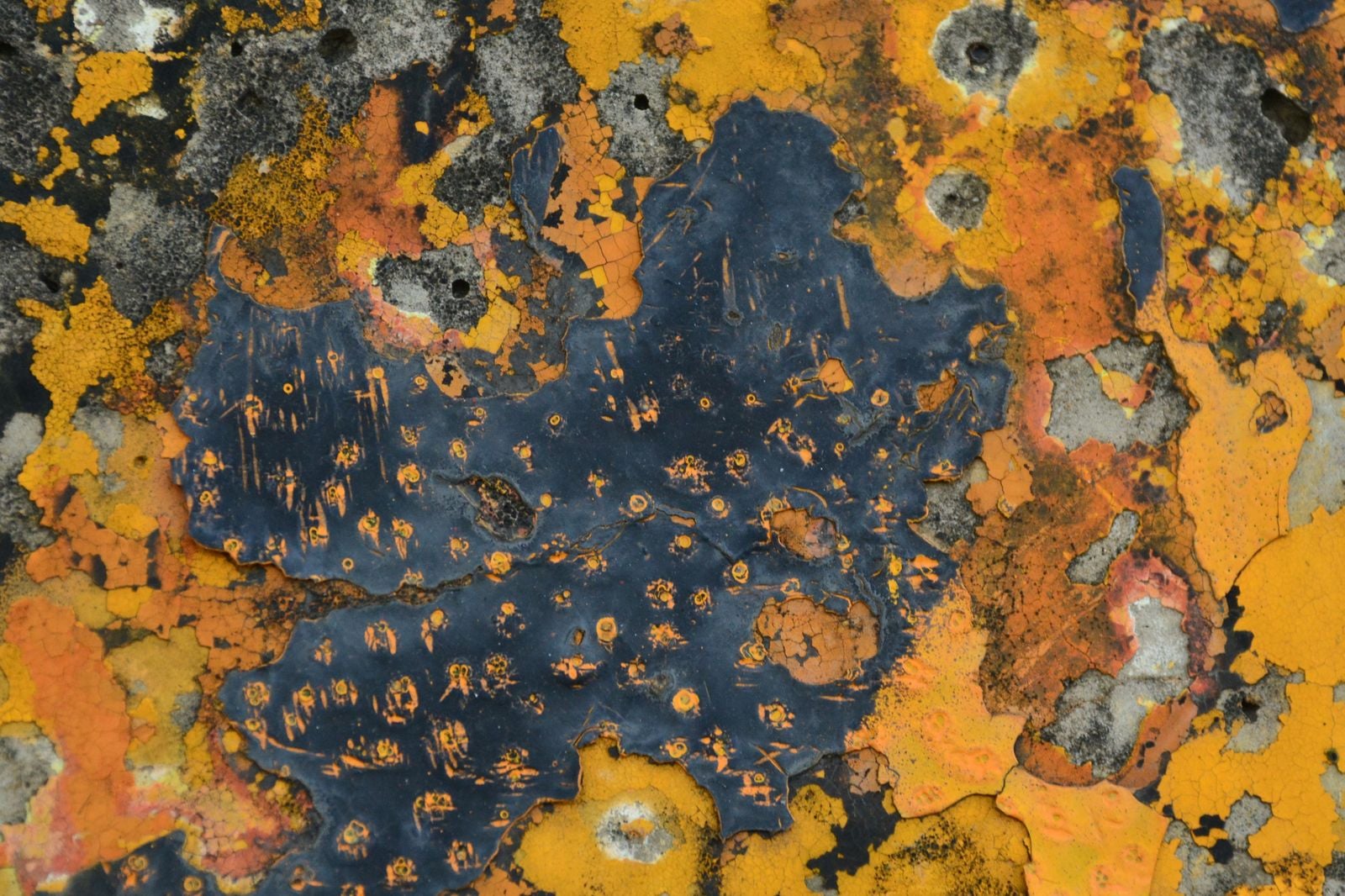
The coastal cliffs of the Atacama — places like the escarpments above Paposo and Iquique — are painted with lichen. Grey-green crusts, orange rosettes, black filamentous species that trail down the rock face like hair. Many are endemic to a strip of coast a few kilometres wide. Move ten kilometres inland, past the reach of the fog, and the lichens vanish. Move ten kilometres up the coast into a slightly different airshed, and the species composition changes.
Fifteen minutes of moisture per day
Field biologists working the Atacama coast have measured the daily fog cycle in detail. The camanchaca typically arrives after midnight, thickens toward dawn, and lifts by 10 or 11 in the morning. Lichens on north-facing rocks may be photosynthetically active for only two or three hours a day, and only during the winter fog season. For the other nine months of the year, they are functionally freeze-dried, a bundle of dormant fungal hyphae and green algal cells waiting.
The engineering equivalent has not gone unnoticed. Chilean researchers have deployed large mesh nets — atrapanieblas, or fog catchers — on the same cliffs where the lichens grow. A single square metre of properly oriented mesh can wring several litres of water per day out of the camanchaca. Villages that once trucked in every drop of drinking water now grow crops on fog alone.
Why the fog carries more than water
The camanchaca is not distilled water. It picks up salts, trace metals, algal toxins, and marine microorganisms as it forms above the ocean surface, and it deposits all of that onto the lichens when it condenses. Researchers at UC Santa Cruz have been awarded a five-year, $737,000 grant from the Heising-Simons Foundation to characterise the chemical and biological composition of Pacific coastal fog water. Peter Weiss-Penzias and Eyal Rahav plan to collect fog samples at 15 sites along the California coast, tracking inorganic nutrients, algal toxins, and chemical contaminants.
California’s coastal fog operates on the same basic physics as the camanchaca — cold current, marine layer, condensation on windward cliffs. In the UC announcement, Weiss-Penzias noted that understanding how fog patterns may shift with climate warming is essential for effective climate adaptation planning. A parallel research effort is underway across four other California campuses studying the role of coastal fog in ecosystems, from the redwoods to the shore.
What holds for California holds, roughly, for Chile. The lichens are drinking a soup — mostly water, but seasoned with iodine, nitrate, sulphate, and traces of whatever the phytoplankton bloomed offshore that week. Which means the fog is not only a water source but a nutrient delivery system. In a desert with no soil chemistry to speak of, the fog is the soil.
The lichens found nowhere else
Genera like Roccellinastrum, Santessonia, and Follmanniella have been documented on the fog-drenched coastal cordillera of northern Chile and adjacent Peru with distributions that stop where the fog stops. Some species are known from a single cliff face. The Peruvian coast has similar fog oases — lomas — where the same physics produces the same result, and where the Peruvian government recently granted formal conservation status to the 6,449-hectare Lomas y Tillandsiales de Amara y Ullujalla site. Those lomas, like the Atacama’s lichen colonies, depend entirely on a marine layer that never falls as rain.
The endemism is not a coincidence. Lichens disperse slowly. Their spores or vegetative fragments travel on wind, but establishment requires a very specific set of microclimatic conditions — enough fog on enough mornings, a substrate that holds moisture, a temperature range narrow enough that the algal partner survives. Once a lineage is isolated on a fog-fed cliff, it evolves in place. Neighbouring cliffs become, in effect, islands.
Extremes as laboratories
Life keeps finding ways into places that look uninhabitable from a distance. Silicon Canals has covered the Pompeii worm on deep-sea hydrothermal vents, which farms bacteria on its back to survive a 58-degree thermal gradient between its head and its tail. The Atacama lichens are the arid-air equivalent — organisms making a living in the narrow band where a physical extreme has produced a resource that nothing else can use.
Last week’s piece on the Vjosa river in Albania looked at what happens when a system is left intact for long enough to develop deep ecological complexity. The Atacama is the mirror image. It has been left alone — by rain, by rivers, by soil formation — for so long that only the organisms capable of drinking air and running on almost nothing remain.
What happens if the fog shifts
The Pacific Coastal Fog Research project exists because nobody actually knows what warming will do to the marine layer. The cold currents that produce it are themselves products of atmospheric circulation patterns that climate models struggle to resolve at the coastal scale. Some projections suggest more fog. Some suggest less. Some suggest the same amount, but at different times of year, or at different altitudes on the cliff face.
For a lichen that has spent perhaps hundreds of thousands of years calibrating itself to a fog band between 600 and 900 metres of elevation on a specific stretch of Chilean coast, a shift of a hundred metres up or down the cliff would be catastrophic. There is nowhere to migrate to. The desert below is too dry. The plateau above is too dry. The cliff is the habitat.
The lichens are already living on the ragged edge of what a photosynthetic organism can tolerate. That is why they became so specialised. It is also why any small change to the camanchaca — a warmer ocean, a weaker Humboldt Current, a higher condensation altitude — could dismantle in a decade a community that took millions of years to assemble.
What the stones look like at dawn
Stand on the coastal escarpment above Paposo before sunrise. The fog is already there, a wet grey that erases the horizon. Water beads on the underside of every rock overhang. The lichens are open, pale green, faintly glistening. They are doing the only work they will do today — the fungus holding on to the stone, the alga making sugar, the whole organism drinking a cloud that has never once, in the memory of any weather instrument nearby, fallen as rain.
By eleven, the sun will have burned the camanchaca back out to sea. The lichens will shrivel again into their dry-season stillness. The rain gauges will register, as they have every day for as long as anyone has been counting, exactly nothing.
