


A vegetarian who has never taken a creatine supplement walks into a lab with muscle stores roughly 20 to 30 percent below the person on the treadmill next to them who ate steak twice last week. Same age, same training, same body composition. Different biochemistry. And when both are handed the same 5-gram scoop of white powder for the next four weeks, the vegetarian’s numbers climb faster, further, and across a wider set of measurements than the meat-eater’s do. This is the pattern that keeps surfacing in creatine research, and it has taken researchers close to two decades to work out why.
The molecule itself has been studied for nearly two centuries, isolated from skeletal muscle and named after the Greek word for flesh. Flesh, nearly 200 years later, is still where most humans get it.
The baseline deficit nobody feels
The average adult body holds a substantial reservoir of creatine, and the vast majority of it sits inside skeletal muscle, waiting to reload the ATP that powers a sprint, a heavy lift, or a burst of concentrated thought. The liver, kidneys, and pancreas manufacture it from arginine, glycine, and methionine. The rest, historically, arrived at dinner.
Take dinner away — or replace the meat portion with lentils — and the internal factory keeps running at its usual pace. It does not compensate. It does not upregulate. The result is a quiet, chronic shortfall that a vegetarian carries for years without any obvious symptom, because muscle creatine stores can drop meaningfully before daily life registers a change.
Vegetarians run measurably below the muscle creatine concentrations found in omnivores of similar age and training status, a pattern documented in a 2020 systematic review in the International Journal of Environmental Research and Public Health, which notes that because creatine comes mostly from meat, vegetarians carry reduced stores and stand to gain more from supplementation. A subset of vegans measure lower still.
Why the shortfall is invisible
Creatine does not behave like a stimulant. It has no calories worth counting, no pharmacological punch that a person can feel arriving or fading. It works less like fuel and more like the mechanism that reloads the fuel, handing a muscle cell a fresh charge before the effort. A muscle cell running slightly low on it will still contract, still lift, still recover. It will just do all of those things a fraction less explosively than it could.
That fraction is what athletes and researchers have spent decades trying to quantify. Katherine Basbaum, a registered dietitian at the University of Virginia Health, told Scientific American that the strongest evidence for creatine is as an ergogenic aid — a substance that supports athletic performance by helping people lift slightly heavier, push out a few more repetitions, or recover faster between efforts.
For an omnivore whose muscles are already close to saturated, that fraction is small. For a vegetarian whose baseline sits well below saturation, the ceiling is much further away. Which is precisely why the same scoop lands so differently.
The response gap
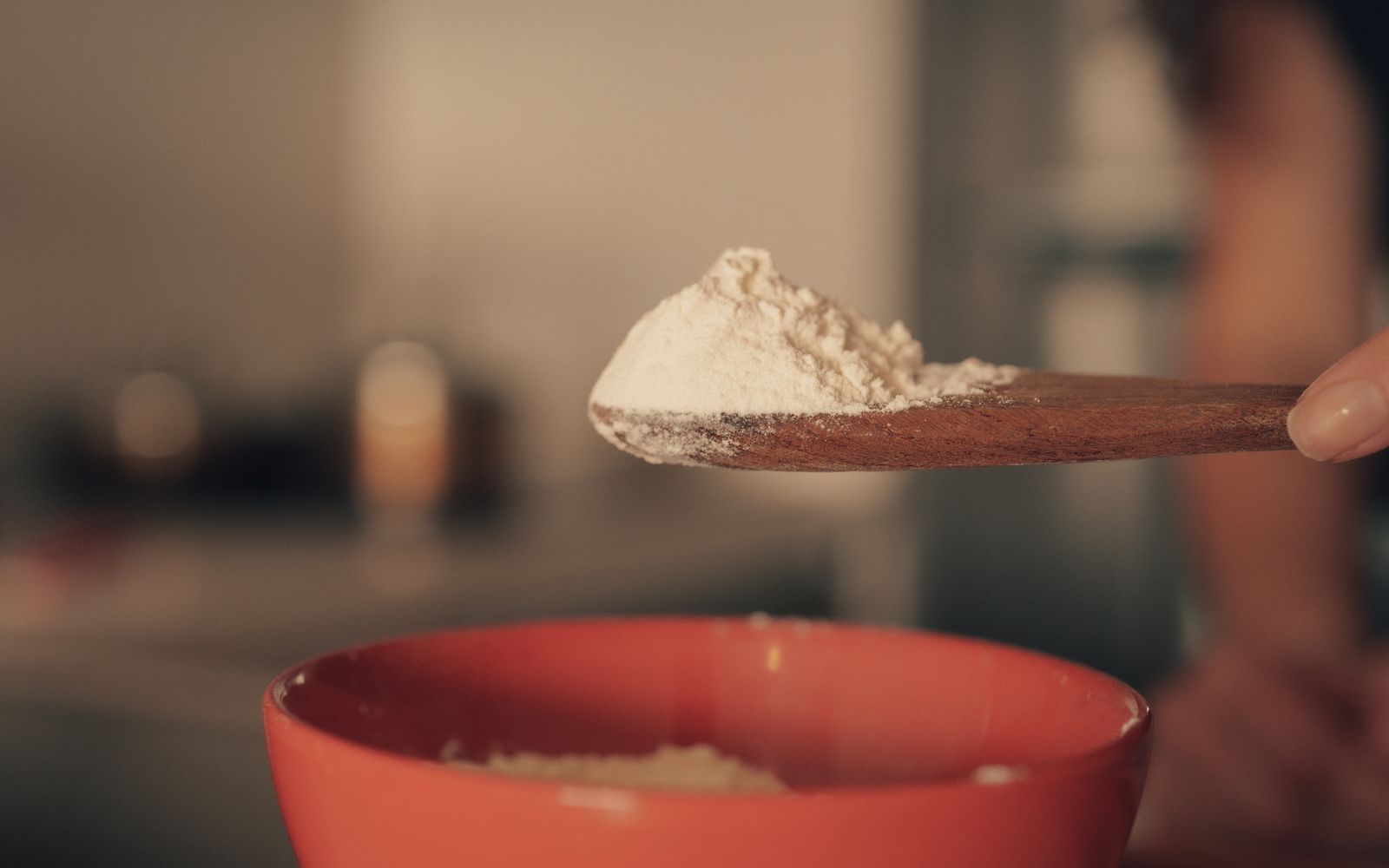
The dosing protocol is not exotic. A single 5-gram scoop of creatine carries roughly the amount found in over a kilogram of raw beef, a quantity almost nobody could eat at dinner. Even committed meat-eaters lean on their own liver and kidneys to close the daily gap.
When vegetarians begin supplementing at that dose, the trajectory of their muscle creatine concentration climbs steeply. Meat-eaters on the same protocol climb too, but from a higher starting point and with less headroom above it. By the end of standard supplementation periods, both groups converge near the ceiling of what skeletal muscle can hold — and the systematic review evidence suggests the lower starting point can even let vegetarians overshoot omnivore levels, a phenomenon researchers describe as super-compensation. The vegetarian has traveled further to get there.
That larger journey shows up on more instruments. The vegetarian cohort tends to post bigger jumps in maximal strength, in single-sprint power output, and — more surprisingly — in tests of working memory and processing speed under mental load. A study in the British Journal of Nutrition captured exactly this asymmetry: vegetarians began with lower muscle creatine, and after supplementation their levels rose more than omnivores’ did, a gain tied to an improved capacity to exercise. The meat-eater cohort improves on the same measures, but the effect size is smaller and the statistical signal is noisier.
Brain tissue plays by the same rules
Skeletal muscle is not the only tissue that runs on the phosphocreatine system. Brain cells use it too, particularly under acute cognitive demand, and creatine crosses the blood-brain barrier slowly but reliably. Preliminary work summarised by Scientific American suggests creatine may support cognition in populations where baseline stores are low — including perimenopausal women and, by extension, long-term vegetarians.
A separate line of research, reviewed by Healthline, has looked at creatine as an adjunct in major depressive disorder, with a large review finding preliminary evidence of symptom reduction and an established safety profile. The mechanism proposed is the same one that explains the vegetarian response: brain regions running slightly short of phosphocreatine benefit more from topping up than regions already at capacity.

The safety picture
The safety data on creatine is unusually thick for a supplement. Richard Kreider, director of the Exercise and Sport Nutrition Lab at Texas A&M University and first author on a 2025 analysis of more than 650 studies, told Scientific American that international adverse-event registries record creatine in roughly 0.0007 percent of reports. Over the last three decades, he estimates, billions of servings have been consumed.
Creatine monohydrate is widely recognized as safe, and the compound remains one of the few sports supplements where the marketing claims and the peer-reviewed evidence broadly align. Creatine has now been examined across a substantial body of published trials, making it the most studied supplement in sports science.
Bonnie Jortberg, a professor of family medicine at the University of Colorado Anschutz School of Medicine, cautioned in the same Scientific American piece that people with kidney problems should avoid supplementation, because compromised kidney function may interfere with processing. Kreider argued that the concern is overblown and that no evidence links creatine to adverse kidney effects even in patients with existing disease. The two positions coexist in the literature, and the standard recommendation — check with a doctor before starting — applies here as much as anywhere.
What the delivery format changes, and what it doesn’t
The dose is the dose. A 5-gram serving of creatine monohydrate in powder form and a 5-gram serving in gummy form should, in principle, land the same way. In practice, according to Healthline, most gummies contain a smaller amount of active ingredient per serving, and recent lawsuits have alleged that some gummy brands contain less creatine than their labels claim. Powder remains the more studied, more affordable, and more dose-flexible format.
For a vegetarian starting from a lower baseline, dose accuracy matters more than it does for someone already close to saturation. Missing 2 grams of a 5-gram dose over sixty days is the difference between reaching the ceiling and stalling well below it.
The plant-based diet is not the problem
Nothing in the creatine data undermines the broader case for plant-based eating. Vegetarian diets are associated with lower risks of cardiovascular disease, metabolic conditions, and obesity, and a recent meta-analysis summarised on ScienceDaily found that carefully planned vegetarian and vegan diets support healthy growth in children when appropriate supplements are included.
A separate observational study of Chinese adults over 80, also covered by ScienceDaily, found that non-meat eaters in that age group were less likely to reach 100 than meat eaters — but only among underweight participants, and not among those who included fish, dairy, or eggs. The authors suggested that modest amounts of animal-source foods, or careful supplementation, may help prevent the loss of lean muscle mass in advanced age. Creatine sits neatly inside that conversation.
The point is not that vegetarians are deficient in some clinical sense. Most are not. The point is that a specific, measurable compound sits at chronically lower concentrations in their skeletal muscle, and that supplementation closes the gap faster and more visibly in them than in anyone else researchers have studied.
Why the response splits so sharply
Two people, same scoop, same protocol, different results. The variable is not the powder. The variable is the twenty years of dinners that preceded it.
A meat-eater arrives at day one with a partially topped-up battery. Supplementation moves the needle a small distance toward full. A long-term vegetarian arrives with a battery running at a lower percentage of capacity, and supplementation moves it substantially further. The physiology is the same. The starting position is not.
This is what makes creatine unusual among supplements. Most substances work best on people who need them least, because those people also tend to be the ones who exercise, sleep, and eat well enough to respond to anything. Creatine inverts the pattern. The strongest responders are the people whose diets have quietly withheld it from them for years.
The white powder, in that sense, is not really adding something new. It is refilling a reservoir that the body kept building anyway, out of amino acids, in the background — hoping the rest would show up at dinner. For millions of people, it stopped showing up a long time ago.
