

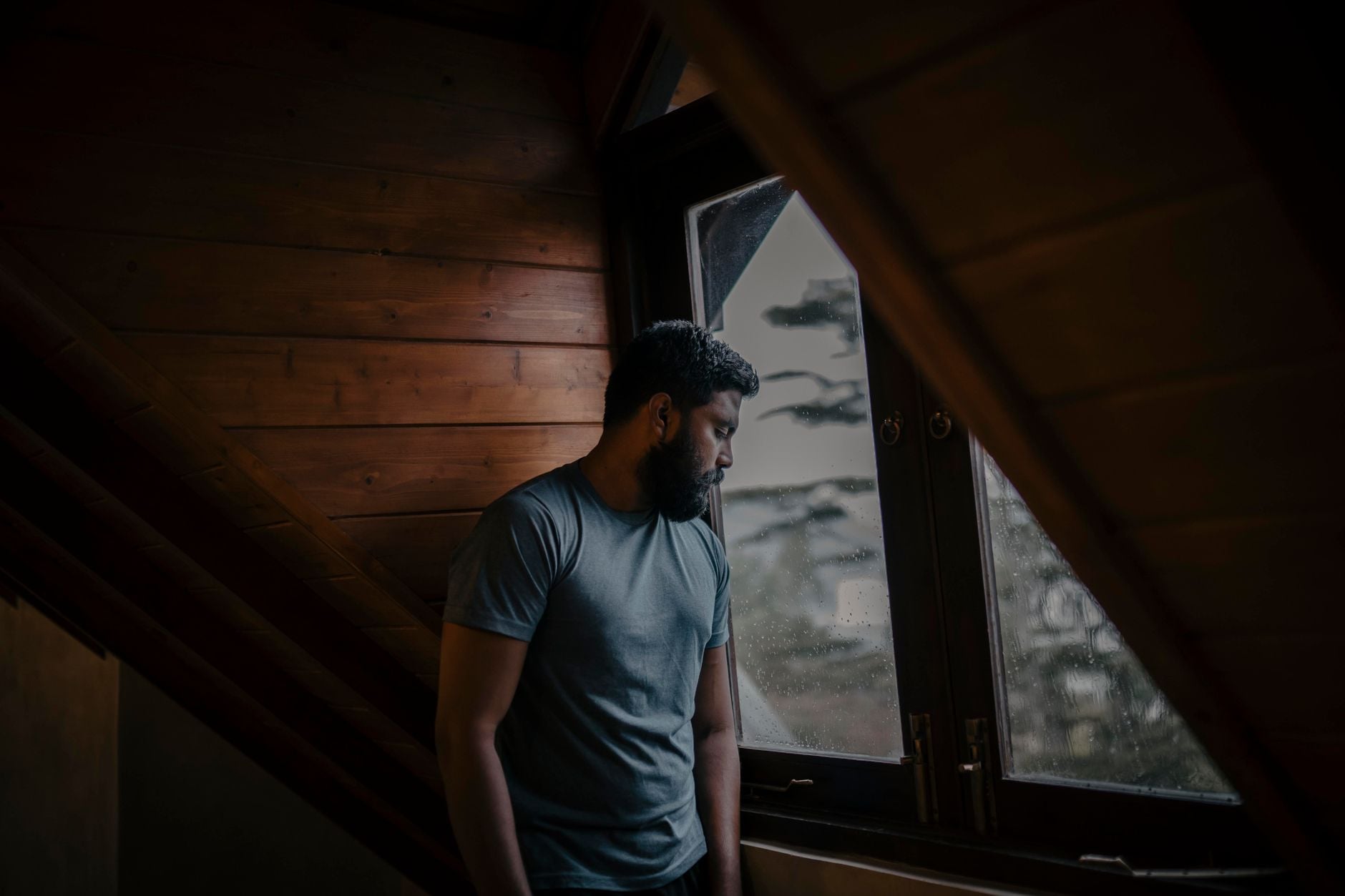
The phrase deeply unhappy men sounds like it should be easy to picture. A withdrawn figure, quiet and low, obviously suffering. The uncomfortable thing the research keeps pointing to is close to the opposite. A great deal of serious male unhappiness is specifically the kind that does not look like unhappiness at all, which is part of why it so often goes unnoticed until late.
We are writers, not clinicians, and what follows is a reading of the research rather than medical or psychological advice. It matters to say that clearly here, because this is a subject where the gap between looking fine and being fine can be wide, and where a wrong impression is not harmless.
Two threads run through the evidence. One is that distress in men can surface in forms that no one, including the man himself, reads as depression. The other is that men are markedly less likely to name it or ask for help. Together they describe a problem that hides.
Unhappiness that does not arrive as sadness
Depression is usually described in terms of low mood, tearfulness, and loss of interest. A study by Lisa Martin, Harold Neighbors and Derek Griffith, published in JAMA Psychiatry in 2013, asked what happens if you widen the list. When they added symptoms such as irritability, anger attacks, risk-taking, and alcohol or drug use to the conventional picture, the familiar gap between the sexes narrowed sharply. On a scale built around these broader symptoms, men actually scored slightly higher than women, 26.3 per cent against 21.9.
It would be easy, and wrong, to turn this into a tidy story about male and female depression being two different things. As the psychologist Shawn Meghan Burn noted in reviewing the study, the more careful reading is the reverse. Irritability, anger and heavy drinking are common in depressed women too, so they are not really male symptoms, and once a gender-inclusive measure was used, men and women did not differ much at all. The honest takeaway is not that men have their own private illness. It is that depression is more varied than the standard sketch of it, and that when it shows up as a short fuse, a punishing work schedule, or a few too many drinks rather than visible sorrow, it is easy for everyone to miss, including the person living it.
This is one study, not the final word, and it was not designed to measure how much masculinity itself drives the pattern. But it lands on a useful caution. A man who seems angry, checked out, or quietly self-destructive is not obviously a man who is unhappy, and that mismatch is exactly where trouble hides.
The number that should not be looked away from
If the symptom research hints that male unhappiness is under-recognised, the suicide figures state it plainly. Across many countries, men die by suicide at roughly three to four times the rate of women, even though women are diagnosed with depression more often and report attempting suicide more frequently. Researchers call this the gender paradox: women attempt more, men die more.
Work on this paradox, including a 2022 review by Laura Griffin and colleagues on masculinity and suicidal thinking, points to some of the reasons. Men are less likely to disclose that they are struggling, and tend to move faster from thinking about suicide to acting on it. A form of distress that stays hidden, and that its owner is reluctant to speak about, is a more dangerous form of distress, and the mortality gap is the cost of it.
These are population averages, not a description of any individual, and suicide is never explained by a single factor. But the size and consistency of the gap is hard to wave away.
Why so much of it stays quiet
The reluctance is not random, and it is not simply that men are worse at feelings. It tracks with a set of norms that many men absorb long before they would ever need them. Traditional ideals of masculinity prize self-reliance, toughness, and keeping emotion under control, and research on help-seeking, notably the work of Michael Addis and James Mahalik, has linked stronger conformity to those norms with a greater reluctance to seek help.
The result is a quiet trap. A man raised to treat needing help as a weakness has been handed a rule that works directly against him at the moment he most needs to break it. Add that admitting to unhappiness can feel like admitting to failure at being a man, and the incentive is to convert the feeling into something more permissible, drive, irritation, a drink, silence, rather than to name it and take it somewhere.
None of this is a case against men or a blanket indictment of masculinity, much of which is neither the problem nor the point. It is a narrower observation, that a specific cluster of norms makes a specific and common form of suffering harder to see and harder to treat.
What the evidence does and does not support
A few limits keep this from hardening into a stereotype. The evidence here is largely correlational and built on averages across enormous variation in age, culture, sexuality, and circumstance, and it does not support the idea of two separate depressions, one per sex. It is not a licence to read every irritable or hard-working or hard-drinking man as secretly falling apart, which would be its own kind of error.
The defensible point is more modest and more useful. Conventional images of what unhappiness looks like can miss it badly in men, the reluctance to name it is real and partly cultural, and the consequences of that combination are measured in the suicide statistics rather than in anything subtle. Noticing the anger or the withdrawal or the extra drinks, and treating them as a question rather than an annoyance, is not overreach. It is often the only opening there is.
If any of this is close to home, for you or for a man you care about, it is worth taking to a GP or a qualified professional rather than waiting for it to pass, and in a crisis there are free, confidential lines to call, such as Samaritans on 116 123 in the UK and Ireland, or the local equivalent elsewhere. Reaching out early is not weakness; it is the thing the research keeps quietly recommending.
Deeply unhappy men are real, and more numerous than the diagnosis rates suggest. The hard part was never that their unhappiness is rare. It is that so much of it has learned not to look the part.
