

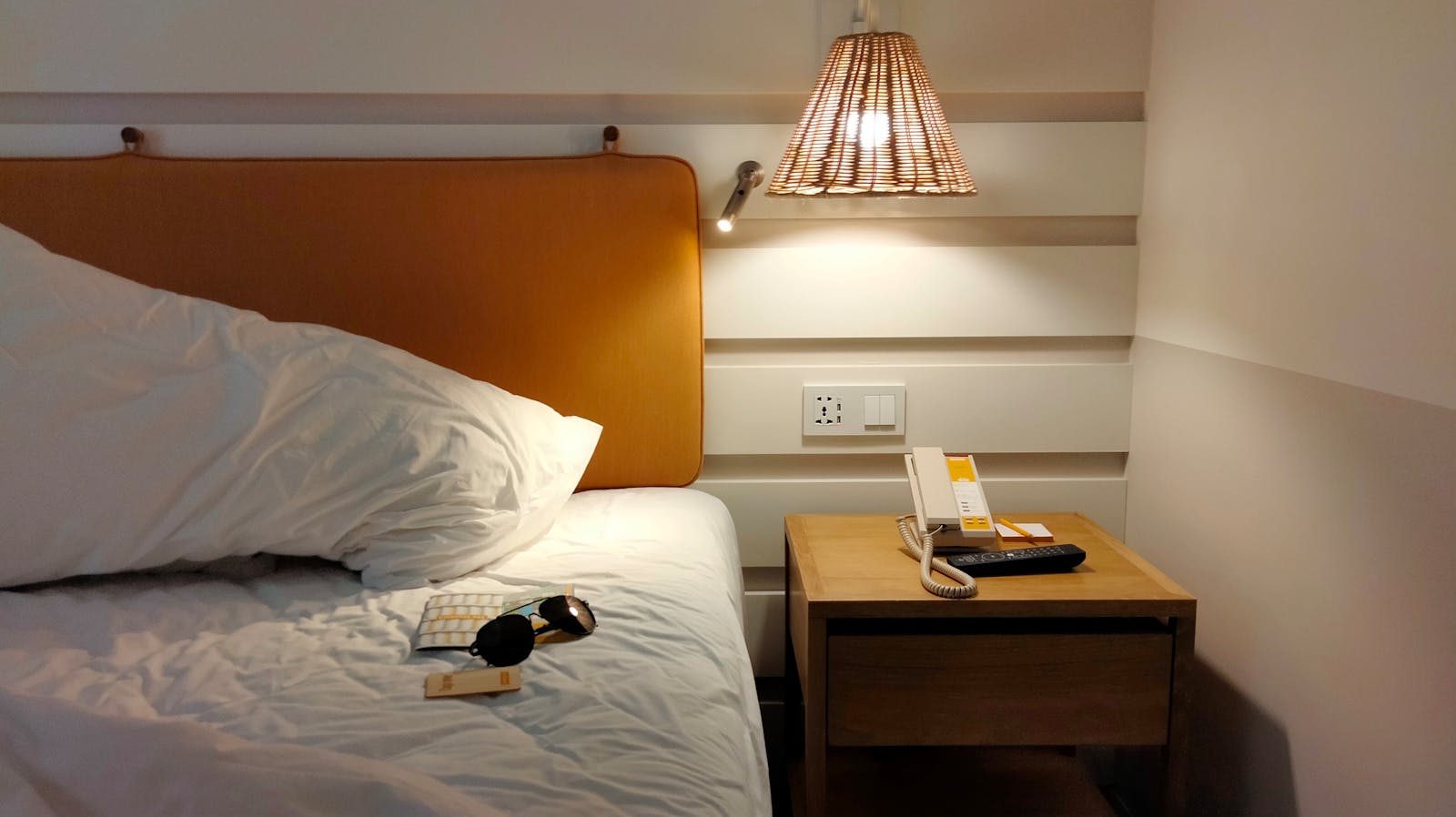
It is 11:14 at night. The lamp is on. A glass of water goes down first, on the left, where the hand will find it without thought. The charger cable gets pulled up from behind the table and laid across the corner, plug end facing the bed. The book lands last, spine angled toward the pillow, the way it was yesterday and the way it will be tomorrow.
To someone watching, this might look like fuss. A tidy person. A particular person. Someone who likes things just so. But the arrangement is less about neatness than relief. It gives the first few seconds of the morning a shape.
A pilot running a pre-flight checklist is not being fussy when she touches the same instruments in the same order. She is reducing the number of things that have to be remembered under pressure. The nightstand works in a much smaller, more ordinary way — but the logic is the same.
The ritual is not really about the objects
The objects could be almost anything. A glass of water, a charger, a book. A watch, a pair of glasses, a set of keys, a lip balm. What matters is that they are placed, not simply dropped. Placement turns a few random items into a small system, and a system means tomorrow morning begins with fewer tiny surprises.
That may sound minor until you think about how much of a morning can go wrong before the day has properly begun. A phone not charged. A missing key. A book knocked onto the floor. A glass absent when the mouth is dry. None of these things is dramatic on its own. Together, they can make a person feel as if the day has started by taking something from them.
For some people, the same arrangement every night is a way of making sure the day begins with one answer already settled: the things they need are where they left them.
Why predictability can feel so comforting
People often underestimate the emotional value of ordinary predictability. A familiar route, a familiar mug, a familiar place for the phone. These small cues tell the mind it does not have to make a fresh decision about everything.
That is where the habit research is useful, as long as the claim is kept modest. In a University of Alabama at Birmingham article on habit formation, Dr. Gareth Dutton describes habits as automatic responses triggered by environmental cues through associative learning. The point is not that a nightstand arrangement proves anything clinical about a person. It is that repeated cues can reduce effort. When the same object is in the same place at the same time, the brain does not have to negotiate with the room from scratch.
That is the quiet appeal of the arranged nightstand. Water is here. Phone is charging. Book is where it belongs. The morning has not yet asked for anything complicated.
Some mornings teach people to prepare
Not everyone who does this has a dramatic backstory. Some people simply like order. Some are forgetful and have learned to build systems around that. Some live busy lives and know that a smoother morning depends on what they set up the night before.
But there is also a more tender version. Some people grew up in homes where mornings carried weather. A parent’s mood could change the whole house. A sibling’s crisis could pull everyone into motion. Someone was always late, angry, hungover, overwhelmed, or unavailable. A child in that kind of home could not control much, but they could control where the school bag went, which clothes were laid out, and whether the shoes were by the door.
Years later, the same pattern can remain. The adult may not think of it as anything deep. They may simply say they hate waking up unprepared. But beneath that sentence is often a very practical history: preparation once made the day feel less likely to collapse.
There is also the chaos version
Not every origin story is harsh. Sometimes the household was not hostile, just disorganized. Things got lost. Mornings ran late. Important papers vanished. Someone always needed five more minutes. Someone else was shouting from another room asking where something was.
A child in that environment may become the family’s quiet logistics manager without ever being given the title. They learn where to put things because no one else seems to know. They learn that a calm morning is not guaranteed. It has to be built in advance.
And so the nightstand habit follows a person long after the original chaos is gone.
The home is calmer now. The alarm works. The phone charges. The keys have a hook. Still, the body of the day feels easier when the small system is in place.
The line between helpful and heavy
There is a difference between a routine that supports a person and a routine that starts running the person’s life.
If the glass is a little out of place and the person simply moves it back, that is ordinary preference. If the charger is on the wrong side and they feel mildly annoyed, that is still ordinary. Most people have small arrangements they like because they make life easier.
So where is the line? A helpful routine gives the person a little more room. A heavy routine makes the room feel smaller. If a small change on the nightstand ruins the evening or makes sleep impossible, the issue is no longer the glass, the cable, or the book. It is the amount of pressure that has gathered around them.
For most people, though, the arrangement is nowhere near that intense. It is simply a small act of preparation. Calling it strange misses the point. It is often just someone being economical with their stress.
The cousins of the nightstand
Once you notice this pattern, it shows up everywhere. The same person may keep their keys on one hook and nowhere else. They may use the same coffee mug every morning. They may pack before a trip earlier than everyone else thinks necessary. They may keep a phone face-down on the table because seeing every notification arrive makes the room feel less peaceful.
These habits are not always about control in the dramatic sense. Often, they are about reducing the number of loose ends. A person who knows where everything is can move through the first part of the day without scanning for what is missing.
That is also why moving house can feel so exhausting for people who rely on small systems. The furniture changes. The charger has no usual place. The glass sits on a different table. The light switch is on the wrong wall. Nothing terrible has happened, but the familiar cues have disappeared. The person has to rebuild the map.
What the nightstand is really doing
The nightstand person is not asking for control over the universe. They are asking for a few square inches of predictability beside their head. That is a reasonable request.
The mistake is reading the arrangement as vanity or rigidity when it may be closer to care. The person is helping tomorrow’s version of themselves. They are making sure the phone is charged before the day asks for it. They are putting water within reach before thirst becomes one more irritation. They are leaving the book where it can be found, even if they are too tired to read it. There is something generous about that. It is easy to mock the person who needs things in the same place. It is harder, and more accurate, to see that they may be making life gentler in the only place they can fully control. The glass, the charger, the book — these are not the demands of a difficult personality. They are the quiet engineering of a person who has decided that at least one corner of the world will behave.
Nothing needs to be fixed if it is working
If the arrangement makes the evening calmer and the morning easier, there may be nothing to fix. Many people have spent years trying to become more spontaneous in ways that only make their lives harder. Not every routine is a cage. Some routines are railings.
What can change over time is the need for everything to be quite so precise. As life becomes steadier, some rituals loosen on their own. The glass no longer has to sit in the exact same spot. The book can be slightly crooked. The charger can still be found even if it is not perfectly coiled.
That loosening does not have to be forced. It often arrives naturally when a person feels less braced for the day ahead.
A small act of self-protection
So here is the position worth taking: this kind of control-seeking deserves respect, not a raised eyebrow. The person who arranges three objects on a nightstand every night is not difficult, and they are not performing some private theater of perfectionism. They have figured out that mornings are easier when they begin from a known position, and they have built the smallest possible structure to make that happen.
Call it care. Call it self-protection. Call it the quiet engineering of a person who knows what they need. What it is not is something to be mocked, fixed, or talked out of. The glass, the charger, and the book are the visible pieces of a private system, and the private system is doing its job. That should be the end of the conversation.
Feature image by Natthanon Chinnasri on Pexels
