JR Howard did not set out to become the face of American agrivoltaics. He was a Texas sheepman with a modest flock and the sheepman’s permanent problem, which is that a successful sheep business requires grass, grass requires land, and land in Texas has never been harder to come by. Between the last two agricultural censuses alone, the state lost more than 2.1 million acres of grazing land to development, and solar farms, ironically, took their share of it.
Then, in 2021, Howard and his family noticed what the solar companies were sitting on: thousands of fenced, sunny, well-watered acres growing grass that the operators desperately needed gone. He began contracting his sheep to solar farms to eat it, and the arrangement inverted the oldest equation in ranching. Instead of paying for pasture, Howard was being paid to graze it.
The company is called what it does
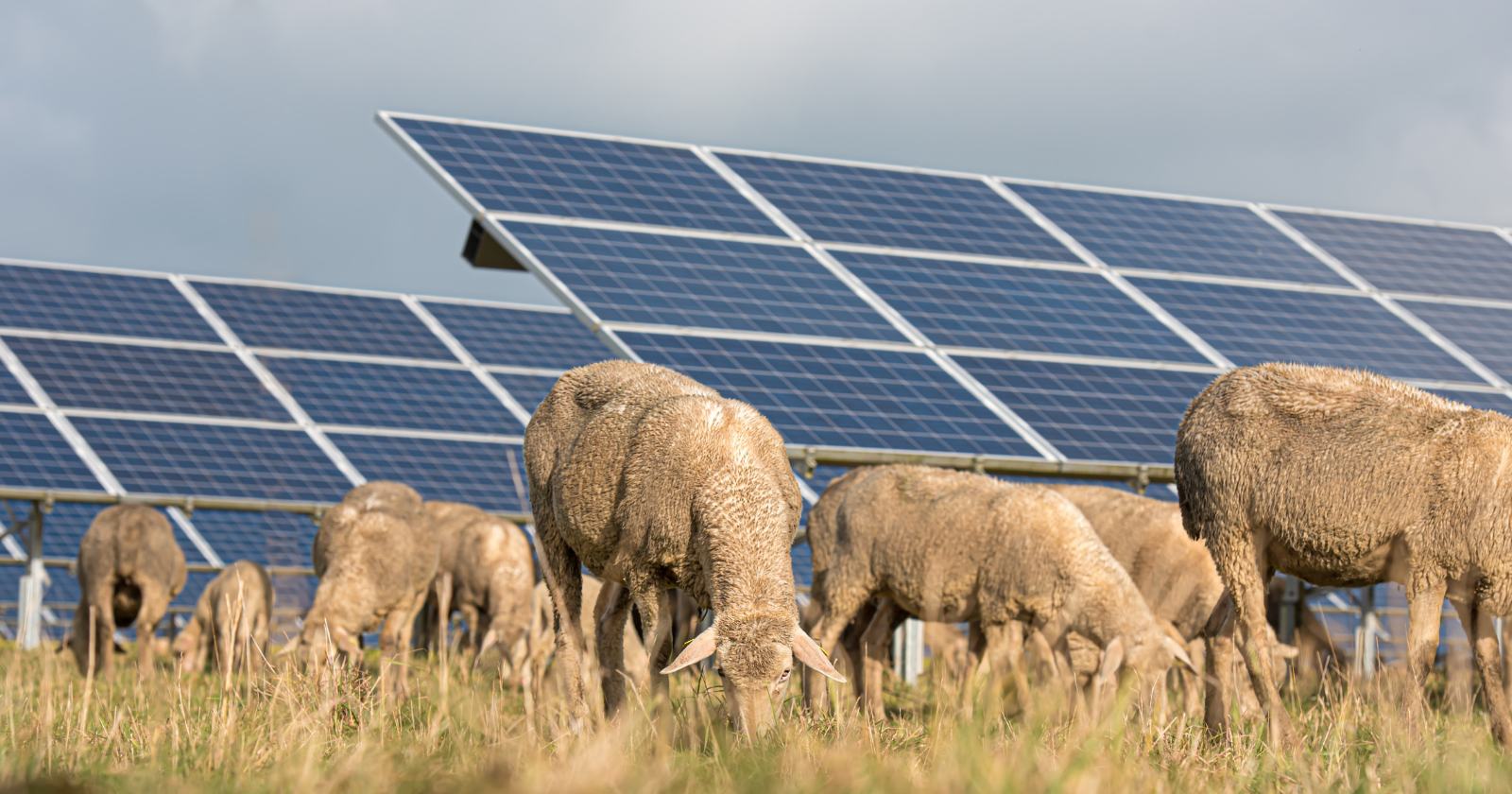
Five years on, the accidental experiment is the whole business. Howard’s company, Texas Solar Sheep, has grown from a small family operation into more than 8,000 sheep and 26 employees, rotating flocks through panel rows across multiple sites; the growth, Howard told the Associated Press, has been kind of crazy for the family. At SB Energy’s project in Milam County, the fifth-largest solar plant in the country, about 3,000 sheep, stocky white Dorpers bred for appetite rather than wool, work 4,000 acres beneath 900 megawatts of panels, and this spring Howard was the main attraction at a field day in Hopkins County, explaining his pasture rotations to a fence-line crowd of ranchers, environmentalists and energy staff while the sheep chewed on, unbothered.
The contracts exist because a solar farm is, underneath the hardware, a field that will not stop growing. Grass left to rise shades the bottom edge of the panels and cuts output; grass left to dry becomes a fire hazard threaded between millions of dollars of equipment. The traditional answer, mowing crews and herbicide, is slow, loud, diesel-hungry and expensive on sites that sprawl for miles. A flock does the same work continuously, in any weather, reaching under the low steel where no mower fits, and fertilizing as it goes. The industry’s own trial-and-error settled the question of which animal: goats climb the panels and chew the wiring, cattle are too big for the rows and lean on things, and sheep, alone among the candidates, mow without wrecking anything.
An industry, not an anecdote
Howard’s operation is the vivid case of something now genuinely large. The American Solar Grazing Association’s census counted sheep working more than 130,000 acres across roughly 500 sites in 30 states, with about 68,000 of those acres in Texas alone, more than half the national map, involving at least 170 solar companies. Nor is Howard the ceiling: Ely Valdez, who started grazing solar sites in 2015 with a couple dozen sheep, now runs a flock of more than 10,000 across 40,000 acres in several states, and cut thousands of bales of hay off solar land last year besides.
The people who study the sheep industry talk about solar grazing in generational terms. Reid Redden, a sheep farmer and solar vegetation manager in San Angelo, calls it probably the biggest opportunity the American sheep business has had in several generations, precisely because it solves the land problem: a young rancher who could never buy 4,000 acres can be paid to run stock across somebody else’s. Advocates pitch it as the truce in the land war, the same acres producing power above and lamb below, keeping agriculture alive inside the solar boom rather than displaced by it, and veterans’ and beginning-farmer groups have seized on grazing contracts as an entry ramp into an industry whose entry price was supposed to be a fortune in dirt.
The equation, run backwards
There are honest limits. Contract grazing is service work with service-work economics, flocks must be trucked, watered and guarded across scattered industrial sites, and the model depends on the solar build-out continuing, which ties a very old business to a very new industry’s politics. But the core of what Howard stumbled into in 2021 is a genuine inversion of ranching’s constraint, and it is easiest to see in the arithmetic of his own company. The scarcest input in Texas ranching is grass. The solar industry has accidentally become one of the state’s great growers of it, on land it fences, waters and cannot use for anything else, and it will pay to have the crop removed. A sheepman’s costs and a solar operator’s problem turn out to be the same object, and Texas Solar Sheep exists in the overlap: eight thousand animals eating their way through the maintenance budget of the energy transition, on pasture their owner never had to buy.