

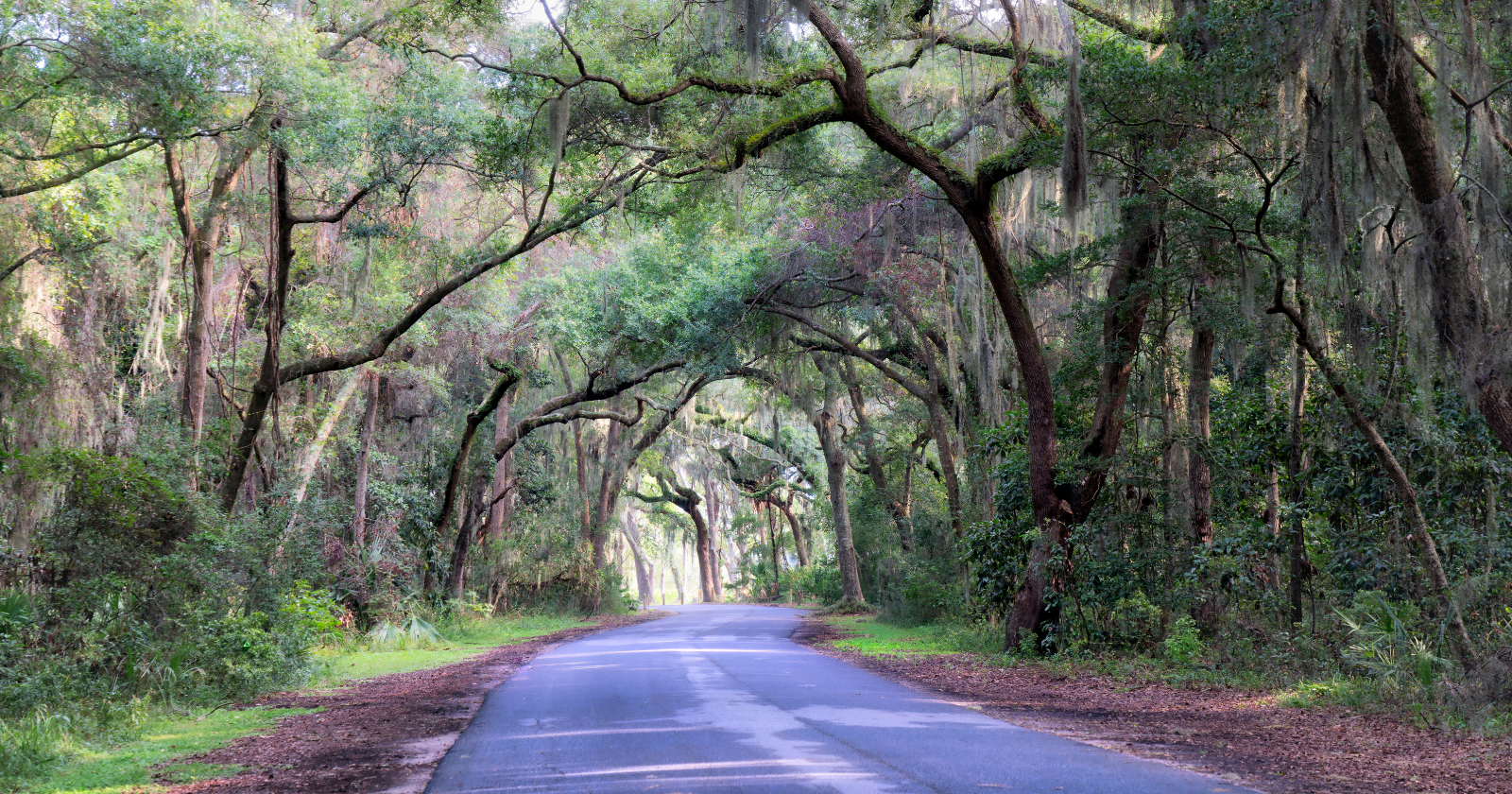
In 1904, Munsey’s Magazine surveyed the private playgrounds of America’s rich and awarded Jekyll Island the full crown: the richest, the most exclusive, the most inaccessible club in the world. The judgment was barely an exaggeration. The membership roll of the Jekyll Island Club, capped at a hundred shares, read like the index of a Gilded Age history: J.P. Morgan, William Rockefeller, William K. Vanderbilt, Marshall Field, Joseph Pulitzer, Astors, Goulds, men said, in the era’s favorite statistic, to represent a sizable fraction of the world’s wealth when they gathered.
What they gathered on was a nine-mile Georgia barrier island of live oaks, marsh and beach, bought whole, in 1886, for $125,000.
The world’s most exclusive hunting lodge
The island came from the du Bignon family, French émigrés who had planted cotton there for a century, and the sale was a scheme cooked up by John Eugene du Bignon and his brother-in-law Newton Finney, who consolidated ownership precisely to sell the island to northern money as a winter resort. Finney marketed it in New York, sold his hundred shares at $600 apiece, and delivered his buyers a wilderness with servants.
The club opened its turreted clubhouse in January 1888, and for half a century the island ran on a private calendar: January to April, families arriving by yacht and private railcar to shoot pheasant, ride under the oaks, and dine in one another’s company, safely beyond the reach of newspapers and the public. Eighteen members built shingled mansions they insisted on calling cottages. The wealth concentrated each winter was dense enough to bend history twice. In November 1910, Senator Nelson Aldrich smuggled a handful of Wall Street bankers onto the island under false names, posing as a duck-hunting party, for the secret conference that drafted the plan that became the Federal Reserve. And in January 1915, AT&T president Theodore Vail, wintering at the club, joined the ceremonial first transcontinental telephone call, patched in from Jekyll alongside Washington, New York and San Francisco.
How empires end
The club’s decline was ordinary economics visiting extraordinary people. The Depression thinned the membership rolls, heirs proved less enchanted by pheasant than their fathers, and the Second World War finished it: the 1942 season closed early amid war jitters and vanished staff, and the clubhouse never reopened. For five years a skeleton crew mowed the lawns of an empty island while the surviving members hoped for a postwar revival, and palmetto roots buckled the roads.
The state of Georgia was watching. Melvin Thompson, the state revenue commissioner, had been eyeing the coast for a public beach park, and when he abruptly became governor in 1947, he moved on Jekyll. The club’s remnant objected; the state answered with the bluntest tool in the drawer, condemnation, the compulsory purchase power governments usually reserve for highway routes. A judge confirmed Georgia’s authority, and on October 7, 1947, the state took the entire island for $675,000, the millionaires’ club dissolved by court order, compensated at a price that valued the clubhouse, the cottages, the wharf and all nine miles of island at roughly what a single member’s yacht had once cost.
The Jekyll Island Authority’s history says Georgia bought the island in 1947 for $675,000 and opened it as a state park on 5 March 1948. The Authority was created in 1950.
The people’s Gilded Age
The afterlife has its wrinkles, honestly told. Georgia tried running the old clubhouse as a state resort and lost money at it for years, closing the complex in 1971; the millionaires’ quarter moldered until its designation as a National Historic Landmark district and a 1980s restoration that reopened the clubhouse as a hotel, where anyone with a credit card now sleeps in the Morgans’ winter quarters. The island’s governing law caps development, most famously through a long-standing rule keeping roughly two-thirds of Jekyll forever undeveloped, and the Authority walks a permanent line between revenue and restraint that Georgians argue about each legislative session.
But the reversal at the story’s center has held for nearly eighty years. An island once accessible only by invitation and yacht is now, by statute, one of the most democratic resorts on the Atlantic coast, its beaches open to everyone, its Gilded Age cottages a museum district, its history tours dining out on the irony that the Federal Reserve was designed in what is now a public park. The arithmetic makes the point with Georgia bluntness: the world’s richest club held the island for 56 years and turned a 440 percent paper profit when the state took it, and the state, for $675,000, acquired the one commodity the members had actually been buying all along, and gave it away. Exclusivity was the product. Condemnation was its repeal.
