

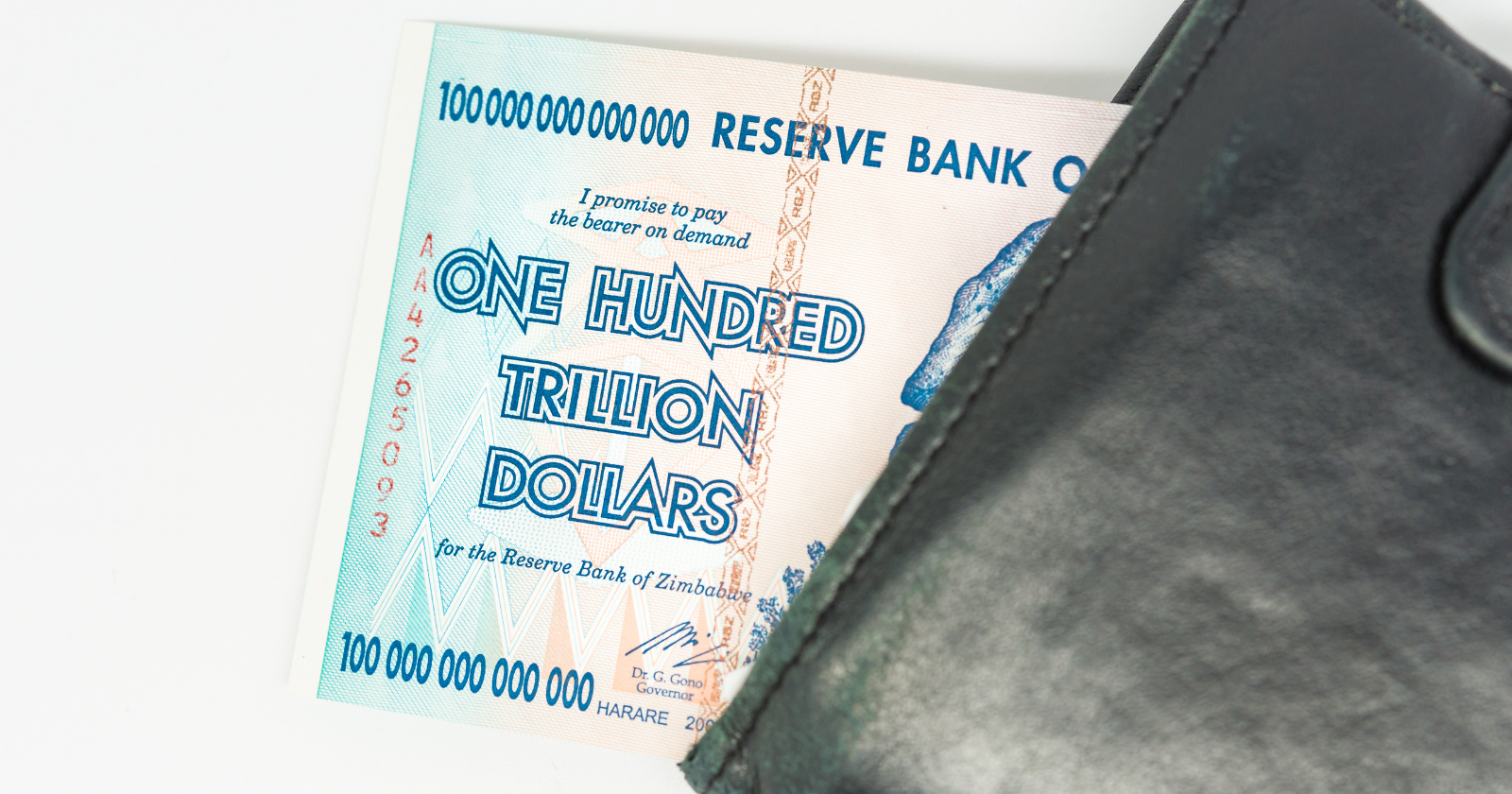
Picture a single banknote with the number 100,000,000,000,000 printed on it. That was the Z$100 trillion note. The Smithsonian describes it as one of the world’s largest denominations of currency. It was worth about US$33 on the black market when it was announced.
The note arrived just after the worst of the crisis. Zimbabwe’s runaway prices peaked in mid-November 2008. The economists Steve Hanke and Alex Kwok later estimated that prices were doubling every 24.7 hours, about once a day. The Reserve Bank of Zimbabwe introduced the Z$100 trillion note on 16 January 2009, roughly two months later. By then the country was already close to abandoning its own currency.
What the central bank thought it was doing
The logic behind ever-bigger notes is simple, and it is also the trap. When prices double every day, yesterday’s largest note cannot buy today’s groceries. So the central bank issues a bigger one. Each new note buys a little breathing room, then vanishes into the same rising prices it was meant to answer. Zimbabwe ran this loop to the end, redenominating the currency three times between 2006 and 2009, without ever touching the reason prices kept climbing.
The immediate cause was the Reserve Bank financing government and quasi-fiscal deficits by creating money. Disruptive land reform had badly damaged agricultural output, while the wider economy and tax revenue collapsed. The Georgetown Journal of International Affairs describes how, as tax revenue plummeted, the government chose to print money rather than cut spending. New money was covering a hole that new money could not fill.
The central bank governor, Gideon Gono, was blunt about his intentions. As quoted by the Irish Times in early 2009, Gono said: “I am going to print and print and sign the money until sanctions are removed and there is balance-of-payments support.” The paper also quoted the Harare-based economist Tony Hawkins, who saw no plan behind any of it. “There’s no policy. There’s no strategy. There’s no direction. There’s nothing,” Hawkins said.
The loaf of bread that settled the argument
A banknote is a claim on real things: bread, fuel, a bus ride home but that claim only holds if the goods exist and the number on the paper keeps pace with them.
In Zimbabwe the goods had thinned out and the numbers had lost all connection to them. A loaf of bread cost about 300 billion Zimbabwean dollars and rose every day. The currency was soon abandoned as the country switched to foreign currencies.
The gap between printing money and creating value is not subtle. A printing press can add zeros as fast as it can run ink. It cannot add wheat, or the trucks to move it, or the trust that lets a stranger accept your paper tomorrow. When that trust is gone, the money measures its own absence in bigger and bigger numbers.
Why the note outlasted the currency
Zimbabwe effectively gave up on its own dollar in early 2009, letting the US dollar and the South African rand do the work instead. The Z$100 trillion note entered circulation in January, but Zimbabwe officially adopted hard currencies for transactions in early 2009. Six years later, the central bank opened a formal redemption window for the old notes.
Its second life was stranger than its first. When the central bank offered to buy the notes back in 2015, it valued a Z$100 trillion note at 40 US cents. Collectors were already paying far more. Reuters reported that same year that notes were fetching up to US$35 online, with tourists paying as much as US$20 for one. One former currency trader, Shadreck Gutuza, put the choice plainly: “I would rather sell the money to tourists” than take the official rate.
As money, the note failed so completely it became a byword for failure. As a curiosity, a framed reminder of what runaway numbers look like, it became a collector’s item. The market found a use for the Z$100 trillion note only once it stopped pretending to be money.
