

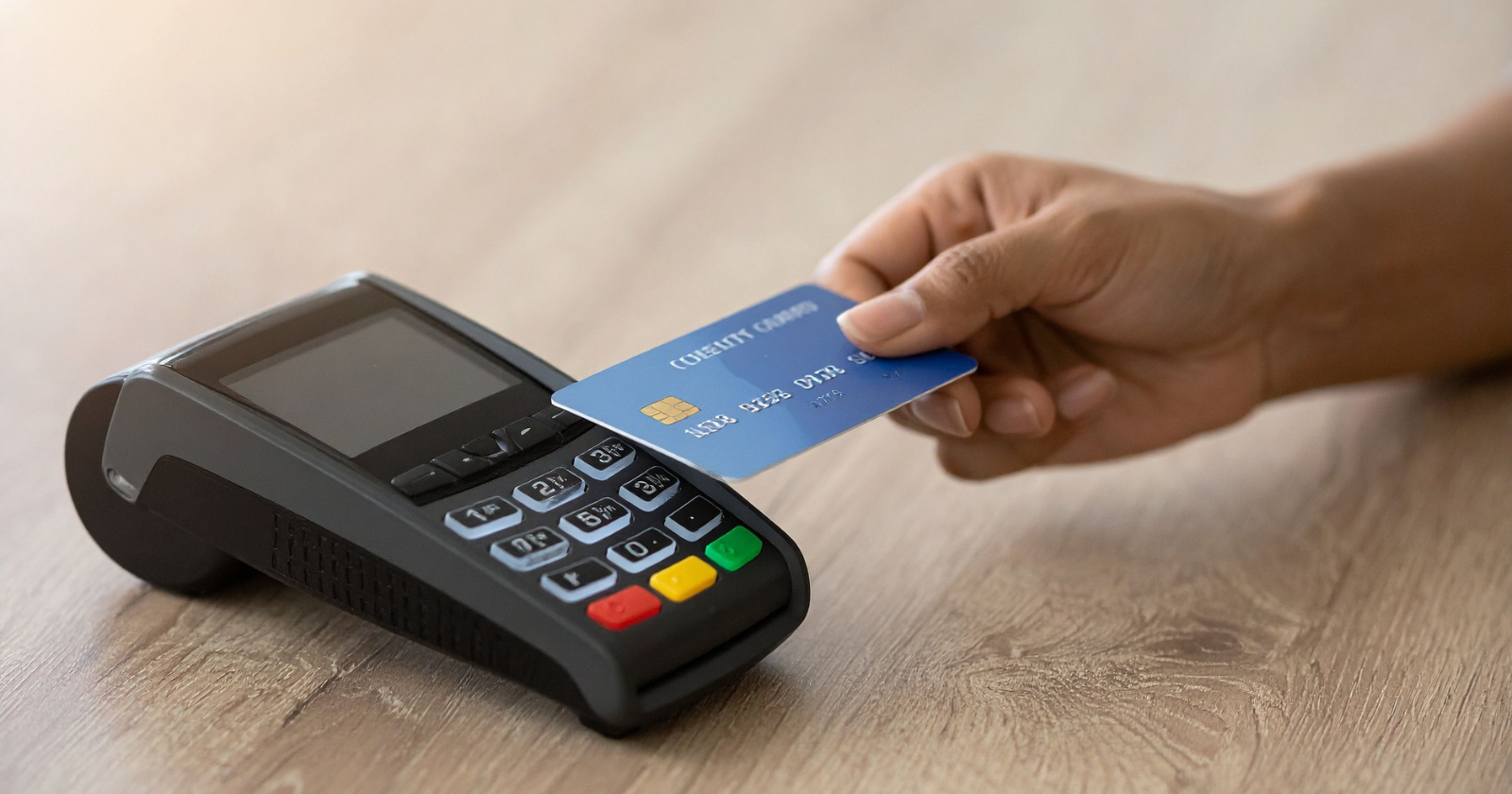
It appears on no receipt. You did not consent to it, and you cannot opt out of it, whether you pay by card or in cash. It is folded into the price of the coffee, the groceries, the plane ticket and the haircut, and it has been rising, year after year, for most of your adult life. It is called interchange, or more plainly the swipe fee, and it is one of the largest costs in modern commerce that almost no consumer could name.
The mechanics are deliberately out of sight. When a card is tapped at a till, the payment passes through three separate layers of charges: interchange, which goes to the bank that issued the shopper’s card; an assessment fee, which goes to the network, Visa or Mastercard; and a markup taken by the merchant’s own payment processor. The merchant absorbs all of it up front, receiving only what is left after the deductions. But no business runs at a loss on purpose, so the fee does not stop at the merchant. It is built into the shelf price, which means it is ultimately paid by the customer, and by every customer, including the ones who never take out a card at all.
The scale is not small, and the direction is only ever upward. In the United States, card fees reached a record 198.25 billion dollars in 2025, up from 62.1 billion in 2009, a rise of well over 200 percent in fifteen years. Visa and Mastercard, which between them control more than 80 percent of the market, each set these rates centrally for all the banks that issue cards under their brands, and the average fee on their credit cards has drifted up from around 2 percent in 2010 to about 2.36 percent today. Translated into a household, industry estimates put the hidden cost at somewhere between 1,200 and 1,800 dollars a year for the average American family, paid entirely through higher prices rather than any line item they could point to.
Watch this short video to understand more:
The part that most deserves the word “hidden” is who ends up paying. For most of the system’s history, the card networks forbade merchants from adding a surcharge to card payments, which removed the obvious remedy of simply charging card users for the cost they impose. With surcharging off the table, the fee had to be spread across all prices, and that produces a quiet transfer that runs in an uncomfortable direction. A Federal Reserve Bank of Boston study found that because merchants do not charge card users separately, cash-paying households effectively subsidise card-paying ones, and because card use and lucrative rewards rise with income, the net effect is a regressive transfer from lower-income to higher-income households. The cashback and airline miles on a premium card are not a gift from the bank. They are funded, in part, by people at the checkout who are paying with cash and often could not qualify for the card in the first place. It is worth adding that the size of this transfer is contested, and later reworkings of the same model found the cross-subsidy could be small, absent, or in some cases reversed depending on the assumptions. But the basic shape, that the reward economy is paid for invisibly and by everyone, is not seriously in dispute.
This also explains why the fee keeps climbing rather than settling. The rewards are the engine. Banks compete for customers by offering ever more generous points and cashback, and the premium cards that carry those rewards also carry higher interchange rates, so the more the industry competes on perks, the more the underlying fee has to rise to pay for them. Merchants cannot easily refuse, because a shop that declined the dominant networks would turn away most of its customers. The result is a ratchet: a cost that goes up because two companies set it, that consumers cannot see and therefore cannot resist, and that the businesses paying it cannot walk away from.
None of this is a law of nature, and the clearest proof sits on this side of the Atlantic. In 2015 the European Union simply capped the thing. Under its Interchange Fee Regulation, in force since December that year, consumer debit interchange is limited to 0.2 percent of a transaction and consumer credit to 0.3 percent. Set that against the American credit-card average of roughly 2.36 percent and the difference is not marginal. To European merchants, the US model tends to look bewildering and needlessly expensive, with interchange alone making up the overwhelming bulk of their card-acceptance costs, where the European structure is flatter and more transparent. The same swipe, the same networks, the same technology, at a fraction of the price, and the only variable that changed was whether a regulator decided to reach in.
There is a quieter strategic point buried underneath the pricing one. Visa and Mastercard are American companies that carry a very large share of the world’s card traffic, which is part of why central banks and governments elsewhere have grown uneasy about depending on payment rails they do not control, and why several are now building alternatives of their own. A fee most shoppers experience as a mild annoyance is, at the level of the system, a toll booth on the movement of money through much of the global economy, owned by two firms.
In fairness to the networks, they do not describe interchange as a toll but as the price of a service, and the service is real. The fee funds fraud protection, the guarantee that a merchant is paid even when a card turns out to be stolen, and the instant, near-frictionless payment that shoppers now expect and that merchants benefit from through higher sales. The card companies argue, not unreasonably, that acceptance pays for itself. The long-running American antitrust fight over these fees, which we have covered in more detail elsewhere, has been grinding through the courts since 2005, and the settlements offered so far have tended to trim the fee rather than rethink it.
What is left, when the arguments are laid side by side, is not quite a scandal and not quite a market. It is a charge that almost everyone pays, that almost no one sees, set by two companies rather than by competition, and rising a little more each year on its own momentum. The one thing that has reliably stopped it climbing is not innovation or consumer pressure but a cap written into law, and only in the places that chose to write one. Everywhere else, the quietest fee in the economy simply keeps going up.
